The problem with Lent is that it is forty days long. I mean, really. I’m not sure if you are aware of this, but forty days is forever. I have complained repeatedly of this absurd length to my Catholic friend and asked her earnestly why Catholics are so mean! I was all fired up about Lent when it first started, but I can’t stay fired up about anything for forty days!
The problem with Lent is that I gave up dessert, and I don’t think I really realized how much I love dessert. I want dessert so badly all the time now, and even though I’m abiding by the Catholic rule that you break your fast on Sundays, that blessed reprieve is definitely not enough.
The problem with Lent is that I hate denying myself. I live in a culture where food is always at my fingertips. I can eat whenever I’m hungry, and even when I’m not. The idea that I would stop myself from eating something I really want to eat is simply ludicrous in such a privileged society. Even my five-year-old doesn’t get it. He says, “I just don’t know why you would do that.” And he even asked, “How does that help God?” The idea that denying myself would be helpful to me seems not to have occurred to him. Frankly, I’m questioning the logic myself these days.
The problem with Lent is that appetites are like some cancers. As long as you let them continue unabated, they won’t bother you much. But if you try to fight them…ooooooh, boy. Watch out! Because they bite back. And it’s not just with dessert. I want to eat everything in sight right now. I will probably be the first person in the history of observing Lent to end my fast weighing more than when I started.
The problem with Lent is that the problem is not really with Lent. The problem is with my flesh. It simply does not want to die. And it seems like on all fronts now, I’m experiencing a bit of a spiritual drought. For about two weeks, I have not had the desire to practice any spiritual discipline. I don’t want to be silent. I don’t want to pray. I don’t want to read my Bible. I don’t want to get up early to spend time with God. I don’t want to do any work. I don’t want to serve anyone. My motivation level for each of those tasks has been hovering around 0%.
Now, it is not totally bleak. Nature continues to draw me to God, and this is a wonderful time of year. The world has been transformed into bright, beautiful shades of green, and flowers have been popping out everywhere. There is this one particular type of cherry blossom tree that is currently in full bloom, and it is simply magnificent. I can’t decide if its blossoms look more like popcorn popping, or a firework exploding; regardless, I’ve never seen a stationary plant seem more in motion. Whenever I pass them, I just have to stop and stare at them in awe. They just look like an explosion frozen in time. Marvelous.
Other than through nature, however, I feel nothing spiritually. My senses are deadened. I feel no encouragement from reading Scripture, no inspiration from prayer, no insight from silence, no joy from service. It kind of reminds me of Captain Barbossa as he rants to Elizabeth Swan about the curse’s effect on him (in Pirates of the Caribbean: Curse of the Black Pearl. I will cite that reference for the five people in this country who may not have seen that movie.) “I feel nothin’!” he exclaims. Same deal here. All I feel is my flesh raging against all forms of self-denial. I have hit a wall. And so I have had to ask myself:
Should I keep doing these disciplines, even though they don’t seem to be helping me at all? Should I keep reading my One Year Bible, even though I’m getting nothing from it? If anything, I think the book of Numbers is actually taking me farther from God. Plus, I have gotten seven days behind. Should I try to catch back up? Should I force myself to get up early, even though it seems not to be helping me to live a Spirit-filled life? Should I keep observing Lent?
To paraphrase my son’s concerns, how do these motions help God? Or me, for that matter?
Is this not all descending into legalism?
I have more, but I think I’ll stop here and ask what you think. Basically, my options are to grit my teeth and force myself through, or to stop these motions until some desire returns.
I actually have chosen a course and experienced some results, but I’m genuinely interested in what my brothers and sisters think about this conundrum. Do you ever experience spiritual droughts? What are they like for you? How long do they typically last? What do you do during them, and what do you do to get out of them? Also, have you ever tried to observe Lent? How did it go for you?
The other day, I wandered into Cokesbury, a Christian bookstore in our area about which I had heard lots of good things. I wanted to check out their store, but I also was looking for a specific book: Scripture and the Authority of God, by N.T. Wright. I have been in a bit of a Bible-reading drought, and I’ve chalked some of it up to lack of communal discussion of Scripture. Well, one of my favorite bloggers (whom I will feature this Tuesday) is hosting a series of discussions on Wright’s book, and so I thought I would buy it and jump in. Greg loves N.T. Wright, and I love the subject matter of this latest book, so I thought it would be a good addition to our library. However, when I finally found the book and took a look at the price tag, all my plans evaporated.
It was $25.99.
And Tennessee has high sales tax.
In short, there was no way I could buy this book. Even if it were not financially irresponsible at this point in our lives, I think I would have had to put it back on the shelf on principle!
To wrap up this literary-themed week, I thought I would briefly discuss the cost of books. Personally, I love to read, and I always have a list a mile long of books that I’d like to have. Most of these books are Christian- or history-themed, and so I view them as edifying and, thus, worthy of my time and money. That said, books can be expensive, and I do struggle with the idea of how much of my resources should go to buying books. I wanted to share with you my top three ways to get cheap books. Even though two out of the three seem super-obvious, it took me awhile to think of them, so I thought I’d share them anyway, on the off chance that you are slow, too:).
1. Half.com
My baseline price for books is $4.74. That is how much a .75 book on half.com costs, plus the usual 3.99 shipping fee. To me, getting a book I ‘ve been wanting shipped to me for less than $5 is a good deal. What I have learned about books on half.com is that their price is not influenced by genre, or even popularity, but by age. It appears that a book needs to be at least five years old before it goes into what I call “the .75 bin.” On the plus side, you can get a lot of classics for dirt cheap. On the negative side, you can’t buy N.T. Wright’s new book for much of a discount. Or Richard Beck’s Unclean. Or Half the Church. Or several other books on my wish list.
However, I was able to get a highly recommended and well-reviewed book that I’ve been wanting, A History of the Jews, for my normal .75.
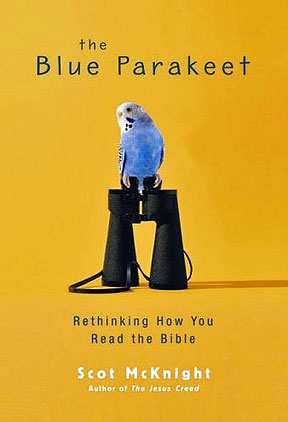
And I got another book on my wish list, The Blue Parakeet, for about $7, including shipping. It was written in 2008, and thus has not reached the magic 5 year mark. However, as I have wanted this book for months and have been unable to find it in any bookstore, I thought that was an okay price.
Thus, half.com has proven to be a good resource when trying to buy books that are slightly older. However, for newer books (or for older books you don’t necessarily want to buy), I recently stumbled upon a grand solution. Ladies and gentlemen, I present to you…
2. The library
I know, I know. Obvious, right? ‘Cept here’s the thing: I’ve been making weekly trips to the library ever since my kids were wee tots, and it just recently occurred to me that the library might be a resource for me, too! Maybe it is because the books I usually want tend to be religious or devotional in nature because I rarely think of them being available at my local library. However, I am now currently on the waiting list at my local library for an eBook version of Scripture and the Authority of God, as well as the physical version of Rachel Held Evans’ memoir, Evolving in Monkey Town. Genius!
Lastly, the best way I’ve found to read books that I don’t want to spend the money to buy is to…
3. Borrow them.
Again, it seems obvious, but I think that often, my consumer-oriented mindset causes me to overlook the free ways to enjoy books without having to own them. And really, I don’t need to own most books I want to read. In fact, it keeps my house from getting so cluttered if I can simply check out the book from the library or borrow it from a friend. Borrowing, however, can be tricky because you need to have friends who 1) like the same books as you, and 2) are comfortable enough to let you borrow them. To be honest, I haven’t gotten to the “Can I borrow that book?” level with my friends in Nashville yet; however, I did enjoy trading books back and forth with my friends in South Carolina. At any given time, I probably had a couple of borrowed books in my possession, and had a few books lent out. My friends and I were somewhat evangelical with our books: whenever we read a good one, our first thought was, “To whom can I pass this worthy message?” I think that it’s worth cultivating such a community, and I hope to do so soon in Nashville. At the very least, it will allow you to read good books without spending money that could be better used elsewhere.
Okay, so those are my three brilliant, revolutionary suggestions for obtaining cheap books. Do you have any others?
In one of my college English classes,we once had a discussion about the purpose of art. Our discussion boiled down to two camps: the aesthetic and the didactic. The aesthetic camp believed in “art for art’s sake”; in other words, art needs no justification. It just is. Or something like that. I didn’t really buy it.
On the other side, there was the didactic camp. The didactic camp believed that the point of art was to teach something. Art needed a purpose, a worthy message. Now, even those in the didactic camp admitted that art shouldn’t beat you over the head with that message, and that preachy art is generally not good art. But at the same time, they argued that art that wasn’t trying to say something was pointless. I am a practical person at heart; thus, I fell into the didactic camp.
I’m still there.
And yet, I’m often torn between these camps when I read books to my kids. Even as a believer in didacticism, some books seem over the top to me. For example, take this Berenstain Bears book we checked out a few weeks ago: it was called The Trouble with Secrets. Now, if you don’t have young kids, you might not know this about the Berenstain Bears, but they have seen the light. I don’t remember the childhood BB stories I read being overtly Christian, but they sure are now. Well, some of them are. And others are just regular stories extolling good behavior. Usually, the overtly Christian ones announce it to you in the title. For example, we currently own a collection called, The Berenstain Bears Show God’s Love. I love it. It has stories about loving your neighbor and about prayer, and the kids love them.
But this book about secrets didn’t seem religious; indeed, neither the title nor the plot really lent themselves to religious application. Instead, it was just a simple story about the trickiness of friendship. It was told from the perspective of Brother and Sister Bear’s friends, who were miffed that Brother and Sister were keeping a secret from them. Thus, they followed the siblings to find out their secret. Fair enough. Throughout this narrative, however, the authors kept dropping non sequiturs about God, from out of nowhere. It has been a few weeks since I read it, but if I recall, the comments were about God not wanting us to have secrets, or something (which, by the way, is not in the Bible). Regardless, it seemed like the parts about God were superfluous, that they were shoe-horned into the plot without really fitting. In a way, it seemed like the authors were playing the God card. And I didn’t like it.
I think I was also put off by the “sneak-attack” element of the book’s Christian content. Nothing about the book suggested that it was going to be religious; it just seemed like an ordinary Early Reader in a public library that services a religiously diverse area. And then midway through the book, the reader is subjected to strained religious applications. To be honest, I think the seeming subterfuge put me off as much as the heavy-handedness of the theme.
In short, I found The Trouble with Secrets to be too preachy, too didactic.
On the other end of that spectrum, we have the Junie B. Jones books. I have heard wonderful things about this series, and especially how much kids love them. Thus, I decided to give them a try. In retrospect, perhaps the title of the first book should have been a red flag, as we don’t usually allow our kids to say the word, stupid. But I didn’t want to judge a book by its title, and I do think there is wiggle room with language when it comes to books (and even movies). Part of teaching our kids about language, after all, is to impress on them that we don’t repeat everything we hear. Anyhow, I read the first book to the kids. They loved it. Then, I read the second book. They loved that one, too.
And then I stopped.
Because I couldn’t do it anymore.
It wasn’t so much that Junie B. liberally used the word, “stupid.” Or that she often remarked how she couldn’t stand people. It was that the overall theme of the book had no element of the didactic. Instead, I decided that Junie B. Jones is the Seinfeld of children’s literature: the series seem to share the theme of “no hugging, no learning.”
It’s not just that Junie B. is selfish and hateful. After all, lots of kid-friendly characters are selfish; the world of Thomas the Tank Engine, for example, is filled with unpleasant, petty engines. What makes the Junie B. Jones series unique, though, is that everyone is selfish. At least Thomas and his friends have Sir Topham Hatt as the voice of reason; Junie B. is not so fortunate. Her parents and teacher hardly seem to care about her: they certainly don’t listen to her, and they never take the time to teach her anything. She basically acts like an untrained five year old, which is probably because no one takes the time to train her. In the first book, Junie B. is terrified of riding the bus, but all the adults dismiss her fears without addressing them, and then force her to ride it anyway. She is so scared to get back on the bus after school that she hides in the classroom. Never at any point does she ponder the deception of her scheme or worry about what her mom or teacher will think. Indeed, she never thinks about anything but her immediate desires. Again, that’s normal for a five year old, I guess. However, even at the end, everyone is exasperated with her, but no one takes the time to teach her why her actions were wrong. Which means that I then have to explain to my own children why Junie B’s behavior is not acceptable. In fact, throughout both the books, I had to stop repeatedly and ask my kids what they thought about Junie B’s current behavior. Then we would talk about why she was being selfish.
To be honest, I really see the series as more of a satire of society…but my kids aren’t old enough to get satire. Instead, they just get a bad example of a five year old (and bad examples of parents and teachers). The books definitely didn’t scar my children or anything, but for me, they weren’t worth it. I figure my kids have enough bad examples around them without me spending hours providing them with yet another one through the books we read. If we read something, I want it to at least have a decent moral. And it’s okay if the moral is subtle. To me, even classics like Where the Wild Things Are or Ferdinand have decent morals, even though they are very understated. But I could find no moral in Junie B. Jones.
So that’s where I stand on The Berenstain Bears and Junie B. Jones. If you are a parent (and even if you’re not), I’m interested in how you decide what books to read to your kids. Do you fall more into the didactic camp or the aesthetic camp? Do you think I am overreacting at either (or both) of these books? (After all, Greg said that this post mainly demonstrates how picky I am!) And have you found any books that are both well-written and at least somewhat instructive? Do a picky mom a favor, and pass those suggestions along!
[Updated to add: This is in no way a moral judgment on anyone who has read, shared, or enjoyed this books. It is strictly a matter of personal opinion and taste. I am just walking through my thought process when deciding what books are worth reading to my kids, given my beliefs and goals for my children.]
The movie, The Hunger Games, comes out in theaters this Friday. It is the first installment based on a trilogy of Young Adult books of the same name. I had been aware of the books for awhile, but since I have a thing against kids getting killed, I was naturally turned off by the bloody premise of a televised game show where kids must fight to the death. However, then I saw the trailer for the movie and decided to give the books a shot. And I’m really glad I did.
For those who aren’t familiar with the trilogy, the basic plot is set in a dystopian future, where an oppressive country called Panem rules ruthlessly over its twelve outlying districts. As a sick and continued punishment for a long ago rebellion, each district is required to provide a yearly “tribute” of a young boy and girl to participate in a televised slaughter for the amusement of the citizens of “the Capitol.” The Capitol is filled with wealthy, privileged citizens who benefit from the labor and the oppression of the districts. Because they live in such an insulated, comfortable world, the populace of the Capitol are generally oblivious to the suffering around them. Instead, they divert themselves with frivolity. They focus an obscene amount of attention on their appearance, embracing over-the-top fashions such as skin-dyeing and elaborate make-up and hairstyles. They spend their time attending parties full of every food one can imagine…and take vomit-inducing pills so that they don’t have to stop eating when they are full. And they are so desensitized to the suffering around them that they divert themselves by watching children slaughter each other.
The genius of Collins is seen in the degree of difference she uses between the Capitol and today’s Western world. Her descriptions of life in the Capitol are just foreign enough for Western readers to easily condemn them, and yet, they are similar enough to then give us pause. For example, here is Katniss’ reaction while listening to her Capitol-dwelling make-up crew:
After they’ve exhausted the topic of the Quarter Quell, my prep team launches into a whole lot of stuff about their incomprehensibly silly lives. Who said what about someone I’ve never heard of and what sort of shoes they just bought and a long story from Octavia about what a mistake it was to have everyone wear feathers to her birthday party (Catching Fire 37).
I thought of that specific passage while I read about the upcoming Hunger Games movie in Entertainment Weekly…and then turned the page and saw this:
Wow, can you see the irony? Octavia can’t stop talking about feathers, and we can’t stop talking about oversized bows. Really?? Really. Were the editors of EW trying to be ironic, or do we truly live in a “Capitol-lite” society? After all,
We don’t dye our entire skin, but we do tattoo and tan it mercilessly.
We may not have as outrageous fashions as they do, but we definitely focus a lot of attention on superficiality and appearances.
Vomit-inducing pills may not be en vogue, but gluttony certainly is.
And while we don’t watch shows where people die, we do love ones based on physical (Wipeout) or emotional (The Bachelor/Bachelorette) suffering. Even though the contestants are volunteers, what does it say about us as a society that these shows are hits?
Plus, I get the feeling that sometimes we (I) are (am) often as oblivious as the citizens of Panem’s capitol. Our lives of comfort can have the effect of insulating us from the suffering of others around the world. The book highlights this obliviousness by forcing the privileged reader to see the world through a poor teenager’s eyes. And that teen, Katniss, clearly sees the vast differences between her lifestyle and the Capitol lifestyle when she is taken there for the Games. Through her eyes, we see the contrast between these privileged citizens and the rest of their world. For me, those differences provided both a critique of my own society and a guide of how to use my privileged position to help others. When looking at my life through the lens of The Hunger Games, I was made aware of two huge privileges I possess, and challenged to use them for God’s greater Kingdom, and not simply for my own personal gain:
1. Time.
Interestingly, one of the biggest differences between Katniss’ life and the lives of the Capitol citizens is in regards to time. She notices this difference when she views an elaborate meal that was prepared for her:
I try to imagine assembling this meal myself back home. Chickens are too expensive, but I could make do with a wild turkey. I’d need to shoot a second turkey to trade for an orange. Goat’s milk would have to substitute for cream. We can grow peas in the garden. I’d have to get wild onions from the woods. I don’t recognize the grain…Fancy rolls would mean another trade with the baker, perhaps for two or three squirrels. As for the pudding, I can’t even guess what’s in it. Days of hunting and gathering for this one meal and even then it would be a poor substitute for the Capitol version.
What must it be like, I wonder to live in a world where food appears at the press of a button? How would I spend the hours I now commit to combing the woods for sustenance if it were so easy to come by? What do they do all day, these people in the Capitol, besides decorating their bodies and waiting around for a new shipment of tributes to roll in and die for their entertainment? (The Hunger Games 65).
The question she wrestles with here is one that, paradoxically, I also wrestle with a lot, as a citizen who lives in a similarly privileged environment: What do I do with my time? It’s funny because I don’t feel like I have a ton of time laying around. And yet, Katniss’ thoughts here reminded me that I don’t have to go out and get firewood to start a fire over which to cook. I don’t have to kill (or grow) my supper. I have electricity. I have running water that comes out hot and cold on command. I have a washer and dryer and dishwasher. I wonder how many hours a day these blessings give me, hours that others do not have. What do I do with those precious hours? Do I dedicate them to pursuits that are unworthy or meaningless? Of course, a lot of my time on Facebook could easily qualify as unworthy, but even besides that, this book made me pause and consider the things that I normally don’t question as valuable. It made me think that, in the grand scheme of things, some of my “worthwhile” pursuits are less valuable than I imagine. For example, how clean does my house need to be in order to be healthy and functional? Does it really need to be free of dust bunnies, or could I spend more time writing cards to the sick? That’s just one example, but there are several things like that in my life. Reading The Hunger Games, then, challenged me to use my privileged time to further God’s kingdom, instead of my own agenda.
2. Passion.
After the Games, Katniss is required to learn some sort of talent. It is comical because she has spent so much of her life trying to survive that she has come to see most hobbies and “talents” as frivolous. She chooses clothing design, but never has the slightest interest in it. In contrast, her stylist, Cinna, is passionate about design. As a citizen of the Capitol, he has had opportunities to pursue skills that aren’t necessary for survival. What is instructive for the reader is how Cinna chooses to use his privileged passion. Without giving too much away, he uses his skill in order to help the cause of the oppressed around him. He uses Capitol privilege to challenge Capitol culture.
Similarly, I have been privileged enough to pursue passions that are not necessary for survival. For example, I like to write and to record things. Had I been born into a third world culture, I probably would not have been able to exercise those passions, as I would have too few resources and would be spending too much time trying to stay alive. But Cinna’s example challenges me to use my passions in a way that further God’s Kingdom. It also opens my eyes to a truth I haven’t been able to see about Jesus and His call to us. So often, I think that Jesus wants me to renounce my position of privilege and to become like the poor. (To be fair, I tend to get this idea from the Man Himself, who seemed big on rich people selling their stuff to provide for the poor.) But thinking of Cinna made me realize something about Jesus: He did not renounce His God-given gifts. Jesus had power. He had the power to heal people and to know people’s thoughts. The great majority of the world could not do that. Even so, Jesus did not give those things up in order to become like everyone else. Instead, He used His power in order to help those who could not heal themselves. Maybe this is a false analogy, but to me, having privilege is like having power. God placed me in this position, and I don’t glorify Him by turning my back on what He gave me. Instead I glorify Him by using it to further His Kingdom.
The Hunger Games really opened my eyes to these gifts of time and passion that I have been given. They made me understand that my time and passion are part of life in a privileged culture. And they challenged me to use my citizenship in the Capitol for the good of all the world’s citizens, not just my own.
That’s pretty good, for a young adult trilogy!
Have you read The Hunger Games? What did you think of them?
“Please,” Sorcerer said again. He felt very stupid. Thirty meters up the trail he came across Conti and Meadlo and Rusty Calley. Meadlo and the lieutenant were spraying gunfire into a crowd of villagers. They stood side by side, taking turns. Meadlo was crying. Conti was watching. The lieutenant shouted something and shot down a dozen women and kids and then reloaded and shot down more and then reloaded and shot down more and then reloaded again…Sorcerer was already sprinting away. He ran past a smoking bamboo schoolhouse. Behind him and in front of him, a brisk machine-gun wind pressed through Thuan Yen. The wind stirred up a powdery red dust that sparkled in the morning sunshine, and the little village had now gone mostly violet. He found someone stabbing people with a big silver knife. Hutto was shooting corpses. T’Souvas was shooting children. Doherty and Terry were finishing off the wounded. This was not madness, Sorcerer understood. This was sin.
–from Tim O’Brien’s In the Lake of the Woods
How could someone do such a thing?
I used to ask that question a lot.
I still ask it sometimes.
But now, the question is really rhetorical. Because I know how someone could do such a thing.
A lot of Christians view mankind as “depraved.” That’s the word they use. Depraved basically means, “bad to the bone.” “Capable of no good.” They say they learned this from the Bible. But that’s not where I got my negative view of man. I got it from the news.
And it wasn’t the Bible that helped me crystallize my theory of our potential for badness. It was the book, Lord of the Flies. I have only read that book one time, in high school. But William Golding’s tale of a group of British school boys who descend into anarchy and violence when they are wrecked on a deserted island has stayed with me ever since. Golding told me that civilization is a conch shell, fragile and easily broken. Golding told me that when that conch shell shatters, all hell breaks loose. Law and order fades away, and chaos reigns. And when I finished reading his book, I cried.
I cried because I knew it was true.
I still know that it is true, and again, not just because of the news. I know it is true because I know myself, and I know the potential that lies within. I am painfully reminded of my predilection for depravity whenever my mask-that-is-n0t-a-mask, my Christianity, slides off as if it were a mask. I know it when I pursue God with all my heart and try to live fully by His Spirit within me…and then the right combination of mild irritants comes along and causes my selfishness to roar forward with relish and gusto. I get irritable and I snap at those around me, even if those around me are my own precious, little children. And if I am having a moment of clarity, I draw back in horror, reeling from the quickness of my descent into sin. And I think, “Wow. If I can switch back that fast, if I can become selfish and hateful, even in the civilized culture in which I live, even with my loving and sheltered background, even with my earnest desire to serve Christ, then just imagine….” Just imagine what I could be like without my Christian background. Imagine what I could be like if I did not have the desire to do good. And if mild irritants like a headache or the house being too hot can set me off on my own children, then what might I be capable of in an environment of heavy, sustained stress and fatigue? What might I do in an environment where civilization has fallen away and barbarism reigns?
When I hear about such things, they ring true to me. They sound like something humans might do in that situation. Something I might do in that situation.
And that realization does not ameliorate the horror of what happened. On the contrary, it makes it all the more horrible. It doesn’t make me want to let anyone off the hook; in fact, it reminds me just how important the “hook” is. We have to have ways of limiting our own depravity, after all–of fighting back as a society against the worst impulses of the individual.
And yet, there is hope.
I said earlier that I do not get my view of human depravity from the Bible. Instead, I get my hope from the Bible. The news tells me that humanity is depraved. My heart tells me that I am depraved. But the Bible tells me something different: it tells me that I was created in the very image of the almighty God. It tells me that I was created to do good, not evil (Eph. 2:10). And it tells me that even though I am capable of great evil, I am also capable of more good than I ever imagine. That I can do all things through Christ (Phil. 4:13). That God has given me everything I need for life and godliness (2 Pet. 1:3). I even think that most Christians sell themselves short, compared to the Bible’s view of their potential. We worship a Savior who set an example of love and self-sacrifice that He appeared to think we could follow. We worship a Savior who told us to stop sinning and to be perfect. We participate in a religion that teaches us that we are guided by the very Spirit of God, which works in us and uses us to accomplish God’s will. That is amazing. And I believe that it is true. Sometimes I picture myself getting to heaven, all used up from a life trying to serve God, and God telling me, “You just scratched the very surface of what you could have done. There was so much power in my Spirit that was available to you…but you were too scared to use it.” I don’t picture Him punishing me for that or throwing me into hell or anything; I just picture Him shaking His head sadly.
My point is, sometimes I think that, as children of God, we are capable of more good than we can even dream (or ask or imagine).
And maybe that is a weird view, given my deep conviction of our potential for depravity.
As usual, C.S. Lewis helps my thoughts make sense in this regard (seriously, when I’m not rolling my eyes at him, I find him to be a great guy). In Mere Christianity, he explains my seemingly contradictory thoughts this way:
When we have understood about free will, we shall see how silly it is to ask, as someone once asked me, ‘Why did God make a creature of such rotten stuff that it went wrong?’ The better stuff a creature is made of–the cleverer and stronger and freer it is–then the better it will be if it goes right, but also the worse it will be if it goes wrong. A cow cannot be very good or very bad; a dog can be both better and worse; a child better and worse still; an ordinary man, still more so; a man of genius, still more so; a superhuman spirit best–or worst–of all” (49).
Drawing from the idea that Satan is a fallen angel, Lewis postulates that it is because we are created with such potential for good that we have such a potential for evil. He reasons that the law of free will dictates that we can be as bad as we can be good, and vice versa. Thus, one could argue that the more guttural the depths of depravity we see, the greater the heights of righteousness we know are possible.
It’s a scary theory. But also a hopeful one.
It’s a theory that suggests that I am the type of person who could have participated in the My Lai massacre.
It’s also a theory that suggests that I am the type of person who can stop Kony.
Greg and I both see teaching our children as one of our most important jobs. We think about what we want them to learn from us, what lessons we want them to come away with from their childhood. One of the biggest questions we ask ourselves is, “How do we get this whole ‘love-God-go-to-church thing’ to be more than a routine or, at worst, a resentment? How do we portray it in a way that is real and life-giving?” With a husband in the ministry, I sometimes worry that my children will grow up surrounded by church, but will somehow miss the heart of what God wants for them. Thus, we try our best to teach our kids about God, even apart from the “routines” of church. Part of that teaching consists of our own examples and words, as well as the spiritual practices we try to incorporate into our family’s lives. And part of that teaching comes in the form of educating them about the rest of the world that God loves so much.
I would love to get your ideas and suggestions of how to teach kids about the world, and how to show them to live outside themselves. In return, I will show you what we have done so far that has worked for us.
Perhaps my favorite “teaching” experience so far has been our Compassion kids. Greg and I first sponsored a Compassion child in 2003, when we first got married. We have tried to get our kids interested in him, but with limited success. It seems that, to them, Duvens is like a distant cousin they have never seen and will never meet. And there is a very good chance that they will never meet him. Duvens is from Haiti, and we really have no connections to that country besides him. Thus, my children seemed pretty indifferent.
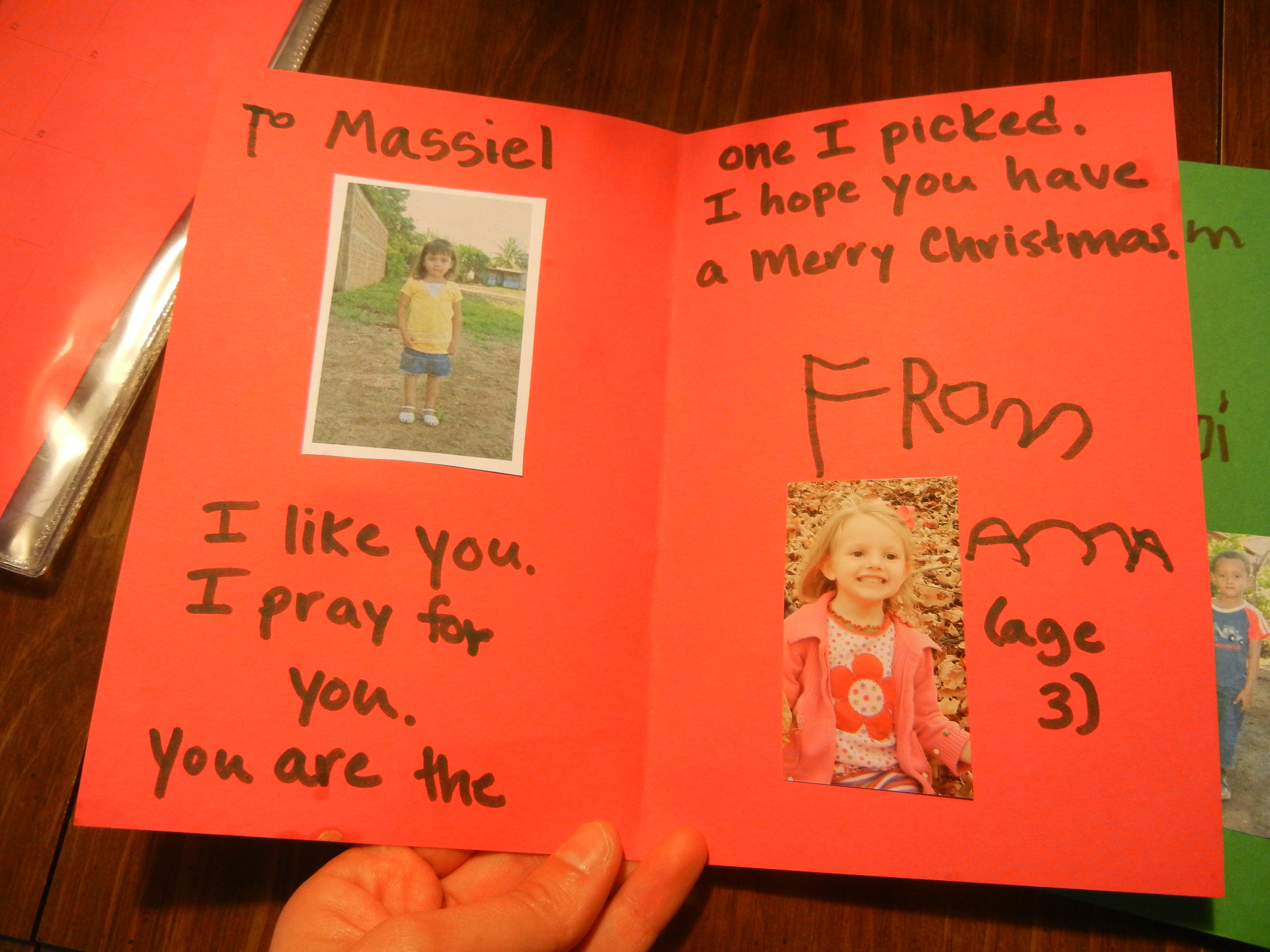
That all changed when we sponsored two more children this Christmas. We had been wanting to try this for awhile, and the Advent season seemed like a good time to finally do it. This time, I selected a country that we might actually visit one day, as we have missionary friends there. I also explained the idea of sponsoring children to my kids and then let them each pick a child who was their same age and gender. (By the way, Compassion’s website is wonderful. You can go through the whole process of sponsoring a child online now, and it is so easy!) The kids were really excited to get to pick “their” children. Luke pored over the pictures of little boys his age before finally picking a boy named Andi. In contrast, Anna marched up to the computer, gave the girls a quick glance, and then authoritatively chose Massiel.
I printed out information on our new kids, and that very afternoon, we got to work on some Christmas cards for them. Unlike some of my less successful attempts to make my kids more “others-minded,” this one went over incredibly well, and the kids did not need any convincing to make their cards.
I let the kids write what they wanted in their cards, and I think that including pictures really helped. I know it helped my kids, and I hope it helped Massiel and Andi, too.
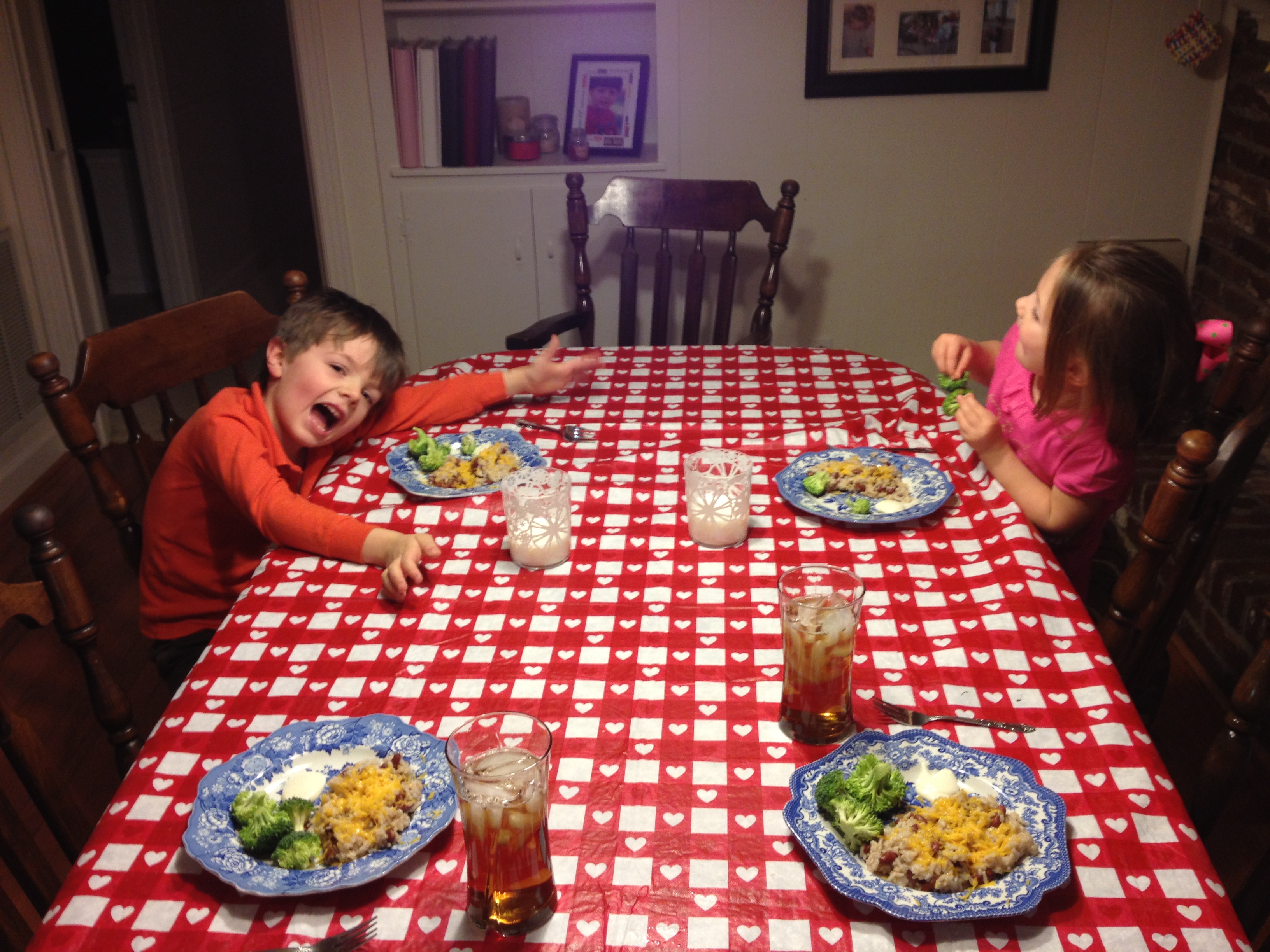
Our cool experience with Compassion didn’t stop there, however. The organization has honed their communication skills a lot since 2003, and soon, we received detailed information packets about Andi and Massiel, along with lots of well-presented information about their home country. A few weeks later, we also received informational letters from both of them, detailing the makeup of their families, some facts about their lives, and even some of their favorite things. We found out, for example, that Andi’s favorite food was “gallo pinto with cheese.” We didn’t know what that was, so we looked it up online. Turns out, it is rice and beans. It occurred to me that Luke and Anna might also like gallo pinto with cheese, and that it would be good for them to see what their Compassion friend ate. So I looked up how to make it, even finding a recipe from the kids’ country. We had it for dinner one night:
Luke loved it. His exact words were, “Andi is not crazy at all for liking this!”
The information sheets gave us fodder for things to write back to Andi and Massiel. And with Compassion’s website, we found that writing back was super easy. We do it online, and the kids can pick out their own stationery and easily include pictures. Then Compassion prints out the letters and mails them. We try to write them at least once a month and to always include pictures. In Andi’s last letter, we shared pictures of Luke eating gallo pinto with cheese, as well as his positive review. The whole process of writing both kids takes about 15-20 minutes. It’s great.
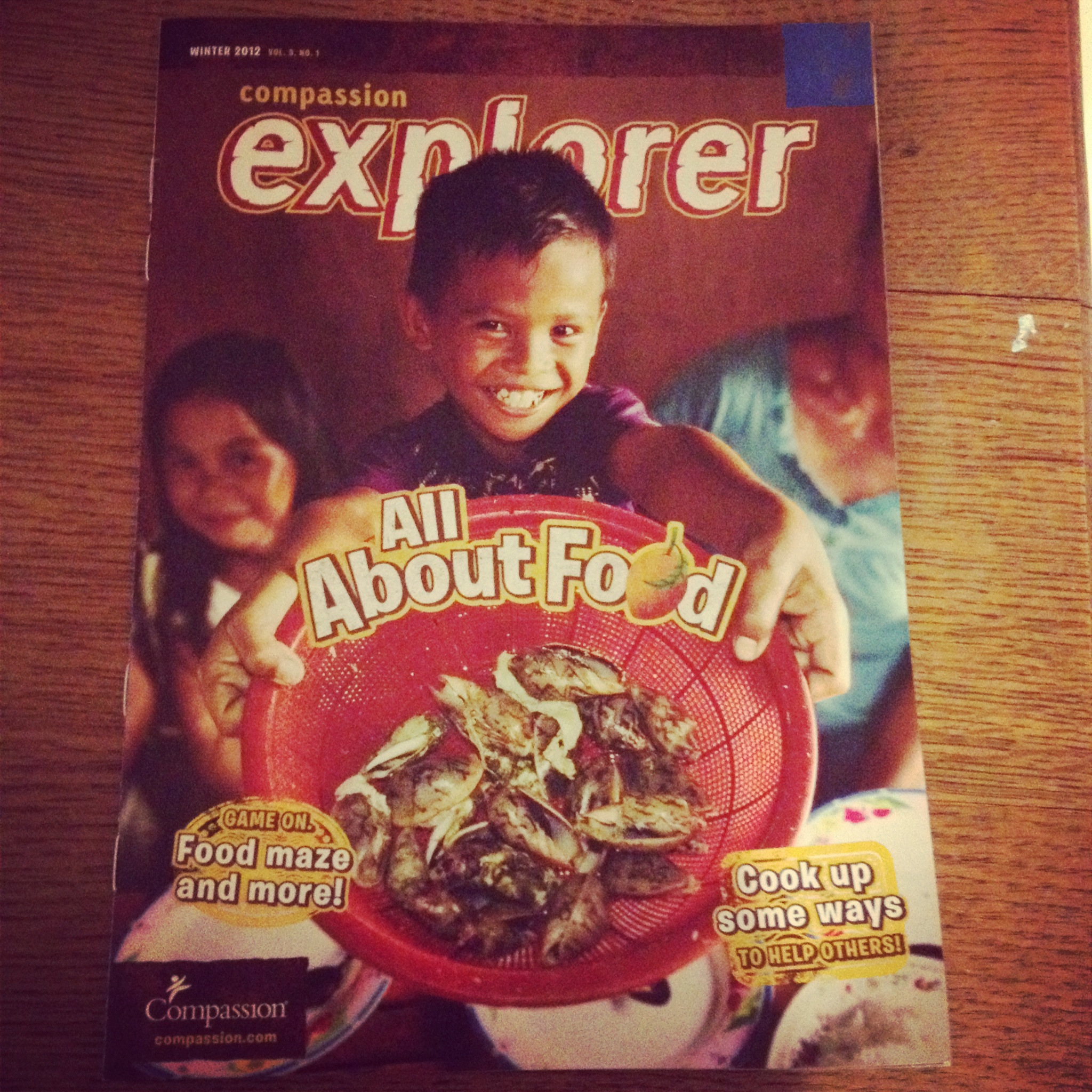
An added bonus to sponsoring through Compassion is that they have a free, quarterly magazine just for kids. It is called Compassion Explorer, and it is a wonderful resource for kids. You can sign up for it online, and it comes with your regular Compassion magazine for adults. The magazine is full of great photos and stories about the lives of kids around the world, and it also has stories of kids helping others. Plus, there are craft ideas, recipes, and science experiments. Both the kids and I were big fans of Compassion Explorer.
So far, we have loved having Andi and Massiel as part of our lives. We have learned about their lives and their country, and it has given my kids a chance to think beyond themselves and their own world. We also pray for Andi and Massiel each night, which brings me to our second teaching strategy.
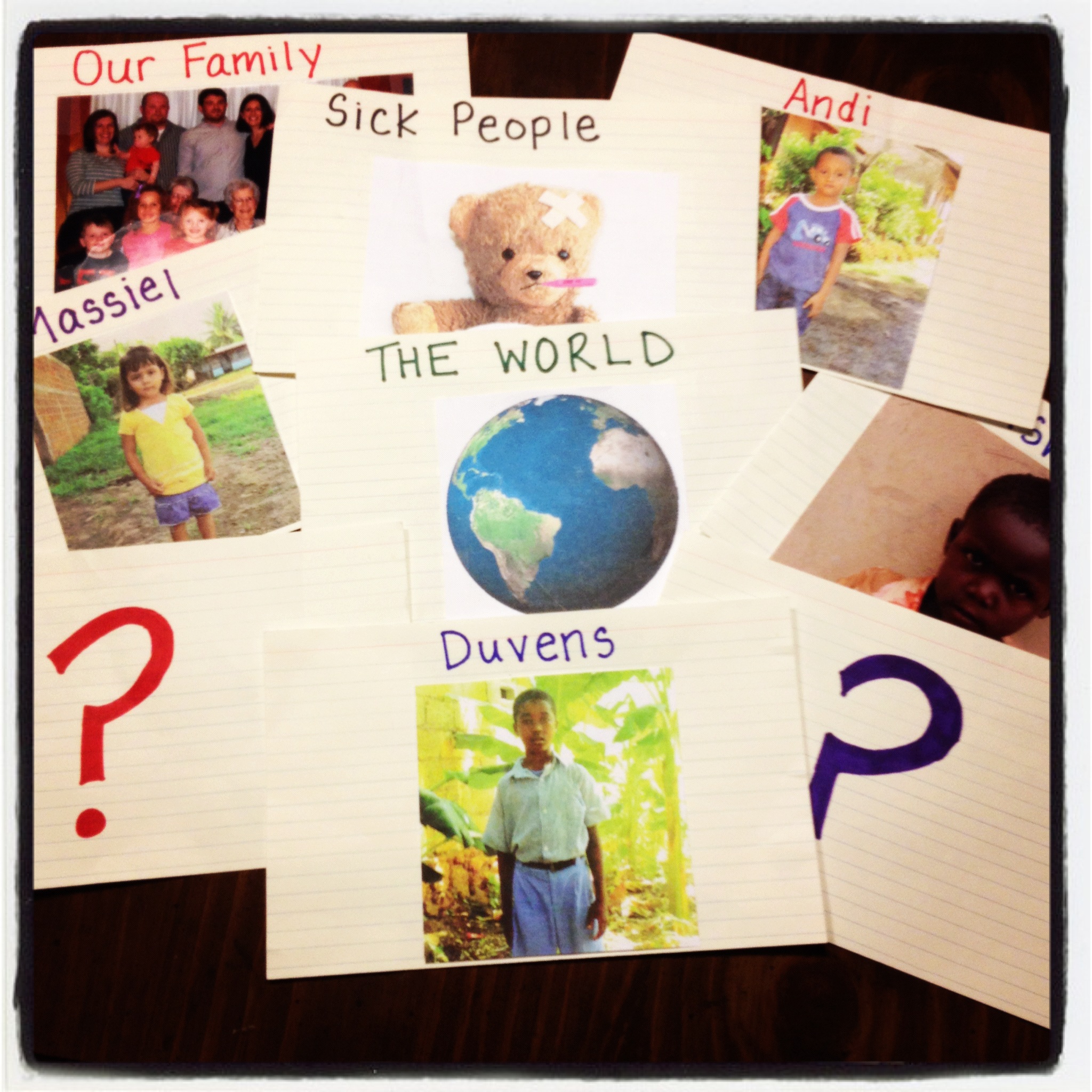
We have always said nightly prayers with our children. Their prayers go in phases. For a long time, they prayed long prayers, thanking God for everything in their lines of vision: ceiling fans, stuffed animals, furniture, and so forth. Their most latest phase, however, has been to rattle off a quick, “Thank you, God, for this day. In Jesus name, Amen.” Usually, I just wait until the phase passes, but this one lasted so long that I decided to intervene. I started by taking prayer requests before we prayed and then divvying the requests up among the three of us. That worked okay, but the enthusiasm was still lacking. I also realized that most of our requests are the same each night. That’s when I hit on the idea of making prayer cards so that we could remember what we were supposed to pray for. I made cards for the usual suspects: our family, our sponsored children, and sick people. Then I got the idea to make a card for “the world.” It’s funny because at the end of last year, had the strong desire to learn how to pray for the whole world everyday. I’m pretty sure I wasn’t picturing an index card with a globe on it at the time, but you have to start somewhere! I also threw in some “question mark” cards where you could put in your own requests.
Amazingly, these cards have been a huge hit with the kids. We have used them for almost two months now, and they love them. We have talked about each card and what to pray for with each one (mainly because Anna’s prayer about sick people started out, “Thank you for sick people!”). The kids love taking turns picking their cards, and it is kind of like a game to us at this point. They have their favorites and sometimes even trade for certain ones they really want. We are still miles away from anything resembling a serious prayer time, but their enthusiasm is definitely an improvement. And I was very gratified last week when Luke hopped into the car after school and announced, “We need to add Mrs. ______ to our prayers. She has missed two days of school!” And he didn’t forget that night, either. Small steps.
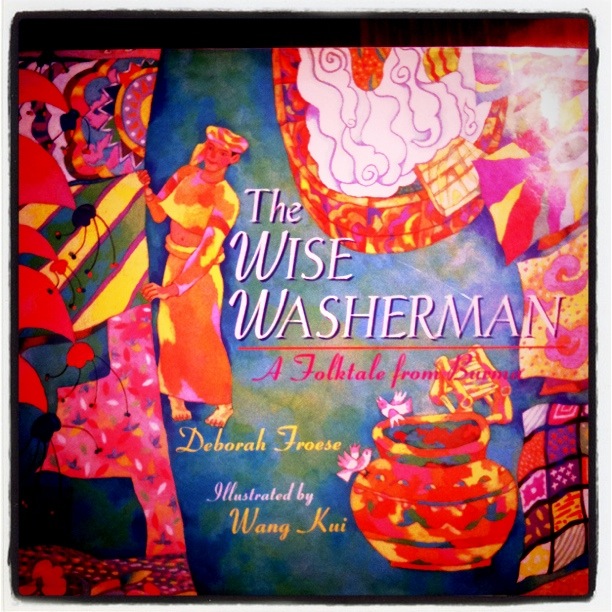
Lastly, Greg and I just try to highlight the diversity that is already around them. To be honest, it’s really not that hard in our current environment. Luke is one of two white kids in his class, after all, and his classmates hail from several different countries. Luke’s teacher recently arranged a meeting with the principal, the counselor, the school psychologist, and me, to brainstorm how the school can continue to challenge Luke (because he is ‘wicked smaht,” but I digress). Since Luke was not around to kill me, I concurred with the principal’s idea of special enrichment projects for him to complete. I then suggested that he do projects on each of the countries represented by his class. Inspired by our gallo pinto with cheese experiment, I thought I could even bring a dish for each country when I come volunteer. We are currently working on a project about Burma, and at our super cool downtown library, I even found a Burmese fairy tale:
I’m doing all this in order to make the most of our current environment. Even if you don’t live near a refugee population, like we do, I’m sure there are other ways to acknowledge the diversity of your environment and turn it into an opportunity to teach your kids about others. In fact, I’m interested in hearing your ideas.
Okay, now it’s your turn. I would love to hear how you teach your children to be more small-world-, missions-, others-minded. Do you have any tips or experiences to share?
Okay, let’s get a few things out of the way first. I don’t know much about Invisible Children. Or Uganda. And before the “Kony 2012” video, I also did not know a ton about Kony besides what I gleaned from the book Outcasts United, reviews of Machine Gun Preacher, and misinformation from Rush Limbaugh. So, admittedly, my exposure has been limited. Furthermore, I’ve never even been to Africa, and most of my recent knowledge of the current situation in Uganda comes from a book called Kisses from Katie. In other words, I don’t know what is best for Uganda, I haven’t done a thing to stop Kony, and I pretty much don’t know what I’m talking about. You probably shouldn’t even be reading this.
That said, let’s begin.
Last week, the internet world was rocked by a thirty minute video about child abductor, mass murderer, and all around bad guy, Joseph Kony. For decades, Kony has been kidnapping children in Uganda and beyond, and forcing them to fight for him in what he calls the “Lord’s Resistance Army.” He is responsible for lots and lots of horrible things. The video was made by a non-profit group called Invisible Children, which apparently was founded in 2003 with the express purpose of stopping this madman. They appear in their video to connect their advocacy to President Obama’s decision to send…advisory military people?…into Uganda to serve as aid to the Ugandan government, who are trying to catch Kony and deliver him to the International Criminal Court. Kony is the ICC’s #1 most wanted bad guy, and…well…they want him. Invisible Children is worried, though, that without continued public support, the U.S. government will cancel the mission, and Kony will continue to wreak havoc. Thus, their goal is to get enough Americans fired up about Kony so that we will continue pressuring our government to intervene, and that they will continue to help the Ugandan government, who in turn will catch Kony. This plan was all laid out in the video in a nifty series of photographic dominoes.
To be honest, it doesn’t exactly seem like a fool-proof plan to me, but again, I’m not an expert. We’ll get to all that later, though. First, here is the video:
Frankly, I’m just impressed that teens watched all thirty minutes. That’s a long time for the younger generation! Also, I have to say that it was really cool to see kids excited about something beyond their own, immediate world. I’ll take awareness of greater human suffering over status updates about the burrito they had at Moe’s any day of the the week! So yeah…my first reaction to this whole phenomenon was that I was pumped!
And I guess that’s why the groundswell of invalid criticism rubbed me the wrong way.
Now, don’t get me wrong: I do believe that there is some very valid criticism–or at least valid questions–about the efforts of Invisible Children here. But in the midst of those good conversation starters came a lot of cynicism and snark. Here are two examples of what I believe is completely invalid criticism:
Invalid Critique #1: “Liking” a Facebook status is “not enough,” and the kids who participate on this level are shallow.
This is a two-parter. The first critique to the movement comes in the form of a not-so-gentle reminder that it takes more than internet activism to make actual change. To the people who pose such an objection, I have a few things to say. First, at the risk of sounding obvious, didn’t you watch the video? “Liking” the Facebook status is part of the first step: Spreading awareness. That leads to government pressure, which leads to American intervention, which leads to Ugandan military success, which leads to capturing Kony. Remember the dominoes, people!
But really, this criticism is not about the dominoes, but about disdain for “clicktivism” as a whole. “Clicktivism” is online activism. It includes such “surface” actions as tweeting a few lines or “liking” a status about some social cause. The objection to clicktivism is that such actions are pretty lame, ultimately meaningless, and that they give a false sense of satisfaction to their participants. I understand these objections because I used to feel the same way. My mind was enlightened, however, by these wise words from a friend, Ryan Dement. I read them in a note he wrote on Facebook in October, 2010. The whole note was great, but in the following paragraph, Ryan addressed the criticism that clicktivism is too easy. Here is what he had to say:
The biggest critique of clicktivism is that it’s way too easy to ‘like’ a facebook page and do nothing else. That real activism is strangled by the useless gesture of a click that assuages guilty consciences just enough to prevent them from enacting real change. This argument always sounds great when I hear it. but the more I think about it, the less it makes sense. 1.) The person who does this, the person who clicks and walks away, is not the person who would drive to D.C. for a modern day march on Washington. People do however much they feel that they should. Or can. The person who cares enough to retweet one link or news story cares exactly that much…There are good arguments for whether or not they should or can do more. But despite that: they decide to click, to tweet, and stop. The clicking didn’t keep them from greater activism. in fact, the ease of social media probably incited them to do that little bit, more than they would have otherwise. 2.) This least amount of effort isn’t useless. The internet works in trends and memes, and adding that one tweet-drop of exposure to a social issue has a positive effect. Even if someone glances over it, makes a programmed decision not to read, care, or think about it, and moves on, that decision to dismiss occurred, where it would not have otherwise. Thus increasing the frequency in which people are consciously thinking about the issue. Certainly not glamorous, but not useless either.
I completely agree. What gets me is that the people who criticize the “small” actions of “liking” a Facebook status are probably not tweeting their objections while on their plane ride to Uganda. In fact, there is a good chance that the objectors to the smallness of Facebook “likes” are doing even less. I’m not hatin’, and I definitely think there is a call for circumspection here. But why must our first reaction to do-gooder idealism be to try to cynically stamp it out? There are so many better reactions to have.
This is the second part of Invalid Critique #1, and to me, it is even more ridiculous. Yeah, maybe most of the people with Kony 2012 pictures all over their Facebook page didn’t care about Ugandan kids yesterday. That’s probably true. But…that’s because they didn’t know about Ugandan kids yesterday. That’s how information works. You don’t know something, and then you learn about it, and then you know it. It’s called a starting point. I wasn’t born caring about poor kids in Nashville. But when I got to Youth Encouragement Services in college, I learned about them and started caring about them. I can’t imagine what my response would have been if, while I was all fired up about Y.E.S. kids, someone came up to me and said, ‘Tell me more about how you’ve always cared about poor kids in Nashville?” As if my new-found compassion didn’t count because it was new. Seriously? That makes no sense. Yes, the cynic in me would acknowledge that most of these “activists” are going to move on from this cause in a couple of weeks. But who cares? Isn’t it good that they are being introduced to issues beyond their own little worlds? And even if 5% or less actually continue to fight for the poor and oppressed, that’s 5% who might not be doing so otherwise. Everyone has to start somewhere.
The Nashville example brings me the second invalid criticism of this movement.
Invalid Critique #2: “We” should not worry about Africa because “we” have too many problems here.
Ah, yes, the question of “we.” In Lee Camp’s brilliantly frustrating book, Mere Discipleship, he gives a little litmus test in order to determine the American Christian’s ultimate loyalty. The test is simply a question of “we”: when you speak generally of “we,” who are you talking about? Is “we” the church, the kingdom of God? Or is “we” America? Whichever “we” is, that’s the group with which you most identify. It’s the group that claims your ultimate loyalty. I’m not sure that the test is entirely fair, but it definitely made me think.
The “we” in this second critique is America. I know that because the kingdom of God is in Africa, too. So “we,” the kingdom of God, have some problems in Africa, and over there, “our” people are suffering. And thus, “we” should do something about it. See, you can use the Bible to justify putting the weak and oppressed first, and you can use it to justify putting Christians first, but you cannot use it to justify putting a particular nation first. That last one is not a Biblical argument.
Now, perhaps it is valid to point out that loving your neighbor should not be an either/or scenario. Perhaps we should remember that we are also called to love our next-door neighbor, as well as our African neighbor. Perhaps we need the reminder that it is often easier to love the people whom you can’t see than it is to love the people who are actually a part of your life. And perhaps we could use the pragmatic counsel that God might want us to work where we could do the most good, and that there is a greater chance that we could do good in our own surroundings. I agree with all of those points. But I certainly don’t think that we have to choose one or the other, local or foreign, as worthy of our time. And I certainly don’t believe that everything in America has to be perfect before we care about anyone outside of America.
In the midst of the cynicism and invalid objections, however, I think that some really good questions have been raised. I have a few myself:
Who, exactly, are the group, Invisible Children, and are they the best people to handle this Kony thing?
If for me, “we” is the church, then why should I want “we” the American government to handle this?
Is military intervention the best solution?
Is the Ugandan government as corrupt as I’ve been hearing?
What important information about this situation do I not know?
Could Invisible Children’s plan do more harm than good?
What does God want me to do in this situation?
I don’t know the answers to these questions, but I do think that they are the right questions. I think Kony is a madman, and I can’t imagine that Africa would be anything but better without his presence. But I also don’t want to ignorantly forge ahead, riding a wave of self-righteous idealism and make the situation worse. So for now, I’m educating myself and praying. I did a fair amount of googling, until I found Rachel Held Evans’ very helpful post, “Some Resources on the Invisible Children Controversy.” It has tons of links to different perspectives and thoughts from people way more informed on the matter than I. I would definitely recommend perusing through the links in this post if you are interested in learning more about the situation with Joseph Kony.
I’ve thought a lot, though, about what I would tell my kids, if they were teenagers who were caught up in this surge of internet righteousness. How would I direct their passion without stamping it out?
I think I would start by rejoicing over their concern for others. Then I would assure them that their compassion was pleasing to God and confirm that all children are equally precious in His sight, no matter what nation they are from. Next, I would show them how to educate themselves in order to be equipped to do the greatest good. And then we would talk about it. And pray about it.
And then we would do something about it._____________________________________________________________________________________________________________________________So what is your opinion of Kony 2012?
One of the highlights of living in Nashville is our local Aldi. For one thing, I have long heard the legend of Aldi from my fellow couponers and couponing websites. I knew from them that Aldi was a super-cheap grocery store that kept prices low in a variety of creative ways: their aisles are formed by the food products themselves, not shelves; the use of a cart cost $.25 (but you get it back when you return it); they don’t take credit cards; and they don’t have bags. It’s definitely a unique grocery store, and the prices are very low.
That’s not the only reason I love it, however. I love our local Aldi because it is an absolute melting pot of so many cultures of the world. Nashville has a large refugee population, and apparently the one thing that all these unique and diverse cultures have in common is that they all love them some Aldi. Thus, on any given trip to Aldi, I find myself absolutely surrounded by the rainbow of God’s creation. I love walking through and observing all the different people. And as someone who loves words, I especially love hearing all of the various languages. I only know English, but I know enough of other languages to know that most of the languages spoken in Aldi are not European. Yet, for all the obvious differences in the clientele, it’s funny how we often have more in common than we think. On my first trip to Aldi, a young Indian woman started a conversation with me about motherhood while our two children eyed each other from our carts. Her little boy was named Arjun, he was sixteen months old, and she was struggling with being a stay-at-home mom. She had her college degree in business administration and thought of herself as a career woman. We talked about the struggles of motherhood for awhile, and I tried to encourage her. What struck me most about the conversation, though, was how similar it was to so many conversations I’ve had with my friends. In fact, were I still apart of my old Mommy and Me group in South Carolina, I would have totally invited her to join us. The commute is a little far, though.
The other night, Greg had a similar “small world” experience at Aldi. He found himself in line behind a large African man who had just let a Middle Eastern guy go in front of him. While Greg waited for his turn, he set his two gallons of milk on a shelf beside the conveyor. Once room was made on the conveyor belt, the African man turned and transferred the milk onto the belt for Greg. Greg thanked him, and a few minutes later, the man gave an unsolicited explanation for his actions. In a very thick accent, he told Greg, “We have to take care of each other. That’s what God wants. He wants us to love each other. If we did, we wouldn’t have so much war and violence and hatred.” Greg agreed, of course, and thanked him again. Then Greg paid for his groceries and went out. As he got into his car, he noticed that the people in the car next to him were having some trouble getting it started. He looked over, and saw a Hispanic man and a white woman trying to get the engine to turn over. With the African man’s words still ringing in his ears, Greg made eye contact with the people and asked if they needed any help. They said they thought they were out of gas and asked Greg if they had a gas can they could borrow. He said he didn’t, but that he would run and get them some gas since he needed some himself. They gratefully accepted the offer, and he drove off to the nearby Citgo.
This particular Citgo is quite dear to me because this summer, I had my own “small world” experience there. I had just gotten into town after spending a few days at my parents’ house. I was in Nashville to meet the mission team from my church, who were currently en route from Oklahoma. They were still a few hours away, and while I waited for them to arrive, I was going to meet an old friend for dinner. But first, I had to gas up. I pulled into the Citgo and up to a pump. Immediately, the gas station attendant came out to help me, as I had apparently chosen a full service pump. I explained to him that I had made a mistake and moved to a self-service pump instead. I got the gas pumping and then went to the back of the van to get out some makeup to freshen up before dinner. It was locked. Oops. I went around to the front of the van to hit the unlock button…but it was locked, too. Everything was inside my car: my wallet, my cell phone, and most dismayingly, my keys.
So there I was, alone in a city with no one’s contact numbers, no money, and no transportation. Even my AAA card was in the car! Sheepishly, I walked into the gas station and explained my plight to the middle Eastern man behind the counter, the same man who had come out earlier to pump my gas. I asked if I could use a phone book and his telephone to call AAA. He was very sympathetic and let me make the call. I had another problem, though: I was supposed to meet my friend for dinner in ten minutes, and I had no way to contact her to let her know I would be late. I knew I was near the restaurant, but I couldn’t remember how far down the road it was. I asked the gas station worker and briefly explained my plight. I was absolutely shocked when he volunteered to let me take his car.
A few minutes later, I was driving down Nolensville Road listening to the strange, Eastern melodies floating from this stranger’s radio. I had learned in my brief interaction with the man that he was from the nation of Jordan, and I had to marvel at the cultural situation I was in: I was driving a Jordanian man’s car to meet a Mexican woman at a Chinese restaurant. It occurred to me that nothing in my behavior so far should have indicated to this man that I was even qualified to operate a vehicle, and I also knew that some middle Easterners don’t even think that women should drive cars (there is a law against it in Saudi Arabia, right?). And yet here I was, having just interacted with one of the first Muslims I had ever met, and I was driving his car. Weird.
I left a message at the restaurant for my friend, and then headed back to the gas station to wait for AAA. During my wait, I had very little else to do besides chat with the Jordanian, and he had little else to do in the empty store besides chat with me. So we talked. Turns out, the man was in this country temporarily. He came over here to go to college, but he had trouble affording it and didn’t really seem to know what he wanted to do. Thus, instead of getting his degree, he had moved down from New York to Nashville, married a Native American woman, and was now working in this gas station. We talked about his impressions of America, his life in the middle East, and our religions. I asked him about Al Qaeda and Osama bin Laden (yes, yes I did), and I listened as he passionately explained the differences in the interpretation of Islam and how he was glad bin Laden was dead. He told me about how there are 27 (or something like that) countries in the middle East and how they are all different, and how Jordan is not crazy like some of the others. He told me about his views of Islam, and his wife’s thoughts on the matter. He told me that we both pray to God, and it is God who will judge between us. And I told him about my beliefs, as well. In short, we both tried to be good witnesses to each other. We talked back and forth in that empty gas station, surrounded by Twinkies and beef jerky and the smell of oil, until the very nice AAA guy came to help me back into my car. Then I thanked him, and I left, and I never saw him again.
But that conversation stayed with me for awhile. It reminded me that it really is small world these days. And where my family lives, we can meet Arabs and Indians and Africans on a normal trip to the grocery store or gas station. I love that. I love getting to talk to people who are different from me, people who look different, who think differently, who live differently. And I love that my children are going to grow up in this environment. This week on the blog, I’m going to explore that idea, that concept of our small world. I’m going to share some cool missionary blogs, as well as some ways Greg and I have learned to teach our kids about our small world. I’m also going to weigh in on the Kony 2012 phenomenon. Paul’s words in Acts 17:27 tell me that God has put us all here, in 2012, for a reason. And here, in 2012, we live in a small world that is more globally connected than ever before. How are we to live in such a world? Who is our neighbor in this world?
Those are two questions worth asking, in my opinion. Perhaps this week, you can help me answer them.
This year marks the first time that I have ever tried to observe Lent. I come from a church background that generally eschews tradition, and while I very much agree with my church’s desire not to bind the people of God with the laws of men, I also enjoy my freedom to partake in spiritual traditions which I personally find helpful. Thus, I decided to use Lent as a time to deliberately focus on my relationship with God. The thing I really wanted to work on was my prayer life. My morning prayers have gotten somewhat rote and shallow, and they leave me spiritually thirsty afterward. I told God all this, and then reread the chapter on prayer in one of my favorite books, Celebration of Discipline. I thought that was a good start.
Then, on the morning of Ash Wednesday, I got up early, sat curled up on my love seat, where I usually have my quiet time, and prepared myself for some renewed prayer. Only…no words came.
I decided not to force it. So I just sat there and watched the sunrise.
A few minutes later, Anna came wandering sleepily into the room. I greeted her brightly, and she came to snuggle with me. The way we were sitting, she perfectly mirrored me: we faced the same direction as she rested against my chest. I absently played with her hair, and in that moment, I was reminded that my love for my daughter was just a pale reflection of God’s love for His children. I also saw that what Anna was doing to me, I was doing to God while sitting in the love seat watching the sunrise:
We were both resting in the presence of our parent.
It was very nice. And peaceful. I enjoyed it immensely.
And then, a funny thing started happening:
Anna started to talk.
She was jabbering really, about nothing. About the designs on her pajamas and things like that. It didn’t even feel like she was talking to me (indeed, she probably wasn’t), but rather talking to herself.
And it was funny, because I love my daughter very much, and I love to hear her sweet voice, and to know what is on her mind…but in that moment, I thought, “I do wish she would stop prattling on and just enjoy the silence.” I wasn’t even annoyed, really–more like amused.
And then I smiled…
because it seemed like God was trying to tell me something.
And I realized that maybe to improve my prayer life, I should stop twittering on about whatever is in my head each morning, and start listening more to God. Maybe I read the wrong chapter of Celebration of Discipline; maybe I should have read the chapter on silence instead.
During the next few days, I became aware of how little I let silence into my life. In the morning, I start writing my prayers to God with little thought or meditation. When I eat alone, I read a magazine. If I’m in the car alone, I listen to music. If I have a spare second in the day, I am on my phone reading a blog. I realized that I had literally gotten to the point where I could not just sit still.
Why was that?
The more I thought about it, I realized that, at the heart of it, my need for distraction reflected dissatisfaction. Sometimes I would use distraction to avoid some unpleasant chore. Sometimes I used it because I didn’t have anything else to do in the moment, like when I was waiting the last few minutes of my planning time before walking down the hall to teach class. Sometimes it was because I was really tired or wasn’t feeling well, and I wanted to distract myself from my fatigue or my sickness. But whether I was trying to escape a chore, boredom, or unpleasant feelings, the bottom line was that I found reality dissatisfying and thus, I sought to distract my brain.
The desire for distraction is understandable, I guess, but there were a few side effects that I hadn’t noticed. For one thing, my brain never had time to rest. Any spare moment was spent reading something or listening to something, and the lack of downtime slowly exhausted my brain throughout the day. One result was that there was much less space in my day for creative thought. Once I started to remove so many of my distractions, I was able to spend more of those spare moments just resting in God’s presence. And then a funny thing happened: when I started resting my mind during the day, I found that afterward, it was teeming with thoughts and observations and ideas–and a seemingly unending supply of blog posts!
Even more importantly, I realized that all the noise around me kept me from appreciating the little blessings of this God-given life. My desire to distract myself had robbed me of all the little, exquisite details of this life that I so easily ignore: a morning chill, a light breeze, the curve of a lampshade, the miracle of my daughter’s hands. When I quiet my mind and take time to look at my world, I notice the beauty in the ordinary…and often, beautiful thoughts come from those observations. Letting quiet back into my life has, perhaps paradoxically, improved my communication with God.
The picture at the top of this post is of the squashed handfuls of wildflowers my children brought to me a couple days ago. Those flowers are so evocative of the little blessings that I receive when my eyes are opened and my mind is focused to receive them. When I silently enjoy the presence of God, I find that my life is full of these little flowers.
I find normal life to be quite difficult sometimes.
Which is weird, because I generally like my life. I enjoy the people in it, and I tend to like what I do each day.
I think the difficulty has to do with the sheer variety of my tasks. I’m not a good multi-tasker, and I’m not very nimble sometimes when it comes to switching back and forth between so many roles. Thus, I often struggle to keep the balance between teaching college kids and my kindergartner, between cleaning the house and playing with my children, between budgeting and grocery shopping, between cooking and laundry, between church responsibilities and school responsibilities. Those are a lot of balls to keep in the air, and I’m not a great juggler. Furthermore, I think that my skill sets are…um…highly specialized. It is infinitely easier (and enjoyable) for me to hold forth my views on epistemology than to make dinner on time…but which one of those do think my family would prefer? Exactly. And when you understand that my skill set does not include anything manual, anything to do with math, or anything that requires extroversion, you can begin to see just how many of my basic tasks require skills that don’t come naturally to me.
Furthermore, when you factor in the really easy tasks that I find to be comically hard, such as parking my beloved land boatvan in between the lines, not losing my cell phone, and moving clothes from the washer to the dryer in a timely fashion…well, you can see how normal life can be a little overwhelming for me at times!
Usually, that’s all okay, though. Usually, that’s just life, and I enjoy stretching myself and doing things that I’m not naturally that good at. What gets me is when two or more of those 87 areas are causing me particular stress. For example, in January, there was a period of time when I was stressed about teaching and stressed about Luke’s educational situation. I felt completely unqualified to be back in the classroom after a six-year absence, and I was also worried that Luke’s school wasn’t meeting his educational needs. Plus, I didn’t know how to fix either situation. Furthermore, on any given day during that period, I was probably also stressed about when I was going to make it to the grocery store, what we were having for dinner, or when I was ever going to get caught up with laundry.
Those are the times when normal life is hard for me.
Nothing catastrophic or horrible had happened; it just suddenly seemed that all of my tasks were too much for me to handle.
In those times, I tend to feel very fragmented, like I am being pulled in lots of different directions at the same time. I feel harried, like I don’t have enough time to catch my breath. And I feel helpless, like my circumstances are controlling me.
Thankfully, I have found a sure-fire way to relieve my stress in those moments. I have found a sentence, a single line, that totally dissipates my feelings of inadequacy. This line makes everything so much better.
Do you want to know what it is?
It’s this:
You have one job to do.
That’s what I tell myself. I say, “Kim, I know that it feels like you are being pulled in 87 different directions right now, and I know it feels like it is all just too hard. But you are forgetting that your job on this earth is not to get groceries on time. Your job is not be an amazing professor, or even to be the parent who always knows what to do for her kids. Your job is to bring glory to God. That’s it. When you get to heaven, God is not going to ask if you kept up with the laundry, or if you were an awesome professor, or even if you made the best educational decision for your child. What will matter then is that, through all those things, your actions brought glory to God. What will matter is that you showed Christ’s love to all those around you. None of the rest of it will matter.”
One job.
I can do one job. I find 87 jobs a little difficult, but one I can do.
That single-mindedness helps me. When I feel fragmented, the idea of having one job makes me whole again. When I am harried, having one job gives me peace. And when I feel helpless, having one job empowers me.
I find my one, God-given job to be very unifying in my life–which is how it should be. It reminds me the observation that Paul makes about Christ when writing to the Colossians: “He is before all things, and in him all things hold together.” When Christ comes first in my life, He does, indeed, hold it all together. Similarly, I think of Paul’s statement to the Athenians: “For in him we live and move and have our being.” When I am living for God, I am constantly aware that my whole world, with all of its many tasks, is all part of the bigger picture of my life in Christ. It is all part of one glorious whole.
The funny thing is that after remembering my one job, my life kind of looks the same as it did before. I still try my best at teaching; I still work to ensure that my child gets a good education; I still make it to the grocery store. But I no longer see those things as ends in themselves, nor do I see my success of failure in those areas as indicators of my worth as a person. Instead, I see all those little demands as opportunities to reflect the glory of my Creator and thus, to be a light to the world. And I remember that I glorify God by theway that I do those things, by the love that I show through my efforts, instead of through success or achievement.
When I have that single-mindedness that comes from remembering my one job, I am very blessed. I am blessed with peaceful days, with feelings of purpose and meaning, and with a unity of being that sets my soul at rest.
When I remember my one big job, it makes the 87 little ones so much easier to handle!
 Other than through nature, however, I feel nothing spiritually. My senses are deadened. I feel no encouragement from reading Scripture, no inspiration from prayer, no insight from silence, no joy from service. It kind of reminds me of Captain Barbossa as he rants to Elizabeth Swan about the curse’s effect on him (in Pirates of the Caribbean: Curse of the Black Pearl. I will cite that reference for the five people in this country who may not have seen that movie.) “I feel nothin’!” he exclaims. Same deal here. All I feel is my flesh raging against all forms of self-denial. I have hit a wall. And so I have had to ask myself:

 In one of my college English classes,we once had a discussion about the purpose of art. Our discussion boiled down to two camps: the aesthetic and the didactic. The aesthetic camp believed in “art for art’s sake”; in other words, art needs no justification. It just is. Or something like that. I didn’t really buy it.








 Kingdom Civics