Archive for the ‘My Life in the Kingdom’ Category

Update on my Love Life: Speaking a New Language

In 2012, my major “resolution” was to live a life of love.  I know myself well enough to know that I cannot simply will myself to be loving, and so this resolution is really a request for God to transform me.  I also know, though, that there are some things that I can do to try to realign my life with Jesus’ standards.  Here is a little “update” on my attempt at an Eph. 5:2 style “love life.”  (You can only imagine how I lit up when I came up with that little phrase.  I couldn’t wait to use that title:)).

So I have this theory that kids get yelled at regularly.  Even my own kids…and they both have parents who save yelling for the moments when they are about to get run over by a car.  But even though Greg and I generally don’t yell at them, I know for a fact that Luke has an art teacher who is a bit of a yeller.  Luke describes her as “grumpy,” and he doesn’t like to go to art (which is so sad to me).  The other day after he had art class, I asked him how it went.  He perked up and said it went well because, in his words, “I think the other kids are starting to figure out that if they aren’t bad, she won’t yell at them so much.”  Also, I have eaten lunch with him at school, and I have seen a very large and very intimidating lunch lady holler at the kids who are stepping out of line.  It seems like the more that children are in a group setting, the more likely it is for them to get yelled at.  Apparently, it is often too tempting for the person in charge of the group setting to use yelling as a means of control.  Sometimes, it might be practical:  if the kids are being so loud they can’t hear the leader, maybe yelling is simply used as a way to get their attention back.  At the same time, I can’t help but think that yelling is a tool of control that can be very easily misused.

It doesn’t stop in group situations, though.  Just the other day, I heard a parent absolutely reaming her kids out in the parking lot.  The fact that she didn’t skip a beat when my two small children and I came into view made me think that this was a regular behavior for her.  And from the stories that Greg hears from kids at Y.E.S., I’m beginning to think that yelling is a regular behavior in many homes.

Now, here is how that all applies to my love life.  In the rowdy world of children, maintaining some semblance of order is challenging.  The temptation when managing children is often to resort to yelling, or at least to speaking harshly out of frustration and anger.  As a parent, I can tell you that there is something about children’s outright and repeated rebellion that is such an affront to one’s sinful pride.  That “insult” often makes it very difficult to respond with patience and love.  My impatience is magnified in group settings.  When a child repeatedly disrupts the whole group, I personally find that very frustrating.

Which brings me to a boy named…well…we’ll call him Frog.  In a lot of ways, Frog is a great kid.  He’s smart, he’s energetic, he’s got a lot going for him.  At this time in his development, though, Frog’s special spiritual gift seems to be driving adults out of their ever-lovin’ minds.  Trying to lead a group in which Frog is a part inevitably proves very difficult, as he continually talks, disrupts, and repeatedly ignores all warnings.

Because of this consistently disruptive behavior, I have a feeling that Frog gets yelled at a lot.

So I was thinking about Frog the other day.  I began to try to see things from his perspective, as a child who was continually in trouble, and I wondered if, in the cloud of yelling that envelopes Frog’s life, Frog was able to tell the difference between grumpy-selfish-adult-yelling and loving-Christian-yelling.  It occurred to me that maybe he (and most children) couldn’t make those distinctions.  That…maybe it all just sounded like yelling.

And then I decided to try an experiment.  I decided to try to speak a new language to Frog.

My experiment was partially inspired by my brother, Mike, who was very good at speaking differently to children.  I remember clearly a time about…seven?…years ago, when Mike came and visited me in South Carolina.  I was teaching 5th and 6th grade Sunday school, and Mike sat in with me.  There was one boy in class, a repeat visitor, whom I really didn’t know very well.  I honestly don’t remember much about him, but I remember he was always very disruptive.  This one Sunday, I was trying to get the kids to turn to the front of the Bible to go over the books of the Old Testament.  It was a large and rowdy class, and I was having kind of a hard time keeping control of it.  Anyway, this kid simply would not participate in turning to the books of the Bible.  He wouldn’t cooperate at all.  In frustration, I sent him out of the class.  He went without a fuss.  A few minutes later, Mike quietly ducked out to join him.

I heard the two of them laughing in the hall, and honestly, part of me felt annoyed.  I didn’t want to be the bad guy, and I started mentally justifying my actions to Mike.  At the same time, I was kind of relieved that the kid was gone, and that I didn’t have to worry about what trouble he might be getting into in the hall.  A few minutes later, class ended, and I looked out in the hallway.  Mike and the boy were sitting beside each other, going over the first five books of the Old Testament.  The kid was cracking up because Mike was giving him silly mnemonic devices by which to remember the books.  I still remember his shortcut for Deuteronomy:  Doo-doo-ronomy.  The boy thought that was hilarious…and, full disclosure, I still chuckle every time I turn to Deuteronomy.

Afterwards, I thanked Mike for taking the kid under his wing.  Mike loved the kid, and told me, “Kim, I don’t think he was trying to be bad.  I honestly don’t think he knew what a table of contents was.”  Ohhhh.  Clarity came flooding into my mind.  Faced with a chaotic situation, I had made a snap judgment and been too harsh.  Mike, on the other hand, took the two seconds to actually see the kid and get to the heart of what was wrong with him.  As a result, the kid fell totally in love with Mike.  All through church service later, he would repeatedly turn around to beam at Mike…to the point where it was, of course, disruptive:).  I watched him get in trouble with his mom.  The boy really couldn’t win for losin’, as we say in the South.

Thinking about Mike’s approach to kids, and about my desires to mirror Christ to others, I decided to speak a new language to Frog.  I decided to reject any type of harsh words toward him and instead to gently discipline him in a clearly loving way.  Or…at least to try.

My first test was last Wednesday night.  In a group devo, I happened to sit in a chair right behind Frog, who was sitting on the floor with his friends.  They talked and cut up constantly.  It was truly a problem and a disruption.  Just to let you know, this type of behavior drives me crazy.  But…I didn’t want to let my personal frustration and impatience cloud my witness.  This kid was loved–absolutely adored–by Jesus.  And I didn’t want that message to get lost…especially not in church.

I tried gently and lovingly correcting him.

No dice.

I tried to inspire him to be an example to others.

He laughed.

But he did stop…for two seconds.

As always.

What I found worked the best was, when he was talking, to gently put my hand on his shoulder and say nothing.  No harsh looks–sometimes I didn’t even look at him, but continued listening.  It was easy and somewhat more effective than trying to whisper corrections to him.  When we prayed, I briefly opened my eyes (a natural function of having small kids) and saw him looking at me.  I smiled at him and closed my eyes again.  After the closing prayer, I said, “Hey, Frog.”  He immediately started getting defensive, apparently thinking that I was about to light into him for his behavior.  Instead I just put my hand on his shoulder and said, “I’m glad you’re here,” and went about my business.

As luck would have it, Frog also sat directly in front of me in church this past Sunday morning.  As usual, he talked and made noise constantly.  I followed my same three-step pattern:  gentle admonition to start, hand on the shoulder after that, and a word of affirmation at the end.  His behavior hasn’t changed much, and for all I know, he may think I’m totally crazy…but I think I’m going to play this out as long as I can.  Also, I really just want to get to know the kid.  I’ll keep you posted on how it goes.  If nothing else, this experiment functions as a great practice in self-discipline for my impatient heart.  It is also good practice on not using what I am coming to consider the verbal “weapons of the world.”  It helps me not only with kids like Frog, but also with my own kids.  I really want to do everything out of love.  And I can only speak for myself, but I know that I am not full of love most of the times I speak harshly.  There are sometimes where I do think it is called for…but those times are in the small minority.

So that’s where I am in my love life so far.

How are your new year’s resolutions going?

The Art of Moment Counting

“Teach us to number our days aright, that we may gain a heart of wisdom.”  Psalm 90:12

I have a confession to make.  I started reading Ann Voskamp’s One Thousand Gifts, which is an amazing, revolutionary book (or so I had heard from everyone and their sister).  I got through chapter three before I nonchalantly concluded that I knew where she was going and that I pretty much already do what she is advocating.  And then I stopped reading.

Wow.

Sometimes I hear my own thoughts and just have to chuckle in disbelief at their arrogance.  In repentance, I did start chapter four today and enjoyed it.

That said, it does seem to me that the heart of her book seems to be about being grateful for every moment…which is a lesson that I have been trying to learn since the beginning of 2009.  That’s when I started a scrapbooking endeavor called, “Project 365,” where I took a picture every day.  One thing I discovered that year was how much looking through the lens of the camera helped me truly see my blessings.  Now, don’t misunderstand:  I am no photographer.  I am a strictly point-n-shoot type of girl, and for the past month, I’ve been relying on Greg’s phone for most of my pictures since my beloved camera broke.  So it was not the art of photography that taught me gratitude.  Instead, it was simply the discipline of keeping my eyes open for the special moments, and pausing to record them.  That discipline has been an incredible gift to me.

Since 2009, I have kept some variation of the same scrapbook.  I always use Becky Higgins’ format, which is called Project Life.  In 2011, I did a digital version of Project Life, finishing up on New Year’s Eve.  Two days ago, I got it in the mail.

Since then, I’ve been greedily poring over it and finding myself flooded by memories of all the sacred and wonderful things that happened last year.  Of course, there were big things like birthday parties and first days of schools, and those were duly recorded.  But there were also little things:

This moment with Anna absolutely melted me.  I remember it like it was yesterday.  The euphoria of having her sleep in my arms was like a drug.  Seriously, I felt high.  She doesn’t usually do that anymore.

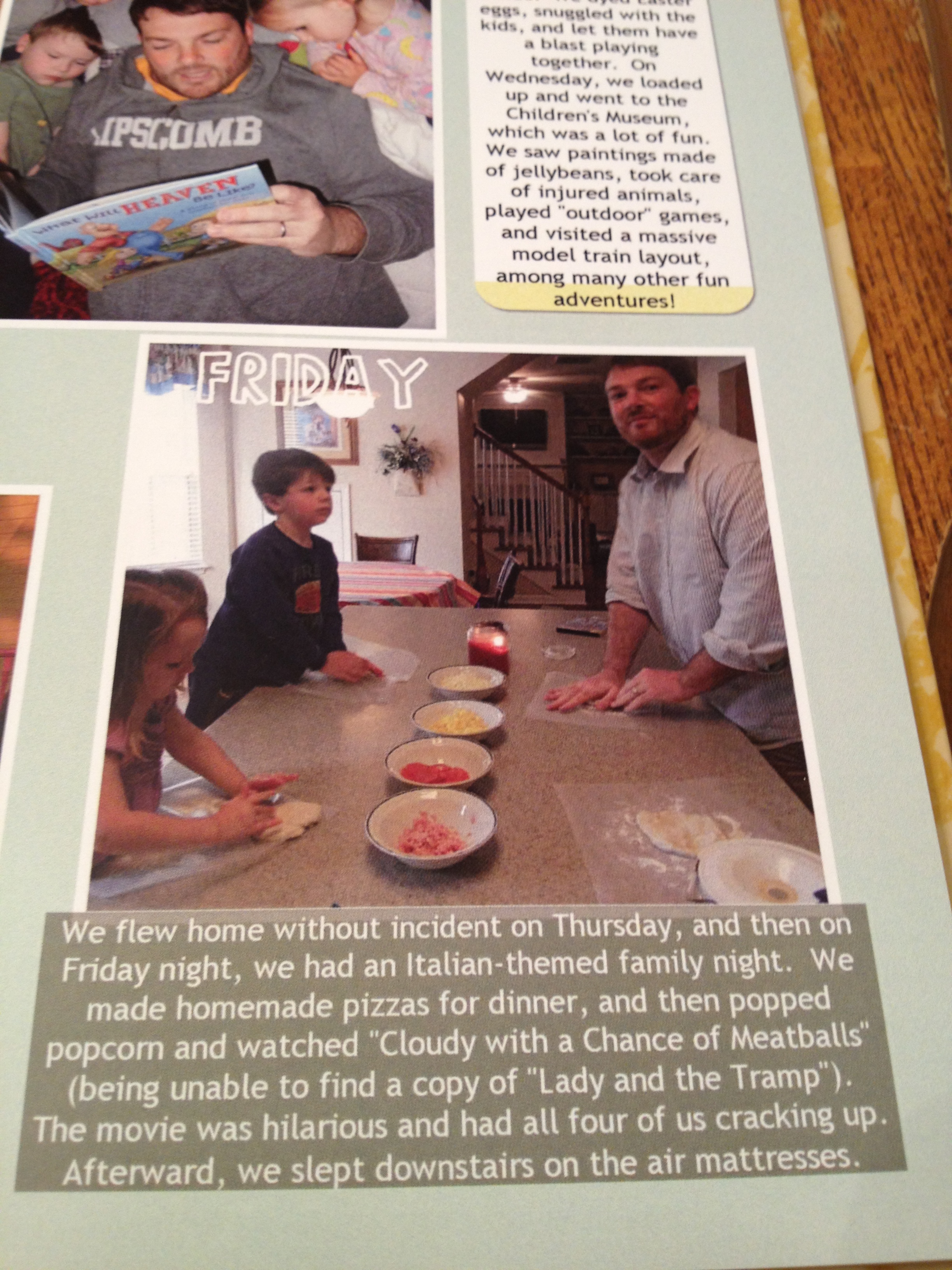
There were also moments, like this one, that I had forgotten.  Seeing the picture revived my memories of the whole evening.  We wanted to have a fun family night, and I thought up an Italian theme.  We would make homemade pizzas and watch Lady and the Tramp.  But everything went wrong.  I couldn’t find Lady and the Tramp anywhere, our pizzas messed up, and Greg and I were both in testy moods.  I remember sitting at the table eating my still-doughy pizza, and staring out the window at a beautiful summer evening.  I wanted so badly to go running instead of watching the movie.  But I gritted my teeth and continued with family night.  We made inflatable beds and watched Cloudy with a Chance of Meatballs.  It was surprisingly funny, and we all ended up laughing and laughing and had a great conversation afterward, snuggling on inflatable mattresses and giggling about our favorite parts.  I went to bed feeling like my heart would burst with happiness.  I am so glad that I stuck out that tragicomic family night.

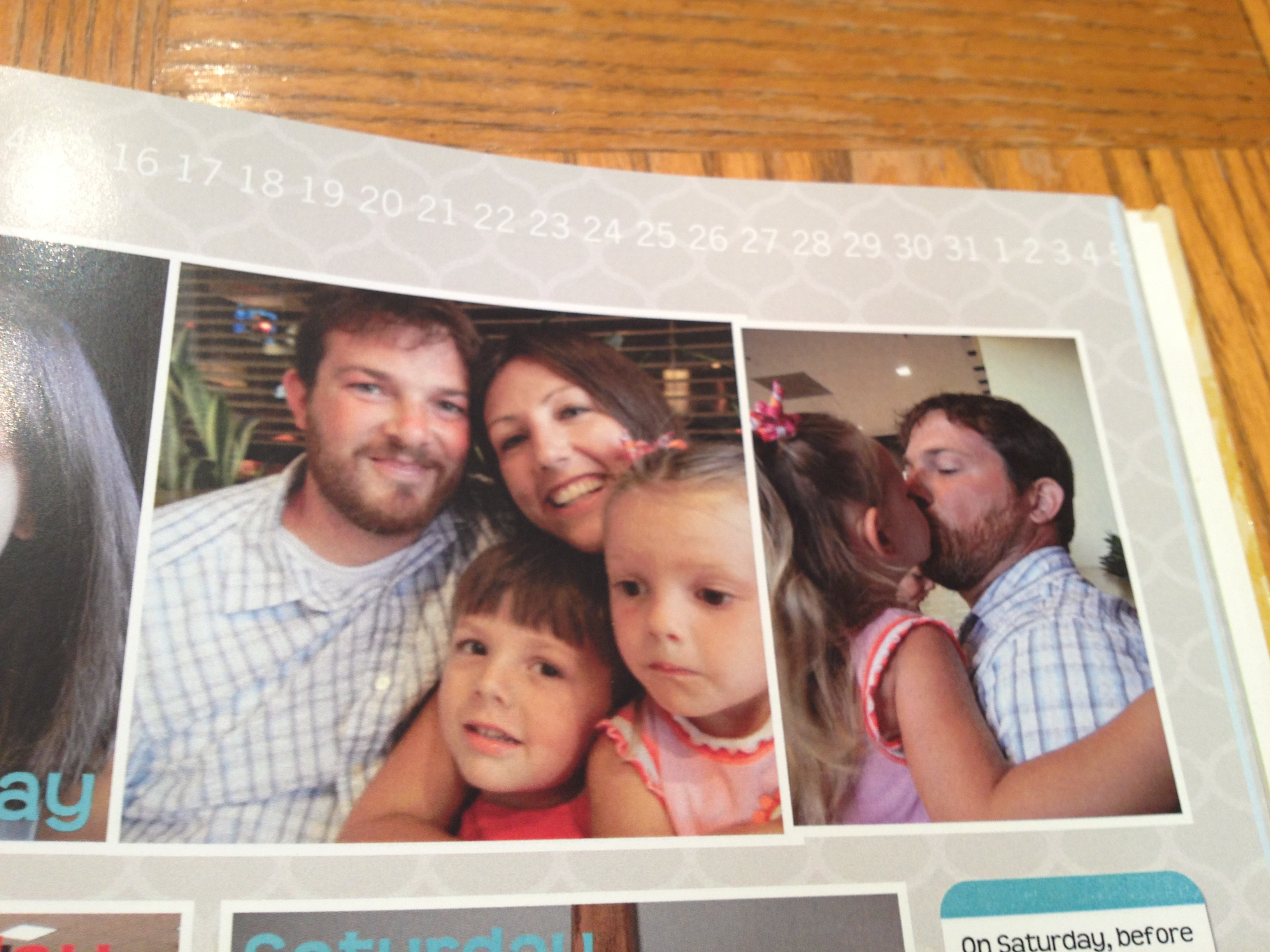
One evening, we tried out a new restaurant, Sesame Burgers.  While we waited outside, we entertained ourselves by trying to get a good family self-portrait.  The results were hilarious, and this one was the best of the bunch.

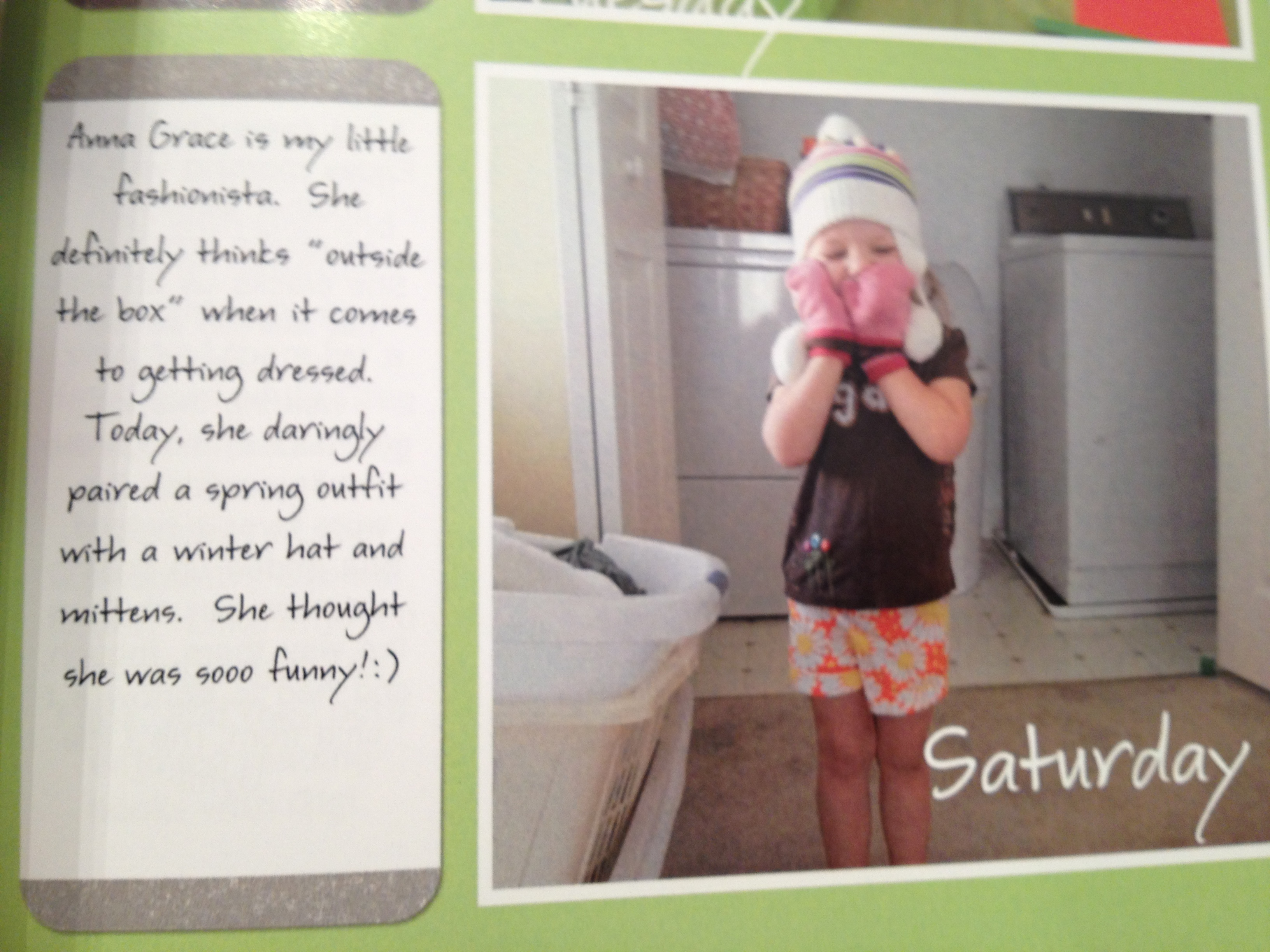
This was one of Anna’s many silly outfits.  I think I took pictures of almost all of them.  She had quite a fashion sense that year!

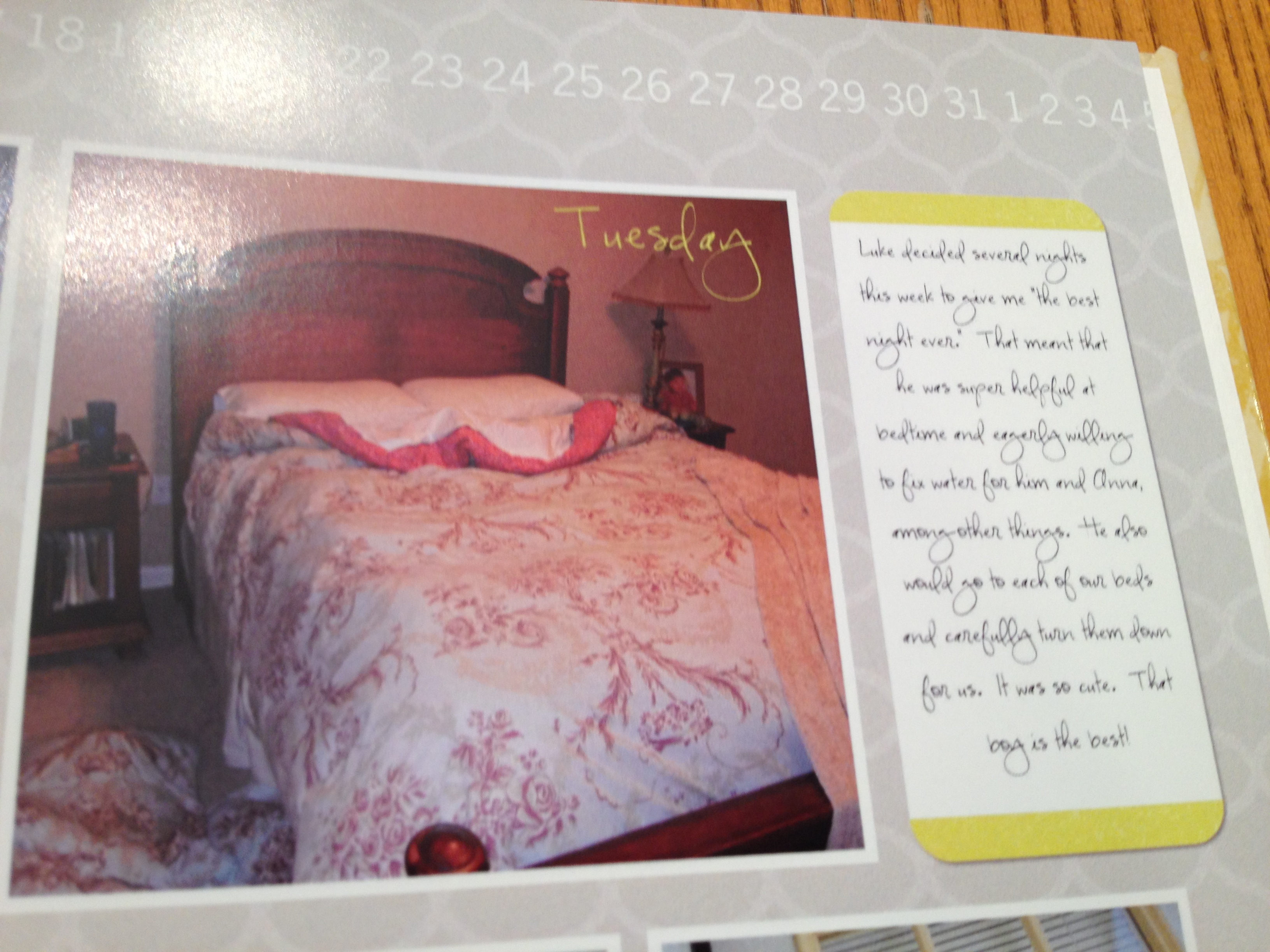
Luke went through a brief phase of trying to give his family “the best night ever,” by turning down all of her beds at night.  I had totally forgotten about this little practice of his, but it was so sweet.

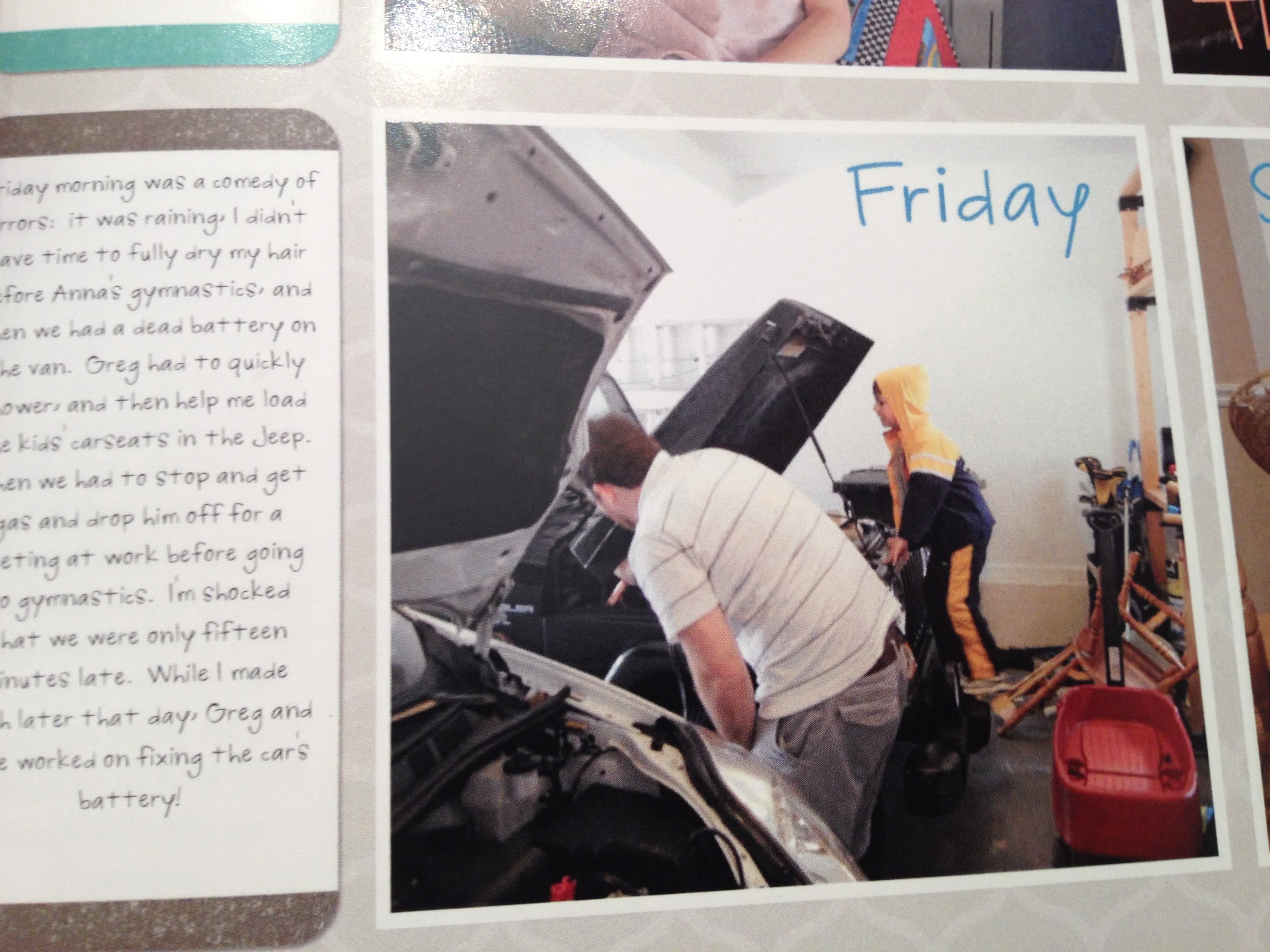
I took this picture after a disastrous morning, where the kids and I barreled out the door, late for Anna’s gymnastics…and found out that the battery on our van was dead.  We had to hastily load carseats into a Jeep (NOT fun) to get there, but by the time Greg and Luke worked on the battery that afternoon, I was able to take the long view and laugh at the whole situation.

I have found that capturing the “small” moments of joy helps me to keep the moments of frustration in perspective:

I capture these moments because I want to remember them.  Remembering them helps me to appreciate them.  And appreciating them in retrospect reminds me to also appreciate the present moments.  It helps me to fully live each moment that God sends me.  That’s my goal, at least.  I guess it’s how I “seize the day.”

I read an article yesterday, in which the author related how the concept of carpe diem intimidated her.  She felt that it put this pressure on her to have every moment full of giddiness and joy…when truthfully, her life was not like that.

Whose life is like that?  I know mine is not.

The article coincided with a conversation I had recently about the degree to which we can truly “seize the day.”  Basically, it was questioned whether we really could maintain such an intense level of existence moment-to-moment…or if the most we could reasonably hope for was a few good moments throughout each day.  Maybe I’m ridiculously naive, but I truly do believe that we can live each moment fully.  And I definitely don’t believe that living each moment fully means feeling non-stop ecstasy throughout each day.

I have the same moments that everyone else does.  Right now, I’m battling a cold, and my head feels like it’s going to explode.  There is fluid in my ears, which magnifies all sound, so I have spent the past couple days repeatedly asking my kids if they could please be a little quieter.  I think they think I am losing my mind.  I also started a part-time teaching job this week, which has been great, but it has made me readjust my routines to figure out how to fit everything in.  We also have quite a few house guests this week, a circumstance that brings a whole other level of housework and meal planning.  There have definitely been moments of exhaustion, which have led to confusion and inefficiency.  But I don’t think that being exhausted and inefficient necessarily means failing to live life fully.  One result of my exhausted inefficiency this afternoon was that I realized that the most efficient thing I could handle with my current level of brain functioning was to sit and find Waldo with Luke in the Where’s Waldo book we checked out yesterday.  We found Waldo, the Wizard, Wenda, Woof, and Ogwald in all the pictures.  And I’ve got to say, I’m a master at finding Woof:)!  I even found the scroll a few times!  That was seizing the day.  It’s really not so hard.

Seizing the day for me is really just to embrace each moment for what it is.  That’s how you make the moments count.  I try so hard not to resent my hard moments or wish them away.  Instead, when I embrace the exhaustion, the difficulty, the frustration, and the pain for what they are…I often find that they are strangely beautiful:

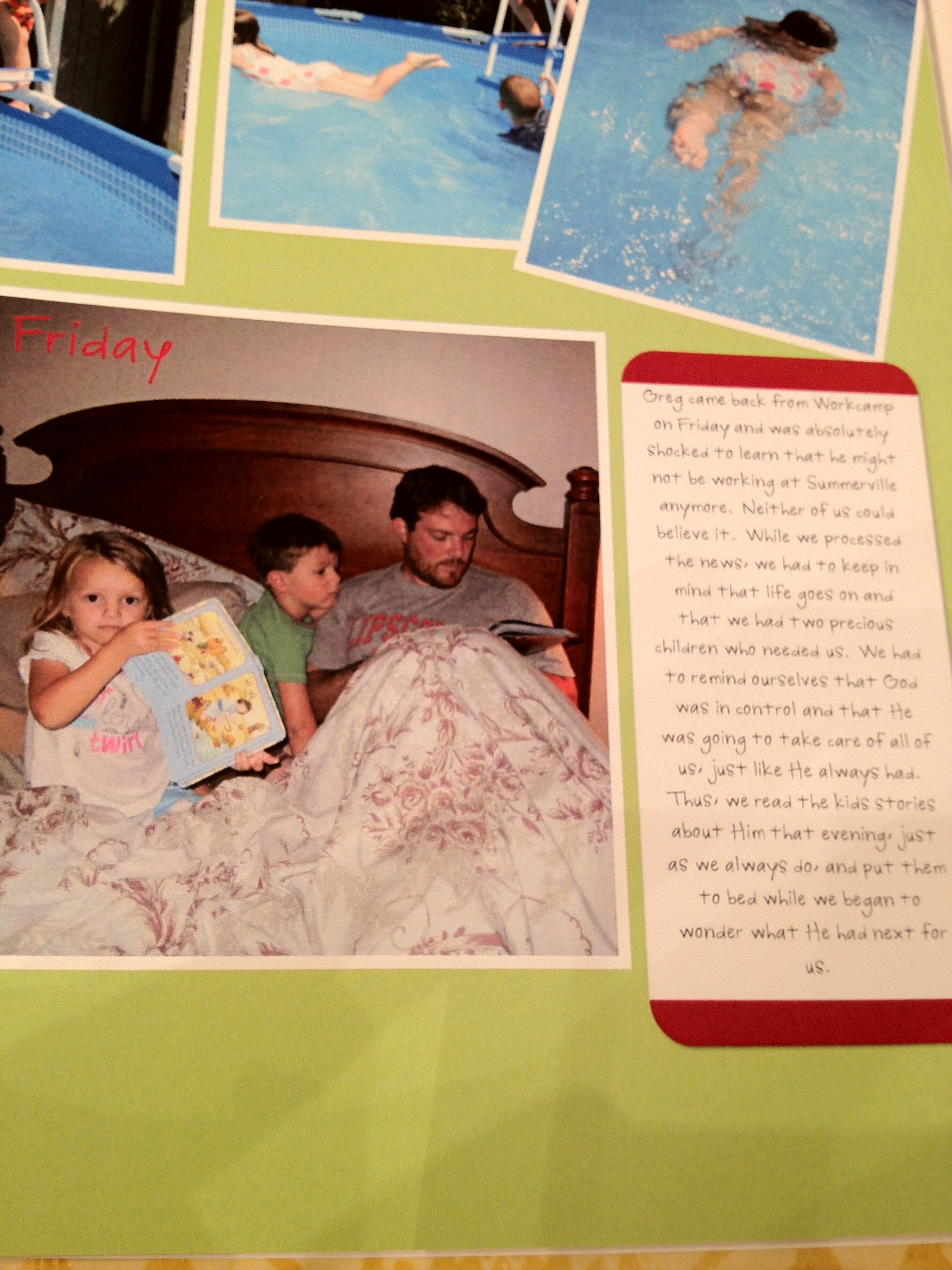
This was taken the evening we found out that Greg would probably lose his job, which was one of the biggest blows of both of our lives.  I can’t even describe to you how much pain I was in when I snapped that picture.  And yet, something compelled me to seize the moment, to make it count, to remember it.  There just seemed to be something sacred in the fact that Greg continued to read the kids their Bible stories, as always.  Even though everything had changed for us, nothing had changed about the God we serve.  There is something sacred about pain, just like there is something sacred about joy.

And so I continue to try to cultivate the art of moment counting.  I try to see the meaning in everything…honestly, because I really want there to be meaning in everything.  I’m not sure that anything is more fundamentally depressing to me than meaninglessness.  Pain, tragedy, heartbreak…it is all manageable if I can believe there might be meaning behind it.  It’s unbearable otherwise.  The same is true, to a different degree, of the rest of my life.  I want it all to have meaning, every second.  Maybe that sounds horrible to you, or unrealistic.  But it sounds like heaven to me–truly!  And the more I seek God, the more He gives me the meaning I long for in every second of the day.  Seek, and ye shall find, right?

And that’s how I count my moments…and make my moments count.

How do you do it?

Shut up.

“Be still, and know that I am God.”  Psalm 46:10

My mind generally races throughout its day:  it reacts to the surrounding stimuli of its world; it plots and plans the practicalities necessary for a smooth daily existence; it ponders the many things I read and hear; it mulls over its own thoughts.  This is normal for it.

And then, sometimes, it gets stopped.

Sometimes, like yesterday, it will be humming along as usual, as I sit on the  back patio, listening to the children play, reading a good book, thinking remotely about my plans for the rest of the day…when I look up…

…and shut up.

Something about God’s world–so often, it’s trees, but it can really be anything–fully quiets my soul.  My thoughts are absorbed completely into the beauty of the moment, and there is no pondering, or planning, or meditating, or mentally describing.  There is simply silence, as the beauty of God’s world, and the immense Love reflected in that beauty, pour into my heart.  Such inward silences can stretch into minutes, which is no small feat for my overactive, ever-thinking mind.

Eventually, something will snap me out of it, and the thoughts will pour back in, and my day will proceed.  But as it once again moves forward, I remain deeply grateful for the times that God simply shuts me up.

How does God shut you up?

Doing and Being

Do you want to know the secret to a good New Year’s resolution?

It has to be observable and measurable.

Take it from a resolution veteran:  “I’m going to work out more” doesn’t cut it.  You need to say that you are going to work out this many times a week, at this place, and going to do these exercises.  And then you need to have a little chart or a space in your planner where you check off your workouts.

I’ve learned all this from experience.  Here are some of my past resolutions that worked:

Run 150 times this year, and at least 12 times each month.

Do crunches three times a week.

Read through the entire Bible, using x daily Bible plan.

The idea behind all this objective doing is the hope that, if you do something long enough, you’ll be something.  I didn’t resolve to exercise out of my love for bodily movement; I did it so that I would be in shape.  (Is this too obvious?  Bear with me; I’m going somewhere with it.)  I want to do my Bible reading so that I will be closer to God.

In 2010, I went for broke in the “doing” department.  Not only did I want to read the Bible through, I wanted to blog my responses.  It took about an hour each day, because even though I am a fast reader, my blogs were generally not short.  However, since this goal was public, my pride propelled me to follow through with it.  And so I did.  Every day, for 365 days, a blog post went up.  A couple of times throughout the year, I traveled to a place where I wouldn’t have internet access, so I wrote my blogs ahead of time and scheduled them to post.  I only got really sick once (a blasted stomach virus during a youth trip), but I still posted while my head was spinning and my stomach was churning.

That was the year of the earthquake in Haiti, and I decided to fast and pray about that.  Fueled by the experience, I instituted a personal weekly fast for much of that spring (I realize that I’m not supposed to tell you that, and that I’m probably cashing in my reward, but I believe that the bigger point warrants it).

The bottom line, is that I did spiritual disciplines that year.  I did them.  If doing something for 14, or 21, days is supposed to make it a lifelong habit, then what is doing something for 365 days?  I figured I had done everything in my power to force regular Bible reading into my life.  And so, in 2011, I wanted more.  I didn’t want to be the person who simply did her Bible reading, who clawed her way through it, through rain or shine, come hell or high water.  Instead, I wanted to be the person who thirsted for God, who spent time with Him out of pure desire and need, not because she had a checklist to complete.

And so that was my central resolution in 2011:  to thirst for God.

You may notice that, according to my rules, that resolution stinks.  It’s not objective; it’s not measurable.  In fact, as I found in 2010, it’s not even possible to do myself.  If it were possible, I would have achieved it in 2010, but in January of 2011, I found myself adrift without my Bible reading scheme, and able to go a week without reading!  Some good that whole year did!

My resolution, I realized was really a request.  It was a request for God to transform me, to make me thirst for Him.  All I could do was to keep asking.

The number of entries in my prayer journal is a reliable indicator of the number of days I spent purposeful time with God.  When I look in it for 2011, I see the following:  January was mediocre.  February was spotty.  March was pretty bleak.  April was looking to be the worst month so far…until the 27th.  From April 27 to June 1, I didn’t miss a single day.  And after that, I was very steady until the end of the year.  What’s more, my entries went from choppy lists to passionate paragraphs, where I poured out my heart to God.

I did not do that.

I tried just as hard from January to April as I did from the end of April on.  And my trying got me nowhere.  Finally, God just answered me.  He answered me through one friend, who gave me a great idea on reading through the New Testament…at the same time that another friend started a wonderful study on grace for the women of our church…at the same time that I was reading an amazing book that had sat, unread, on my shelf for over ten years.  The confluence of these factors struck the match in my soul.  And it has kept burning until now, well past the end of my New Testament reading, past the end of the grace study, past the end of the book.  Through this experience, I have seen the glory of God in the land of the living.  I have seen how He can transform my soul to make me be the person I want to be, apart from simply doing the things I want to do.

Now, don’t get me wrong:  I completely affirm the value of disciplines.  But every good discussion of spiritual discipline (and I’ve read a few) will emphasize that it is not the disciplines themselves that bring you to God, but it is God’s Spirit working within you.

And so this year, my “New Year’s resolution” is simply another request for God.  Make no mistake, I do have a few “measurable” ones, centering around justice and hospitality, but my “big” one is completely in God’s court:

I want to live a life of love.

Over the past six months, I have had recurring thoughts about the “weapons of this world.”  In 2 Corinthians 10:4, Paul tells us, “The weapons we fight with are not the weapons of this world.  On the contrary, they have divine power to demolish strongholds.”  That verse has really taken root in my imagination, and I have mulled it over often.  What weapons do we fight with?  What has the divine power to demolish strongholds?  I have come to believe that the only “weapon” that fits that description is love.  Only love can transform a person’s soul.  Everything else amounts to coercion.

This idea has interesting ramifications in the area of international conflict, and I do admit an almost unhealthy interest in the debate between pacifism and just war theory.  But the reality is, I never have been, nor ever will be, a soldier, so there’s a degree to which that debate is irrelevant to my life.  But…that doesn’t mean I don’t use the weapons of the world.  How many times in relationships am I tempted to fight fire with fire?  How many times do I use the verbal violence of harsh words in order to force my kids, or others, into line?  The weapons of this world, I have come to theorize, are the things that try to force external behaviors in an attempt to control others.  Harsh words, yelling, biting remarks, passive-aggressiveness, the silent treatment:  these are all weapons of the world.

This year, I want to lay my weapons down.

As a wife, as a mother, as a teacher (whether college or Sunday school), I want to use love as my only weapon.

Maybe that’s impossible.  Maybe it’s stupid.  Maybe it’s based on a misinterpretation of Scripture.  I really don’t know.

But I want to find out.

One thing I know is that I can not live a life of love on my own.  I get irritable; I get frustrated; I am insufferable when I’m tired or sick.  I’m horrible at multi-tasking and thus, resent interruptions of my work.  I get easily stressed and am snappy as a result.  I have so many flaws that would prevent love from flowing out of me, and I have a handy arsenal of verbal weapons, ever ready at my disposal.  To instead choose peace and love every time I’m tempted to reach for a verbal spear will require nothing short of divine intervention.

But I want to live a life of love, as God’s dearly loved child, because I want to be a follower of Christ  And I want to be a full, practicing citizen in the kingdom of God.  And I want to be a living sacrifice, bringing glory to God.  I want to be a vessel through which His Spirit flows.

I want to be all those things, and without His Spirit actively accomplishing His purposes in me, there is no amount of discipline on my part that can achieve those goals.  In that way, my New Year’s resolution is really a prayer of helplessness.  Instead of relying on a checklist to make me into the person I want to be, I’m throwing all my hope behind the Creator Himself.

May He do great things in 2012 for all of us.  May He transform us all into the people we were designed to be.

What do you want to do this year?  Or, more importantly, who do you want to be this life?

Chocolate Update and Confession

Greg and I recently decided to try to start buying fair trade chocolate, a conviction I blogged about here.  A couple nights ago, Greg asked me if I had read about Nestle partnering with the Fair Labor Association to investigate the use of child slavery in its supply chain.  He really didn’t have to ask:  if it wasn’t featured on the front page of Yahoo! news or my friends’ blogs, then the answer was no.  I hadn’t heard.

After his heads-up, I read several articles about the agreement, and while it seems like good news, it also seems from my “research” that these companies have a history of making promises without backing them up with action.  So we’ll see.

Besides some healthy skepticism, my impromptu investigation of Nestle’s claims led to a couple of different emotions in me:  it made me feel kind of warm and fuzzy about the populist power inherent in capitalism, while also arousing strangely competitive feelings against Great Britain.

Regarding the first emotion, look, I know capitalism has its problems.  That said, there is something uniquely empowering in the ability to affect the decisions of a corporate juggernaut with the use of (a whole lotta people’s) measly little dollars.  It reminds me of the thrill that my kids got at the Science Center the other day when they used a lever and pulley system to lift up a car.  As Jack Sparrow would say, it’s just “a matter of leverage.”  Yes, fair trade chocolate has a long way to go, but just look at how far fair trade coffee has come!  When my hippie husband broached the idea of buying fair trade coffee a few years ago, I couldn’t find it anywhere, and on the rare occasions that I could physically locate the mythical bag, it was outrageously priced.  Now, you can buy fair trade coffee at Wal-mart and Target, and it’s honestly not that much more expensive than regular coffee!  We can do this, guys!  Power to the people!

Secondly, though, must Britain always beat us to the punch on the slavery issue?  I keep thinking about William Wilberforce, whom I conveniently picture as Ioan Gruffudd, and not this guy:

File:William Wilberforce.jpg

Gruffudd’s movie reminded me that Britain voted to abolish slavery in 1833, while the U.S. lagged some thirty years behind (and wasn’t there a war involved or something?  I forget).

And their annoying moral superiority still goes on today, people!

Did you know that Nestle already sells a fair trade Kit Kat bar in Britain?  And it’s not like Kit Kats are some little rinky-dink candy over there:  they are the best-selling chocolate bar in the UK!  And Cadbury also has a fair trade line of chocolate that they sell in Britain.

But do they sell the fair trade Kit Kats in the U.S.?  And for that matter, does Cadbury sell fair trade chocolate in the States?  No, and no.

Why?

I confess that I haven’t fully investigated the disparity, but I can only imagine it’s because they know we don’t care.  We. don’t. care.  Because if we did, we wouldn’t buy them, and then they’d have to sell us something we would buy.  It’s quite simple, when you think about it.  And so now, I’m feeling competitive.  We’re America, dang it!  We are proud of our morality, our Christian heritage…unlike those pagan Europeans!  (Sarcasm.)  Did Bradford call England the “city on a hill”?  No, he called America that.

So…why are we still behind?  

Well….probably because we (read: me) are not so awesome at sticking to buying fair trade chocolate.  Oh, we can do the chocolate chips and the cocoa mix, and we don’t really buy chocolate bars anyway…but we (okay, I!) have two downfalls.  One is M&M’s.  I don’t buy them for myself (for real–I really don’t buy candy just for the heck of it), but I did “need” them for my gingerbread house party and for SANTA bingo with the Y.E.S. kids’ Christmas party.  In retrospect, I could have probably used some substitutes, but I was in a hurry and not thinking creatively.  Really, there’s no excuse, but I’m not as concerned about the errant M&M’s because they were for unique circumstances.  What really bothers me is the brownie mix.

In my house, we always have three or four boxes of brownie mix.  Because of the nature of Greg’s job, we usually have people over to eat about once a week, and brownies are a really quick, easy dessert to throw together.  Plus, they often go on sale, buy-one-get-one free, and there are tons of coupons.  Cheap, simple, delicious.  There’s just one problem.  It recently occurred to me (like, today, when I was unloading my four boxes of Ghiradelli brownies from Publix) that brownie mixes have chocolate in them.  And I’m gonna go out on a limb here and say that the chocolate is probably not fair trade.

*Exhale*

Now, that will require a lifestyle change.  (Seriously, we love brownies that much!)

I often have to reorient my gaze to the big picture (CHILD SLAVERY!), and remind myself that I really am committed to being more responsible with my measly dollars.  But now, you gotta help me out.  It would be so great if I had some good, quick, easy, cheap, non-chocolate-laden dessert ideas to replace my brownies.  I need the kind of thing that most guests would like and that I could throw together easily when we are having people over.  In fact, that’s going to be my ending question:

Do you know any desserts that fit my criteria?  This is important, people (and I’m only sort of joking)!

I will leave you with this for inspiration (I couldn’t find any clips like I wanted, so I had to go with the preview.  And full disclosure:  I may have a penchant for cheesiness):

“If there is a bad taste in your mouth, you spit it out.”

I agree completely.

Good Instincts

So often, the natural desires that come from deep down inside me are…well…bad.  They are selfish, they are petty, they are grasping, they are selfish, they are impatient, they are worldly, and they are desperately selfish.  Did I mention that they can be selfish?  The Bible talks about the flesh being in opposition to the Spirit, and I can relate so completely.  Really, I have learned to trust none of my knee-jerk reactions to situations because generally, they are the wrong things to do.

And then I became a mother, and lo and behold, I found a good instinct!  I love my babies so incredibly much…and even more than that, having those babies opened up a whole other level of love and compassion for all children.  I have blogged about these feelings in the past on our family blog, and I may even reprint that post here some day, but the gist of it was that when I had kids, I suddenly felt a profound love, not just for my own children, but for all the children of the world who did not have a loving caregiver.  On a deep, guttural, soul-hurting level, I mourned the abuse that was undoubtedly happening all around me in this world.  The feeling was so overwhelming that I wasn’t even sure what to do about it…or if there was anything I even could do.  It even briefly put me at odds with God, but eventually, He brought me through it, and showed me some productive steps I could take to advocate for hurting children.

It has been awhile since I’ve thought about that rawness of emotion, that deep hurt for hurting kids that I felt shortly after having my own, but yesterday, I saw a reprint of the following blog post on Rage Against the Minivan.  She was sharing these thoughts from another blogger, and the words reverberated in my soul and reminded me of that tumultuous time in my spiritual life.  What I love is the way this blogger has used that passion to do something constructive.  This is her second year to use her blog to help an orphaned child (you can read about the first year here).  I love her words, and I love the way she enables us each to participate in the beautiful act of looking out for an orphan in his distress.  Even if you don’t contribute $5 toward his fund (which I highly recommend), it is worth the read:

life rearranged

Hello my sweet friends.

I’d like for you to meet Xander.

The squishiest, sweetest, most delicious little face you ever did see.

Xander lives in an orphanage in Eastern Europe with no Mommy and no Daddy.

Those almond eyes, a sign of Down Syndrome…and likely much needed medical care.

Once when Henry was a bitty baby, I found myself in his nursery in the wee hours of the morning consoling his whimpering and kissing his feverish little forehead.  I remember thinking: of all the people in the entire world, I’m the only one who can make him feel even remotely happy.  All he wants is his mama.  No one else will do.

And suddenly, out of the blue, in the glow of a new mom’s overwhelming love for her first baby, I was crushed at the thought of the orphan crisis.

How, if my life were different…if one of millions of things weren’t exactly the same as they are now…

I was devastated at the thought of a feverish and sick child whimpering in a crib alone.

No mama to stay up and whisper sweet nothings and coo in his ear.

No daddy to chase him around the house and throw him high into the air for no reason but to elicit squeals of delight.

No cherry flavored Tylenol and cool washcloths for his head.

In that moment, in the middle of the night, sitting in a gliding rocker, in a perfectly decorated nursery, I sobbed.

And truth be told, I’ve never really stopped sobbing over it, you know?

Something happened that night, or really the moment I became a mother, that made me look at the entire world differently.

The world is a much smaller place the moment you have children. 

I think we all break in some way for the orphan crisis…but we have no idea where to start or what to do.

After all, little Xander is only one of 143 million orphans.

Read that number again.  Roll it around in your brain.

Horrific.

And let’s not forget all of the other issues of our broken world. The cancer, the poverty, the dirty water, the child trafficking, the abuse, the wars, the AIDS pandemic, the….name it.

I’m tempted to shut down in an overwhelmed panic.

Because the truth is, we can’t save the world.

We can give and give and advocate and try, and it still won’t be enough.

Right?

But you know what?

It doesn’t mean we shouldn’t try.

It doesn’t mean it’s a good reason to sit back and do nothing.

We must try.

We must do our part.

We must.

Do not buy into the lie that your portion does not matter.

Do not allow yourself to believe that you cannot make a difference.

Do not give yourself permission to throw up your hands in frustration and then cover your eyes with them.

Because today my friends, we will do something.

It may not be much, but we will do our part because it’s the right thing to do.

Because God calls us to do it.

After all, last Christmas, $5 at a time, we made a difference for Cliff and raised almost $9,500…Cliff who is now Joshua and has a mama, a daddy, three brothers and a whole host of grandmas and aunts and uncles.

I know your heart breaks for orphans.  I know it does.  And I know that it may not be possible for you to adopt.  But a family out there would love to. And you can help.

Together we will combine our portions for Xander’s adoption fund.  So that when a family steps forward to adopt him, a gift of funding will be awaiting them.

International adoption is expensive.  And is hands down the biggest deterrant to would be adoptive families.

Not desire.  Not extra bedrooms.  Not politics.

Just stupid, awful money.

So let’s bless a family today.  Let’s bless Xander.

Let’s make this Christmas be about more than wrapping paper and twinkling lights.

Consider making a tax deductible donation to Xander’s adoption fund through Reece’s Rainbow.

I know life is expensive and times are tough.  I know.

But ask yourself this: Can you afford not to?

Reading Jeannett’s words, my heart not only went out to Xander and all the orphans, but my mind started mulling over the good instincts that God gives us, those times when doing the right thing is actually natural.  For me, it is caring for orphans because I’m a mom, and moms take care of kids.  For you, it might be something different.  But I think it’s worth it to identify those instincts and to thank God for them, because I believe they are part of being made in His image.  As we are trapped in bodies that are so often dogged by sin and selfishness, those beautiful instincts are good and perfect gifts that come down to us from the Father of the heavenly lights.  I’m sure that, like everything else, they can be manipulated, and we can use them wrongly.  Like everything else, they must be guided by God’s Spirit.  But in the midst of all of our bad instincts, it’s nice to have a few good ones, you know?

What are your good instincts?  Were you born with them, or did they develop over time?

Birds

“But Jesus called the children to him and said, “Let the little children come to me, and do not hinder them, for the kingdom of God belongs to such as these.”  Luke 18:16

I carry around a list in my head of all the things I need to do in a day.  Before I had kids, this mental list dictated my day.  It kept me focused on all the tasks I needed to complete, and I would methodically move from one to the next until they were done.  I call this practice, “sticking with the plan,” and Greg occasionally makes fun of me for it whenever it veers into neuroses.

My children, on the other hand, could not care less about “sticking with the plan.”

Much of “the plan” even revolves around them these days:  fixing their breakfasts, packing their lunches, playing with them, helping with homework, etc.  And yet, there are also those pesky other things that must be done:  quiet time, laundry, mopping, cooking, emailing, budgeting, errand-running, and so forth.  My kids are not always on board with that other list.  And frankly, that’s not always a bad thing.  In fact, their indifference has managed to get me to do something that all of my husband’s loving jabs could not:  cultivate the discipline to break from the plan when needed.

My children have taught me that sometimes a tea party is more important than a mopped floor, and that curling up with two babies and a pile of books can and should be the first priority of many days.  They have taught me that most of my tasks are really not that important at all, and certainly not too important to be interrupted several times to take care other others.

And they have taught me to watch birds.

A couple of days ago, I was walking from the family room to the bedrooms, probably carrying a pile of items to be distributed to rooms along the way, when I caught sight of Luke sitting on the living room floor, gazing out the window.  He was situated between the glass and the sheer white curtain, just a gauzy outline of a five year old.  Out of amused curiosity, I stopped and asked him what he was doing.

“Oh, just looking at the birds.  Do you want to come watch?”

It was a question whose answer held a strangely moral dimension for me that day.  My mental list had been very prominent in my thinking, and I had been zipping through it, check-check-checking things off.  And yet, suddenly, watching birds seemed like more than a suggestion; it seemed like the right thing to do.

“Yes, buddy.  I’d love to.”

And so I settled in behind the curtain, cross-legged against the glass, and watched the crows fly from tree to tree.  I watched a blue jay chatter on a branch, and smaller birds zip in between “the cord lines,” as Luke calls the telephone wires.  We laughed together at each unexpected flight and each avian interaction, wondering aloud what the birds were saying to each other.  I totally forgot what it was that I was supposed to be doing, and can’t remember even now, because I knew somehow that I was doing something that mattered so much more.

I was looking at the birds of the air and realizing that they do not sow or reap or store away in barns, and yet my heavenly Father feeds them.  Are Luke and Anna and Greg and I…are we all…not much more valuable than they? 

Sitting there, I was thankful to a God who not only took care of birds, but who gave this overly-driven mama a kindergartner who was delighted by them.  I remembered fondly how, even at less than a year old, he would be fixated by the smallest outline of a winged creature flying through the sky.  We would laugh at the way he would ignore all of the large, bright toys we were waving in his face to point and grunt excitedly at the pinprick of a bird so far overhead that we adults had missed it.

Back at the window, we remained contentedly gazing at the birds for well past the normal attention span of a five year old.  It was a cold, gray and gloomy day.  The sun was gone, it was too wet to play outside, and in my mind, the coloring of the day could best be described as “dismal.”  After sitting and watching the birds for a good, long while, Luke and I decided to play with his Toy Story characters, which really excited him.  Still, he could barely stand to wrench himself away from the window, sighing, “It’s just such a beautiful day.”

And I looked out the window again…and realized that it was.

Sometimes it’s so easy to see why the kingdom of God belongs to such as these.


How do your children–or any children–draw you closer to God?

Call for Books (Mind-blowers only, please!)

Last year, right after Christmas, I had an amazing reading experience.  My husband had gotten me When Helping Hurts, which is kind of a “game changer” of a book, in that it makes you rethink everything you do to help the poor.  I absolutely consumed it at my parents’ house in a matter of hours, and it simply blew my mind.  It was such an amazing experience to have my whole way of looking at a subject be completely transformed.  Then, when we were at Greg’s parents’ house, his mom loaned me the book, Same Kind of Different as Me, which kind of served as a powerful illustration of several of the principles in When Helping Hurts.  Plus, it was a deeply moving book all on its own.  I loved that experience of reading two powerful books in such a short span of time, and I will forever remember that week or two fondly, as a time of great spiritual growth.

Because of those memories, I am eager to repeat that experience.  I am looking for some good, world-rocking books to read in the lull between Christmas and the craziness that will be my 2012.  Here are some books that I think might fit the bill, and I’m interested in any other suggestions:

1.  The Divine Conspiracy, by Dallas Willard

A trusted friend said that this one was a “MUST. READ.” and then actually sounded smart when he used the material from it in a discussion (Just messing with you, Sean, if you are reading:)).  So naturally, I’m dying to read it.  Plus, I learned from the Amazon reviews that Richard Foster (RICHARD FOSTER!) called this book “the book I’ve been searching for all my life.”  Wow!  Richard Foster.  I was sold at “MUST. READ.” but that just elevated my level of need for this book to DEFCON 1.

2.  The Blue Parakeet, by Scot McKnight

Having read through the entire Bible a grand total of two times, I now consider myself an expert in being confused by it.  As a result of my forays into the entirety of Scripture, I have become increasingly concerned with the problem of hermeneutics.  I even have an ongoing blog post in my head called, “In Search of a Consistent Hermeneutic,” which, if I ever actually type it, promises to be incredible scandalous incredibly scandalous?  Anyway, before I try to hammer that all out into my keyboard, I’d like to hear some different takes on hermeneutical approaches to Scripture.  Apparently, McKnight does a good job of highlighting the inconsistencies of our traditional interpretive models, and I would actually like to hear someone admit that who is a believing Christian and not the atheist who kept commenting on my Bible blog last year.  Unlike my atheist pal, I’m hoping he has some constructive solutions.  So…yeah.  Really want to read this.  (Also, I can’t turn around these days without hearing something about Scot McKnight, and I had never heard of him before, like, two weeks ago.  So now I’m wanting to know what the big deal is.)

3.  Half the Church, by Carolyn Custis James

Speaking of incredibly scandalous, I’ve been recommended this book several times through the blogging world, and I have decided that I’m interested enough to read it.  It seems to be all about women’s roles in the church, which is a pretty contentious subject these days (and probably all days, really).  Like most of these books, I don’t anticipate agreeing with everything in it, but I’m eager to hear her argument. (The lone exception to my skepticism is Willard’s book.  I fully expect to be blown away by it).

4.  The Bible Made Impossible, by Christian Smith

Did I mention that I’m interested in hermeneutics?  Because I am!  This book has gotten rave reviews from several bloggers I read.  Also, “the most helpful favorable review” on Amazon mentioned that this book addresses the  “interpretive quagmire that exists in the Protestant world,” and that totally sold me.  Anyhow, I just wanted to check this one out.  Full disclosure:  I’m not sure that I know what “biblicism” is, which might be a problem.  And like I said before, I seriously doubt that I will agree with everything (or even most) of what is in this book.  Like I alluded to with The Blue Parakeet, though, I’m kind of in the market for a new hermeneutical model b/c the makeshift one I’ve been using keeps confusing the heck out of me.

5.  Unclean, by Richard Beck

This book intrigued me, both because it is by a fellow coC’er, and because the amazon reviews used phrases like, “paradigm-shifting.”  Ooooh…I do love a good paradigm shift!  (Also, in hindsight, I might be a little too swayed by the verbal stylings of the Amazon reviewers.)  Anyway, from what I remember from reading about the book, it’s all very psychological and talks about the concept of “disgust” in the church.  I don’t know, it’s definitely not something I sought out, but I have found myself bizarrely intrigued by it.

So now that I’ve gathered the books that I’m wanting to read in one place, feel free to go buy them for me add to the list.  Over the years, I have created my own maxim:  “To love is to give something to read.”  (Doesn’t exactly roll of the tongue, does it?)  I will now alter that phrase to say, “To like is to give reading suggestions.”  (Hmmm…still not really flowing.)  Anyway, I’d love to hear any recommendations for any great books.  Not just any books, now!  I’m looking for some big, fat, juicy, thought-provoking, “paradigm-shifting” mind blowers!  No pressure…but yeah, I want some good ones:).

So…do you have anything for me?

(Also, have you read any of these?  What do you think about them?)

The Dreaded Syllabus

I’m supposed to be working on my syllabus for the courses I’m teaching next semester.  I have to meet with the head of the department tomorrow to go over what I have written.

Instead, I’ve been eating oreo balls at an alarming rate, vacuuming the house, and making shrinky dinks with Anna, interspersed with moments of opening up Microsoft Word, staring worriedly at my half-written syllabus, and biting my fingernails.

It is not my most productive strategy, but I can’t help it.  Syllabi absolutely terrify me.

They always have.  I remember when I was in college and would be so excited about starting a class (yes, I’m a nerd).  On the first day, students would file in, and a cheerful teacher would do something moderately fun to break the ice, and everything would seem so nice and welcoming…and then, it would happen.  The professor would hand out THE SYLLABUS.  Pages and pages of rules and guidelines and…oh…a list of everything you were expected to do for the whole semester.  Every single time, I would look at the list of papers I was expected to write and completely freak out.  Every. single. time.

It didn’t help that syllabi are totally free of grace.  They are the most graceless documents outside of mortgage agreements and insurance policies.  Syllabi are all about penalties and loss of letter grades and unexcused absences and rules for paper spacing.  There’s no, “Just do your best,” or “You can handle this” inferred in a syllabus.  Instead, I tended to interpret the following message: “This class is obviously too demanding for you and probably completely over your head, and you would do best to go on and drop it.  Stop wasting my time.”  And I would agree with the syllabus’ unspoken words.  I would think, “There is no way I can write all these papers and read all these books and do all these journals and take all these tests and learn all of that stuff!”   I kid you not, in at least 50% of my classes at college, I spent the first day seriously pondering walking out and dropping the class because I thought it was just too hard.  (You are probably reading all this and thinking, “And they want you to come back and teach??”  Ha!  I know.  I am just as surprised as you are!)

Here’s the thing, though.  I never dropped a class.  Never.  And I never failed one.  In fact, I always did pretty well.  I always found out that I could write all those papers, and I could read all those books, and I could do all those journals, and I could take all of those tests and learn all of that stuff.  It’s just that when you see it all at once like that, when you see up front what’s expected of you, it tends to be overwhelming.

I thank God in heaven that He did not give me the syllabus for my life.

I haven’t even had that bad of a life.  I’ve had a pretty great one, actually, but if I saw a syllabus-like list of all the demands that would be made of me, even in the midst of the blessings, it would be overwhelming.  If I had seen all at once that I would have a miscarriage, my brother would die, and my husband would lose his job all in the span of a relatively few years, well, I can guarantee you that I would have been on the floor rocking back and forth in a fetal position.  And even when you don’t consider the traumatic stuff, if I saw on a sheet of paper how many loads of laundry I was going to have to do and how many diapers I was going to have to change and how many times I was going to have to vomit in my life…well, no thank you.  I would take one look at the list of demands on that paper and say, “There is no way I can do this!”

Thinking about the syllabus for a life, I realized the grace that God showers on us by making us live out our days one moment at a time. He probably knows that giving us the whole picture would lead to a panic attack that would make my inward, first-day-of-class freak outs seem mild by comparison.  Instead, He unspools our lives for us, one beautiful/difficult/joyous/tragic minute followed by another.  And He experiences those moments alongside us, carrying us through the hard ones, rejoicing with us over the happy ones.

One of the great ironies of my life is that I tend to spurn this moment-by-moment existence, yearning instead for the big picture.  In those times of waiting, of uncertainty, of confusion, I beg and plead with God to please, please just show me what’s around the bend.  I pray to Him to relieve me of this time-bound existence, of this insufferable ignorance of the future.  I ask Him to please not make me walk this path in darkness, with only the light to see the very next step.

But then I think about the syllabus, and I realize that instead of complaining, I should be thanking God for the mercy of minutes, of hours and days.  I should be thanking Him for meting our life out to us in little spoonfuls of time, letting us savor each second of our existence before it fades into our future.  I should be thankful to Him for hiding from us what’s around the bend, to spare us from dread of the tragic and over-anticipation of the happy.

One day, when God’s kingdom comes fully, we shall be free from the constraints of time.  Until then, I have to keep reminding myself that time is a gift, and ignorance of the future a blessing.  They are both given to us by a God who knows what we can handle and who wants to be there each step of the way to tell us that yes, with Him, we can do this thing.

And now, I have a syllabus to write…

(Just kidding!  I finished it before I finished this post.  I do have some sense of priorities!)

What about you?  Do you think having a syllabus for life would be helpful, or would you freak out like me?

Sour Patch Kids and Sin

When I was a kid, I absolutely loved Sour Patch Kids.  I would get them every time I went to the movies, and would eat the whole bag by myself…despite the fact that they would inevitably leave my taste buds completely raw by the end (sidenote:  I don’t think that Sour Patch Kids are actually a food product).  Anyway, even though the candy laid waste to my tongue, I would not only polish off the bag, but then pour all the little leftover sour granules into my mouth to cap off the experience.  Mmmm…heavenly.

File:Sourpatchkids.jpgMy relationship with Sour Patch Kids came to an abrupt end, however, sometime in my mid-teen years.  I had bought–and promptly devoured–a bag at the mall…just before I came down with a stomach bug.  Needless to say, after spending hours heaving their acidic goodness into the toilet (you’re welcome), my body was done–DONE!–with Sour Patch Kids.  In fact, it promptly passed an internal decree that we would no longer be eating that candy under any circumstances.  For the next ten years, I could not even look at Sour Patch Kids without my stomach lurching, cringing in memory of The Dreaded Event.

Shockingly, in that ten years, I still caught several stomach bugs, despite not touching Sour Patch Kids.  That’s because, while I wouldn’t necessarily recommend consuming whole bags of Sour Patch Kids, they are not what made me sick.

I was already sick when I ate them.  My sickness didn’t come from them, but from something that was already inside of me.

Perhaps you see where I am going with this.

I happen to love rules.  I see great value in them.  Rules keep me safe.  Rules keep society stable.  Rules help us to survive.  Rules are even instinctive.  My ban on Sour Patch Kids, while uninformed and ineffective, was simply a natural survival instinct, like the birds who learn to avoid the berries that make them sick.  That’s why we still have birds, people.

See, when we suffer, we don’t like it, and we don’t want it to happen again.  Thus, we try to ferret out the cause of our suffering and to make a rule that will prevent future suffering.  In terms of physical suffering, this can be an effective strategy for a safe and harmonious society:  do we not like random murders?  Let’s make murder illegal!  Were some children horribly maimed at the factory they worked at?  Time for some child labor laws!  Did my daughter haul off and smack my son?  No hitting!  That’s a rule!

But there is one area over which rules hold no sway.  Oh, they can control, at least to a degree, our physical behavior, but they have no jurisdiction over our souls.  Paul comes out strong against rules in Colossians:

“Since you died with Christ to the basic principles of this world, why, as though you still belonged to it, do you submit to its rules: ‘Do not handle! Do not taste! Do not touch!’? These are all destined to perish with use, because they are based on human commands and teachings. Such regulations indeed have an appearance of wisdom, with their self-imposed worship, their false humility and their harsh treatment of the body, but they lack any value in restraining sensual indulgence.”  Col. 2:20-23

Wow.  Mull that one over for a minute.  Paul tells the Colossians here that these religious rules are completely pointless.  They lack any value in actually restraining sin.  And even more than that, Paul says that they are worldly!   I still can’t really wrap my mind around that one, but the bottom line is that he dismisses this attempt to regulate morality.

This verse is not the only place in the Bible that warns against the pitfalls of external regulations.  In fact, you could argue that the Old Testament Law was a grand experiment in the efficacy of using rules as a path to God.

It didn’t work out so well.

The Law seemed great in theory:  do this, don’t do that, wear these clothes, avoid that mold, don’t eat shellfish…and voila!  You are clean before God.  But in practice, it just didn’t work out that way.  In fact, here’s what one former Pharisee said about his experience with following the Law:

“What shall we say, then? Is the law sin? Certainly not! Indeed I would not have known what sin was except through the law. For I would not have known what coveting really was if the law had not said, “Do not covet.” 8 But sin, seizing the opportunity afforded by the commandment, produced in me every kind of covetous desire. For apart from law, sin is dead. 9 Once I was alive apart from law; but when the commandment came, sin sprang to life and I died. 10 I found that the very commandment that was intended to bring life actually brought death. 11 For sin, seizing the opportunity afforded by the commandment, deceived me, and through the commandment put me to death. 12 So then, the law is holy, and the commandment is holy, righteous and good.

 13 Did that which is good, then, become death to me? By no means! But in order that sin might be recognized as sin, it produced death in me through what was good, so that through the commandment sin might become utterly sinful.

 14 We know that the law is spiritual; but I am unspiritual, sold as a slave to sin. 15 I do not understand what I do. For what I want to do I do not do, but what I hate I do. 16 And if I do what I do not want to do, I agree that the law is good. 17 As it is, it is no longer I myself who do it, but it is sin living in me. 18 I know that nothing good lives in me, that is, in my sinful nature.  For I have the desire to do what is good, but I cannot carry it out. 19 For what I do is not the good I want to do; no, the evil I do not want to do—this I keep on doing. 20 Now if I do what I do not want to do, it is no longer I who do it, but it is sin living in me that does it.

 21 So I find this law at work: When I want to do good, evil is right there with me. 22 For in my inner being I delight in God’s law;23 but I see another law at work in the members of my body, waging war against the law of my mind and making me a prisoner of the law of sin at work within my members.”  Romans 7:7-23

Paul concludes by lamenting, “What a wretched man I am!  Who will save me from this body of death!”  Then, he answers his own question:  “Thanks be to God–through Jesus Christ our Lord!”

You can see from his talk in Romans 7 why Paul might have spoken so harshly against external regulations in Colossians.  He had learned through a lifetime of experience that rules just didn’t work.  They didn’t bring him closer to God; if anything, they just made him more aware of his distance from God.  If anything, rules just gave his sinful nature something to rebel against.  In that way, they made him sin even more!  Paul is careful to note that while the rules themselves weren’t bad, they did bring out what was worst in him.  That’s why they failed in their purpose.  The one thing that the law “was powerless to do” was to set us free from our sinful nature (Rom. 8:3).  The spiritual ineffectiveness of rules is similar to my ban on Sour Patch Kids.  I can avoid them all day long, but that will not protect me from getting sick if there is a virus already inside of me.  Similarly, we can make all kinds of rules to keep us away from situations that might lead us into sin, but they are still not going to keep us from sinning if the problem is in our heart.

And yet, God knows we try.  We still do love rules.  At least, I do.  I love them ever so much.  I periodically ban myself from Facebook in an attempt to focus my mind on things more spiritual; I cut myself off from a particular show, or a certain practice.  And I don’t believe that those disciplines, in and of themselves, are bad.  The problem is when I try to make my personal rule a universal rule, when I force my rules upon others.  That’s where the Pharisees ran into problems, and that’s where we in the church can run into problems.

Recently I stumbled upon a Mormon blog post describing their church’s struggle with regulating women’s dress.  As I scrolled through the lively comments section, I was mainly thankful that I wasn’t personally having to figure out the issue along with them!  I was also struck by the futility of trying to solve the problem of lust by telling women what they could and couldn’t wear.  Honestly, it just doesn’t seem effective.  Plus, when you consider religions that have taken this concept to its logical conclusion, it just gets pretty scary really quickly.  Legalism can be quite oppressive.

Thankfully, I think that, for the most part, we Christians realize that.  I am grateful that I have never been to a church that has enforced an actual dress code, regardless of how much they are concerned about modesty.  And I’m glad that I have never been a part of a church that forbade movies or playing with cards that had faces on them, which I have heard has happened in the past.  I’m glad that we seem to be slowly but surely giving up–at least on the church level–the unscriptural idea that we can regulate morality through rules.

But there’s another side, too.  

Sometimes I wish the pendulum could just stay in the middle, you know?  Would that be so hard?

Apparently, yes.  It would seem that we humans love the wild and exhilarating ride that is the extreme pendulum swing, and so we just keep banging back and forth into oblivion.  Now, instead of being hyper-legalistic, we have a strain of anti-legalism.  We can get to where we are skeptical of any challenge to our lifestyle, any claim that might make some demand on our behavior because we fear that such claims might be legalistic.  A friend of mine recently shared how passionate she is for God here lately, and how she feels that God is calling her to a deeper level of service (yes, this is a real friend, and not just a “friend” that is really me:)).  She also, however, expressed frustration at sharing her passion with her dear Christians friends, because she tended to be met with skepticism.  Whenever she shared her suspicions that God might be wanting a little more from her, she was chided for trying to earn her salvation or for being legalistic.

I myself have received a few (very kind and often funny) comments from friends in passing that seem to assume that I now view it as a “rule” that we should not go to movies or buy stuff because of this blog post I wrote.  I was also warned in the comments section of that blog not to make an idol of asceticism or to let it lead to Phariseeism.  I took the comment as the thoughtful, helpful point that it was, but the sum total of the reaction to that blog did make me think.  To be honest, I completely understand the drive to avoid legalism at all costs.  I don’t want to live under the burden of 50,000 rules that do nothing to bring me closer to God.  But when I hear the backlash my friend has received from her passion, and the concerns about legalism as a result of my movie thoughts, it takes me back to my Sour Patch Kids response.  It’s the same story all over again:  something hurts us (in this case, it’s having too many rules); we vow, “Never again!”;  and then, we assiduously avoid any appearance of having rules, at all costs.

But where does that leave us?

I know it leaves me with several questions.  Specifically,

Is there room any more in the church to challenge  each other without being seen as legalistic?

Is it possible to call each other to higher standards without making “rules” about acceptable behavior?

In what ways can we spur each other to more Christ-like behavior while still acknowledging that only God can transform our hearts?

I honestly don’t have the answer to those questions.  I only know that “anti-legalism” can lead to spiritual inertia, apathy, and irrelevance just as surely as legalism can lead to spiritual ineffectiveness and oppression.  I’m sure that there is a middle ground…and I’m hoping to figure out what that physically looks like.

Any ideas?