The Civil Reader–15 May 2012

Welcome to this week’s edition of The Civil Reader.  Since Mother’s Day was on Sunday (I had a wonderful one; thanks for asking!), I thought I would start by sharing a couple of blogs on the subject.

_______________________________________________________________________________________________________

How to Miss a Childhood

As someone who struggles to always be “present” for my children, I needed this little reminder.  Greg and I were just talking today about how we sometimes fear that our smart phones and the internet are rewiring our brains and making it impossible to just sit still and “be” for more than a few minutes.  Reading this blog gave me inspiration in my fight against internet distraction, and I reaped the benefits this week.  For example, I let Anna watch a video on my phone in the carpool line this afternoon.  Usually, I grow quickly bored without something to read, but today, I just adjusted the rearview mirror to watch her face while she watched the screen…and let me tell you, that was the real show.  I learned that, when watching a video, Anna’s brow furrows into a slight frown of concentration for most of the program, interrupted only by short, fleeting smiles or completely abrupt bursts of quick laughter, which meld back into her concentration frown almost as quickly as they come.  I spent the fifteen minutes of her video just marveling at the complexity of her features.  What a gift she is!

Where is the Mommy-War for the Motherless Child? by Kristen Howerton at Rage Against the Minivan

Kristen wrote this in response to the controversial Time magazine cover.  Only an excerpt from the blog itself will do it justice

I don’t much care if you breastfed your kid until they started kindergarten, or if you fed them formula from day one. I don’t really care if you turned your infant car-seat forward-facing prior to age 2, or if you homeschool, or if you send your kids to daycare while you go to work. Do you cosleep? Did you circumcise your son? I DON’T CARE.  Do you babywear? Push your kid around in a stroller? Use a leash for your kid at Disneyland?  Whatever.  Good for you.

When it comes to issues of motherhood, there is one issue I care about: some kids don’t have one.

_______________________________________________________________________________________________________

On the Bible front, I enjoyed the following three articles

Let Them Both Grow Together, by Richard Beck at Experimental Theology

If I’ve ever heard a sermon on the parable of the weeds, I have forgotten it.  Thus, the story is always a treasure to find on my tours through the Bible.  It doesn’t take much to make this story come to life, because it really speaks for itself, but I like Beck’s thoughts here.  His one misstep, in my opinion, is when he makes a small, misguided attempt to label weeds–something the parable seems to speak against.  But I can understand the impulse; I think it is part of human nature to want to classify.  I, particularly, should have been a Victorian (hello, binomial nomenclature!) because I love the idea of separating things into parts and organizing them by kind.  Thus, I am naturally prone to applying such labels as “wheat” and “chaff.”  Maybe that’s why I find Jesus’ words here to be so instructive.

We are the Pharisees, by Jenny Rae Armstrong

When I first read Luke Timothy Johnson’s description of the Pharisees a few years ago, I was immediately filled with sympathy for them.  After all, unlike most of the Israelites in the Old Testament, the Pharisees were zealous for the Law and passionate about keeping it.  Honestly, if I didn’t have Jesus’ words to contradict them, I would probably think they were right on, based on my understanding of the Law from reading the OT.  I mean, keeping the particulars of the Law was important to God.  Think Uzzah.  Think Nadab and Abihu.  Think Moses’ blessings and curses.  The Pharisees probably worked harder at staying between the lines than any generation before them.  And yet…they missed it.  My sympathy for them is part of what made Jenny Armstrong’s article resonate with me.  I think we naturally have such a knee-jerk defensiveness when it comes to being described as a Pharisee that  we immediately dismiss it.  To do so, however, misses the many important lessons that they can teach us.  They are more than just mustache-twirling cartoons.

God Behaving Badly, Part One, by Frank Viola (an interview with David Lamb)

I was excited to see this interview, as Lamb’s book, God Behaving Badly, is on my must-read-soon list.  The full title is God Behaving Badly:  Is the God of the Old Testament Angry, Sexist, and Racist?  In this interview, Viola plays devil’s advocate and asks Lamb some tough questions about God’s behavior in the OT.  I even threw in a question of my own in the comments, and Lamb gave a helpful response.  There is also a part 2 of the series, which is also good.

_______________________________________________________________________________________________________

And lastly, here is a great read that is about so much more than the recent NC vote:

A Challenge to Both Sides of the Amendment One Debate, by Justin Lee at Crumbs from the Communion Table.

As a “Side B” Christian who “believes that the church has mishandled its response to homosexuality,” even as I affirm that the male/female relationship in marriage is God’s plan for sexuality, I really appreciated Justin Lee’s grace-filled response to Amendment One here.  I think he shares concepts that we all need to keep in mind during this election season and beyond.

I Love to Tell the Story

Yesterday in church, we sang some older songs, and this was one of them:

I love to tell the story 
	of unseen things above, 
	of Jesus and his glory, 
	of Jesus and his love.  
	I love to tell the story, 
	because I know 'tis true; 
	it satisfies my longings 
	as nothing else can do.  

	I love to tell the story, 
	'twill be my theme in glory, 
	to tell the old, old story 
	of Jesus and his love.

One thing I love about older songs is that, as I sing them, I imagine all the people in the past who have sung and clung to the song.  I picture all of us thinking about the words that we are singing, really meaning them, and allowing them to sink into our lives.  I wondered what, in particular, this song meant to people in the past.  What did “telling the story” look like to them?  How did they share the gospel?

As we sang, the words of the hymn filled my soul, and I thought, “Yes!  This is what I want to do!  I want not just my words, but my whole life to tell the story of Jesus.  I want my actions to put flesh on ‘unseen things above.’  I want my words and deeds to reflect ‘Jesus and his glory, Jesus and his love!'”  As I pondered this concept, several people in my life rushed to mind, people who needed to see the unseen, to see God’s glory and love at work in their lives.  I thought of tangible ways to tell this story to them, and I hope that I will follow through on those ways.

Even more than with specific actions, though, I want the very fabric of my life to tell that story.  Recently, I have realized more than ever how simply having a stable, godly marriage tells a story.  Loving my children tells a story.  Keeping a peaceful, welcoming home tells a story.  My life tells a story when we are giving kids rides to and from church, through the mundane conversations we have.  It tells a story when I interact with my kids at church and at Y.E.S.  It tells a story even when I’m not directly speaking to the kids who are watching me.  Knowing that I’m always telling a story makes me realize how important it is for my life to tell the right story.  I want to tell the story of Jesus’ glory and His love, not the story of petty human selfishness.  I screw up this story regularly, of course, but I pray that the overall narrative remains true to the gospel.

Anna’s little life told that story to us on Saturday.  From allowance and other sources, the kids had saved up about twenty dollars each, and we were going to take them to the mall to spend some of it.  Before we went, we asked them if they wanted to set any aside to give to the church.  Luke considered, and set aside $3, a perfectly reasonable amount.  Anna thought about it, and set aside $15.  The way she put it was that, “My heart told me I should give it to the church.  My heart told me that I had enough things.”  

How’s that for telling the story of Jesus’ love?  Greg and I were floored and asked her several times if she was sure she wanted to give so much.  Even Luke, my sensible child with his furrowed brow, said, “Whoa, whoa, whoa!  Anna, are you sure?”  Anna was quite sure.  When he found that he could not appeal to her sense of reason, he sighed and said, “Well, if you find anything that you want but can’t afford, I will buy it for you if I have enough money.”  And with his generosity toward his sister, he told a story, too.  

Anna’s story was a little loud this morning, when she matter-of-factly dumped $15 in change into the collection plate without a second thought, and then went back to playing with her Strawberry Shortcake dolls.  Usually, though, the Christian stories being told all around us are quiet, behind-the-scenes affairs.  I am blown away by the stories of  Jesus’ love that I see all around me on a regular basis, and I can only hope that the story I tell will point to Jesus as well as those others do.

How do you tell the story?

The Civil Reader–8 May 2012

I took a little blogging break last week because I was extremely busy and because I wanted to spend some time thinking about why I blog.  It was a nice, somewhat clarifying week to me, and now I’m ready to jump back into the game.  I have several plans for new directions to take, and one of them is to try to orient my blog more tightly around the “Kingdom Civics” theme.  To that end, one simple change I made was renaming my “Top Three on Tuesday” column something more fitting to my theme.  “The Civil Reader” is pretty lame…but I kind of like it.  I’m a nerd when it comes to themes, and to me, this new name serves my purpose better.  The purpose of this weekly feature, after all, is to curate articles that will help us be more “civil minded,” in the Kingdom sense.  (That said, I’m definitely linking to an article on kids drinking “beer” at the bottom, simply because it cracked me up.)  Also, I’m tired of having to limit it to three articles.  Since it’s been two weeks, I have lots of articles to share, and I want more freedom in that regard. I’m also going to interact more with the articles.  Feel free to share your own thoughts in the comments!

____________________________________________________________________________________________________

The Disease of Building Theology in the Theoretical or “A Needed Corrective to Our Polarizing Discourse”, by Jon Huckins at Red Letter Christians

Recently, I read a blog (I have no idea where, or I would give credit) questioning the absence of female voices in the theological blogosphere.  The author, a woman herself, went on to suggest several possible reasons why women shy away from discussing theological issues, either on their own blogs or the comments sections of other, more well-known blogs.  One of her hypotheses was that even when women do write about theological matters, their blogs tend more toward “memoir-style” writing than strictly theological.  For some reason, I sensed a hint of dismissiveness in this description, and it gave me pause.  I started my own blog, after all, to discuss theological matters, and not because I was trying to make a name for myself or “get ahead” in the blogging world (whatever that means), but because…well, because I am interested in theological matters.  However, I do tend more toward memoir-style writing, and that is very much on purpose, although I don’t think it is because I am a woman.  You see, over the years, I seem to have developed a spiritual allergy when it comes to matters of faith separated from concrete action.  As much as I love talking about God, too much talking makes me antsy, and I feel the overwhelming need to actually do something real about it.  It’s like a nervous tic, and sometimes it can be a bad thing.  For example, this tic led me to blow a whole essay question on the final for one of my college Bible classes.  Instead of answering the question, I calculated (and accepted) the hit to my grade and then teed off on my disillusionment with the content of the class.  As much as I loved my professor, I was so disgruntled with the idea of all these erudite biblical scholars devoting their whole lives to sitting around and talking about the Bible.  My whole “essay” was somewhat misguided and more than a touch judgmental, but like I said, my obsession with corresponding action is a quirk I can’t seem to shake.  That same year, a group of us started our current church, and I may or may not have driven everyone crazy with my insistence on sticking to our “launch” date.  I was just so worried that if we pushed it back, we wouldn’t start it at all.  I hated the idea of us just sitting around talking about it. We did end up pushing back the date a few weeks (definitely a good call), but thankfully, it did start!

Nervous tics aside, my point is that, to me, there is something so sterile about discussing matters of faith in a strictly theoretical way, apart from the actual application of actual life.  This article does a good job of articulating those ideas, and it does so by contrasting the faith of Christians in the “first world” with Christians in the “third world.”  There is also the tacit suggestion that the reason we get caught up in theological disputes is because we have too much time on our hands.  I agree.

____________________________________________________________________________________________________

It’s Not Complementarianism; it’s Patriarchy, by Rachel Held Evans

The thesis of this article is neatly contained in the title, but what intrigued me the most was the opening, where Evans quotes the dean of the School of Theology at Southern Baptist Seminary.  This dean laments his theory that many marriages that would define themselves as “complementarian” (where the male is the head of the household) are actually “egalitarian” (where both partners are treated as equals) in practice.   Reading that, I realized that my own marriage could probably be described that way.  I was raised to take the Bible fairly literally– a habit which can be quite troublesome when one reads Jesus’ words–and so I’ve always embraced the Christ-church model of marriage in Ephesians 5.  And yet, in my marriage, my husband certainly does not act as “lord.”

These thoughts led to a very interesting conversation between Greg and me that evening as we contemplated what to do for dinner.  We had gift cards to Outback, but it was Friday night, and we didn’t want to have to wait for a table.  I suggested take-out, but Greg has this real bias against take-out from nice restaurants.  He says the food gets too cold, and he doesn’t want good food to get cold before he eats it.  I laughed at him, told him he was crazy, and said how we always got take-out growing up.  I even mentioned that my mom and I have gotten take-out from Carrabba’s a couple times here, and it is always fine.  He still was not for “blowing” our gift cards on take-out, so we didn’t do it.  It was as simple as that.  It got me thinking, though, and I told him about Evans’ article.

“The thing is,” I said, “I don’t think I acquiesced to your preferences because you are the ‘man,’ but because I love you, and I would not want to spend ‘our’ resources on something you would not enjoy.  There were no gender issues at work right there.  I respect you as a person, not simply as a man.”

Greg agreed, and added a great twist:  “Exactly.  It’s just like when you are crazy and don’t want to eat at Baja Burrito, we always eat somewhere else–even though Baja Burrito is awesome.  Because even though I think you are insane, why would I insist on eating somewhere that you didn’t want to eat?  That’s stupid.” It’s true.  Baja Burrito is awesome, but I haven’t been in the mood for it for months.

We paused.  “I know some husbands who would insist on the restaurant,” I said.  Greg laughed.  “I do, too, and they would think they were exercising their God-given rights as men.”

The bottom line is that Greg agreed that, whatever we said about our marriage, it is pretty egalitarian.  The thing is, though, I still think our marriage is based on Ephesians 5.  The section starts in verse 21, where Paul tells husbands and wives to “submit to one another, out of reverence for Christ.”  And the very idea of embodying Christ in a marriage (the husband’s role) would seem to suggest radical self-sacrifice and service to one’s family.  To me, my husband embodies that really well.

I don’t know…the whole thing just made me think about that idea of a “biblical marriage” and what that is supposed to look like.  I agree with the commenter on iMonk’s open forum yesterday, who said, “Personally I feel what other people do in their marriages is their business. But I do get tired of people holding up their marriages as the “Biblical” example.”  So just to be clear, I’m not holding up Greg’s and my restaurant dealings as “the biblical example”; it just made me think about how our marriage looks different from what I’ve sometimes been told is the biblical example.  And not just in terms of restaurant choices.

Okay, I’m going to stop rambling about every article.  (Clearly, my blogging break took its toll on me.  I have a lot of words to get out!)

____________________________________________________________________________________________________

An Apology to the Democrats (and Jesus), by Marla Taviano

I’m not even a Democrat, and I’m tempted to accept this apology.

Or give it!

In light of my thoughts, actions, and experiences over the last ten years, I’m kind of in a position to do both.

____________________________________________________________________________________________________

Wounded Healers and Healed Healers:  Physician Heal Thyself, by Jennifer Dawn Watts at Red Letter Christians.

From a ministry standpoint, this one is really good.  Over the years, I have become more and more aware of the inherent brokenness of ministers (due to their humanity), and I’ve also seen several people whose pasts and predilections pose particular problems in ministry (I was not even trying to get that alliteration!  Sweet!).  I’ve often wondered about this conundrum of “wounded healers,” especially when some of the wounds are so…obvious.  This article gives me a lot of hope, as well as a reminder that we don’t have to be perfect to serve in the Kingdom.

____________________________________________________________________________________________________

Oppressors, Activists, and Spiritual Stinginess:  St. Paul’s Guide to Praying Better Prayers, by Jenny Rae Armstrong

This is a wonderful read on Philemon, full of that practical application I was talking about.  Plus, Armstrong highlights a dynamite prayer by Paul that I had never paid attention to before.  Seriously, it’s a great verse–I bet you’ve never noticed it!

____________________________________________________________________________________________________

Missing, by Michelle DeRusha at Rachel Held Evans’ blog.

As one whose faith grows and shifts with each passing year, I could really relate to DeRusha’s predicament of passing on her “faith” to her children.  Like her, I have to say, “I don’t know” more than I would like to admit.

____________________________________________________________________________________________________

When Sex Sells and Provides, by Tim Fall at Think Christian

Faithful blog commenter, Tim Fall, muses on the decline of our culture from his perspective as a judge.  As suggested by the title, much of his reflection centers around the way our society, as well as others, views sex.  Even though many of us don’t interact with strippers in our day job, I think we can see the truth of his words just by turning on the tv occasionally.

____________________________________________________________________________________________________

Waiting, by Courtney Steed at Living Peacefully Less Stressed

My dear friend, Courtney, is currently in a season of “waiting” on God.  I know how hard, yet fruitful, these seasons can be, and I love her words here.

______________________________________________________________________________________________________

The Time the Kids and I Drank Beer at Target, by Kristen Howerton at Rage Against the Minivan

Okay, this one is just funny.  As a mom who is “a little bit Amish when it comes to soda and the kids,” I found it all the more amusing.  Thank goodness my kids don’t have a great idea of what beer is, either, or I could completely see this happening in our own lives!

_______________________________________________________________________________________________________

Well, those are the interesting articles I found this week.  Do you have any interesting reads?
7: An Experimental Mutiny Against Excess (Book Review)

Unless book reports count, or the random assignment in college, I don’t think I have ever written a “book review.”  Frankly, the idea intimidates me, as I tend to have a passionate relationship with books.  I view them more as conversations, and I am constantly mentally interacting with the author.  The result is that when I’m done reading the book, I often have a hard time figuring out where the author’s thoughts end and mine begin, and I spend a lot of time wondering, “Did he/she say that, or did I just think that?”  One result of this confusion is that I can sum up a book in three sentences, or talk about it for two hours over coffee, but I have trouble finding the in-between.

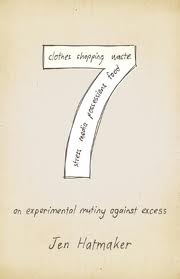
My weird book issues, however, actually helped me when I was reading Jen Hatmaker’s new book, 7:  An Experimental Mutiny Against Excess.  I have enjoyed reading Hatmaker’s blog for a few months, so I had a good idea of where she was coming from even before I picked up her book.  I knew, for example, that Hatmaker had recently adopted two children from Ethiopia to join her three other children and her husband; I knew that she was passionate about fair trade issues and ethical consumerism; I knew that she had already written several Bible studies; and I knew that she was very funny.  Thus, I thought I was fairly prepared to read her book on the need to cut out materialistic excess from our Christian lives.

The first two things that struck me about the book were initially liabilities in my mind.  First, she structures the book around a series of fairly radical fasts.  In an order to reorient her family’s spending habits, Hatmaker fasts from seven “excesses,” one per month.  Furthermore, she generally fasts by limiting herself to seven elements from that area of excess.  For example, the first month is food, and so the author eats only seven foods for that month.  The second month is clothes, and so she only wears seven articles of clothing for the whole month.  Honestly, this initially struck me as too much of a stunt.  I came to this book wanting practical applications and logical conclusions, and these fasts did not seem either practical or logical to implement in my own life.  Thankfully, my initial misgivings proved unfounded, however, as Hatmaker gave me lots of inspiration and practical tips throughout this book.  More on that in a minute.

The second thing I noticed was how casual the writing style was.  I even coined a word for it:  “blogular.”  I had expected Hatmaker’s book to be a cleaned up version of her blogs, but instead, it reads like a series of blogs put in book form.  It is even structured as a running journal, written in “real time,” as she goes through her fasts.  Each entry is about blog-sized.  Plus, when you thumb through the book, there is an alarming variety of fonts, not to mention italics, all caps, parentheses, and bullet lists.  Again, this initially disappointed me.  Like I said, I am a big fan of Hatmaker’s blog, but I was expecting this book to be a bit more…polished.  I guess I was wanting a manifesto of sorts, something I could hand to my skeptical friends and say, “Here.  This is what I believe about materialism and excess.”  Needless to say, a book formed around bloggy journals detailing crazy fasts does not really lend itself to tight coherency. It wasn’t something I could pass along to my not-quite-on-the-bandwagon friends without some explanation and caveats.

In retrospect, though, I think I was putting unnecessary and even unattainable expectations on the book.  When I put aside my preconceptions and just read the book for what it was, I really, really enjoyed it.  For one thing, Jen Hatmaker is hilarious, and her stories will have you laughing out loud.  For another thing, despite all the craziness of the book’s structure, when the author gets going, she can really be profound.  As I read, I posted some of her zingers on Facebook.  My favorite quote was this one:

“The average human gets around twenty-five thousand days on this earth, and most of us in the United States of America will get a few more. That’s it. This life is a breath. Heaven is coming fast, and we live in that thin space where faith and obedience have relevance. We have this one life to offer; there is no second chance, no plan B for the good news. We get one shot at living to expand the kingdom, fighting for justice. We’ll stand before Jesus once, and none of our luxuries will accompany us. We’ll have one moment to say, ‘This is how I lived.'”

It’s funny–when you read that quote out of context, it sounds so serious and profound.  You wouldn’t think that it came from a book with so many silly stories, a book that includes random emails from the author’s friends and status updates on Facebook.  I think that’s one thing I really liked about the book:  it can swivel from hilarious to convicting within a paragraph or two.  The humor definitely helps the “medicine” to go down.

Another element that makes the book powerful is Hatmaker’s tendency toward self-deprecation.  It is obvious that she is passionate about her beliefs, and with beliefs that are as “radical” as hers (though, should they be radical in the church??), it is easy to put other Christians on the defensive.  Nobody likes to feel preached at, and Hatmaker does a great job of staying off her high horse.  In fact, she is quick to poke fun at herself.  For example, she writes this about a speaking engagement she had during her “food” fast, where the pastor mentioned her “weird food requests”:

I knew it.

I won’t be remembered as the funny author or the fascinating Bible teacher but as the high maintenance girl who sent a list of culinary demands like I was Beyonce.  So I babbled uncontrollably trying to explain 7 (which I haven’t done yet in under eight minutes), hoping to resurrect my reputation as low maintenance.  I came across as a bizarre hippie who was a below average communicator.

There are many such self-deprecating moments in the book, and they serve to remind the reader that no one is trying to put them on a guilt trip.  In fact, even though Hatmaker calls into question many of our most basic practices as “wealthy people,” she affirms at the end, “I don’t think God wants you at war with yourself.”  The purpose of this book is not to make people feel guilty, but to motivate them, to excite them, to open their hearts and minds to the incredible reality of God’s kingdom.

At least, that’s what it did for me.  I said earlier that I got lots of practical motivation from 7.  For one thing, I retooled my grocery and eating out budgets to include more “real food” cooked at home and less eating out.  I finally tried several new “natural” recipes that I had been putting off.  Greg and I also rethought some financial decisions that we had been planning on making.  I am more generally mindful of all my purchases, thinking about my God-given responsibility as a steward of the resources He has given me.  I have even been setting the alarm on my phone to remind me to stop and pray throughout the day, like Hatmaker does in chapter seven.  The added prayer time, especially, has given my days more focus and kept me more “on mission,” as Hatmaker puts it.

Lastly, the book reminded me of the importance of community.  Throughout her fasts, Hatmaker relied heavily on a group of friends whom she dubbed, “The Council.”  The Council helped to guide her, to encourage her, to help her make decisions on her journey.  To me, they served as a stark reminder that we need each other to live this Kingdom life the right way.  Hatmaker (really, it’s been hard not to call her Jen this whole time) needed her Council just like I need my completely amazing friends to motivate, inspire, and guide me.  And to be honest, I need Jen Hatmaker.  And Francis Chan.  And David Platt.  And Shane Claiborne.  I need them to add their thoughts to the greater church conversation, and I need people with whom to discuss their thoughts.  Reading books about God and the church always reminds me that the body of Christ is called such for a reason.  We need each other to function, to even figure out where we are supposed to be going and what we are supposed to be doing.  I have enjoyed figuring that out with my friends, both here in Nashville and back in Summerville, and I look forward to many more conversations and “Council” meetings.

In that sense, Jen Hatmaker’s book was just another (great) addition to a conversation that has been going on in the church for a few years now.  Many Christians have begun to reexamine the most important tenets of Christianity in light of Jesus’ words on the kingdom of God.  They have begun to question their Christian identity and ask themselves what it really means to call oneself a follower of Christ.  If you have been asking such questions (and even if you haven’t), I think that you will find 7 to be a wonderful encouragement and motivation.  It’s just another example of the church trying to figure out these answers together.

“Step Away From the Computer”

I’m taking a little break from blogging this week.

I plan to resume my regular schedule next week.  See you then!

A Quick Prayer for the Church’s Children (and Their Parents)

But first, a brief story:

On Tuesday, I went with Luke’s class on a field trip to see a play.  Anna came, too, and we all sat and laughed as the silly animals onstage revolted against their silly farmer.  There was singing and dancing and plenty of comic relief.  It was great.  After the play was over and the house lights came up, Luke’s classmates, Darvon and Juan turned and looked at me, beaming.  I grinned and raised my eyebrows at them.  “Did you guys LOVE IT??”  I asked.  “Yeah!” was their enthusiastic reply.  Then, Luke and Anna started chatting with them about their favorite parts.  Much smiling and laughter ensued.

They chattered on while we waited for our bus to be called, and I leaned my head against the back of my seat while I waited.  “I hated that play,” said a voice behind me to his friend.  “Me, too!”  his buddy replied.  “It was so kiddish.”  “Yeah, I hated it, too,” said a third, “It was stupid.”  I glanced around and saw that the original speaker was an adorable blond headed boy talking to his friends.  His hair was long and swooped across his forehead like a little Abercrombie Kids model.  He and his friends wore the matching “field trip shirts” from a wealthier school in town.

“Please, God,” I silently prayed, “save my kids from that attitude.”

“Oh,” I added, “And thank you for Luke’s classmates.”

And now, a second quick story:

That same afternoon, I sat on my friends’ couch while our children played happily in the backyard.  She had told me on Sunday that she was praying for God to bring helpers to our church–our “little wisp of a church,” as I affectionately call it.  Just that day, two of her (Christian) friends called expressing interest.  One of hers approached the subject like this:  “My daughter is really starting to worry and frustrate me.  She feels so entitled all the time, and seems to honestly think the world revolves around her.  I’m not sure what to do…..So, tell me about your church.”  I laughed.  It’s no secret that our church will change your perspective on life and especially on materialism.  I understood her friend’s hope that maybe getting to know her lower-income neighbors would help her daughter reexamine the difference between wants and needs.

These two events rattled have rattled around in my heart and have finally coalesced into a silent prayer that my soul prayed all day yesterday:

God, please be with my children…our children…the children of your church here in the West.  Protect them from the self-absorption and greed that are such hallmarks of their culture.  Guard their souls from ingratitude and wastefulness–the wastefulness of their resources, their opportunities, their lives.  Show us as parents, Father, how to guide our children into your Kingdom.  Show us what it means to live in the world, but not of the world…because honestly, God, I’m not sure what that means half the time.  Show us how to spur our kids on to the radicalism to which you have called us all, without making them resentful toward it.  Show us how to challenge them without exasperating them.  But mostly, God, I pray you protect them from the evil one.  So often, I pray for their protection from the physical manifestations of evil.  Today, I pray for protection from the spiritual.  As scary as the physical can be, the spiritual dangers are so much more prevalent.  Protect them, God.  Protect us all.  Amen.

_______________________________________________________________________________________________________

What do you pray for your children?

Top Three on Tuesday

I’ve been toying with the idea of retooling some parts of my blog to bring them more in line with the overall theme.  For my “Top 3 on Tuesday” posts, that basically means changing the title to incorporate something about civics.  I’m picturing something that conveys 1) the Kingdom civics theme, 2) the fact that it is a collection of pertinent articles, and 3) that it is a weekly feature.  Any ideas?

While you chew on that, I’ll share my top 3 this week:

The Sane Ones, from Experimental Theology

The sanity of Eichmann is disturbing. We equate sanity with a sense of justice, with humaneness, with prudence, with the capacity to love and understand other people. We rely on the sane people of the world to preserve it from barbarism, madness, destruction. And now it begins to dawn on us that it is precisely the sane ones who are the most dangerous.

The bulk of this article (including the above excerpt) is quoted from Thomas Merton.  Some of it resonates with my thoughts on the human capacity for evil, and it also echoes some of my concerns about our tendency to always elevate the logical and dispassionate as morally superior.

Forgo, from Millions of Miles

I am among the 1-3% wealthiest persons of the world. Not because of my income, but simply because I have a bed and access to clean water. To realize I am just like the man to whom Christ spoke in Luke 6:24 is a horrible feeling.

When did retirement become one of life’s biggest goals? When did comfort become the deciding factor in all major decisions? What happened to living like foreigners in the land in which we live (1 Peter 2:11)?

The excerpt from this article is also a quote from a third source, and this time, that source is the creator of an app called Forgo.  I loved the idea behind the app, and even if I don’t end up personally using it (mainly b/c I want to choose my own charities), I was inspired to incorporate the premise into my own life.

A Ban on “Biblical,” from Internet Monk

I made a New Year’s resolution this year: I will try my best to avoid using the adjective “Biblical” to describe what I think “the Bible teaches.” The use of this word as a prescriptive adjective to promote positions and convictions is rampant among Christians. The problem is, it usually obscures more than it enlightens, hurts rather than helps, and stops discussion dead in its tracks rather than promoting good conversation.

Chaplain Mike goes on to list the necessary caveats, but on the whole, I totally agree with his point.  It’s funny because the verses we read in our Wednesday night class last week talked about the banning of oaths.  One of the comments I read on that passage was that people used oaths to claim that God was on their side and basically to stop the conversation.  It was a power play.  It seems sometimes that we do the same thing with the word, “biblical.”  After all, if you claim that your view is “biblical,” and someone disagrees, does that mean that he or she is un-biblical?  That seems to be what’s implied!

Did you read anything interesting this week?

The Futility of Spot Cleaning (and Why Ben Franklin was Wrong)

In my mind, there is no chore worse than spot cleaning my carpets.  The carpets in this house are especially light, and thus, they inevitably get various spots on them throughout the week.  These spots drive me crazy, but in order to maintain sanity, I limit my cleaning of them to once a week when I vacuum.  In the meantime, I content myself with thinking bad thoughts about them and giving them the “stink eye” whenever I pass.  That way, once vacuuming and spot cleaning day comes, I am usually more than ready to take them out.

Each week, there are inevitably one or two spots that drive me especially crazy, perhaps because of their location or their darkness.  I tend to fixate on those big spots; whenever I pass them, I think, “Oh, I can’t wait to get that spot out!”  A funny thing happens, though, on spot cleaning day.  I come marching up to my spotty enemy, armed with Spot Shot (very aptly named) and a clean, damp washcloth.  And then, I annihilate that spot, much to my own satisfaction.  I bask in the triumph, but only for a second…because now that the offending spot is eliminated, I see a smaller spot nearby, a spot that went unnoticed while Big Daddy was alive.  Hmph!  I promptly take out spot #2.  But oh no!  Now that #2 is gone,  a cluster of five smaller spots comes into focus, a little group that would have never bothered me while the others were there.  In fact, now that I’m down at carpet level, I see all kinds of spots, and–even more alarmingly–there appear to be several swaths of light gray that I have successfully ignored until now.  Confronted with this horror, I tend to then fly into a spot-killing frenzy, zapping and scrubbing spots until I finally give up and admit to myself that I need to borrow or rent a carpet cleaning machine.  And then I realize that will probably involve phone calls (ugh) and money changing hands, and it all seems too hard, and I never do it.

I repeat this process every week.  It sounds lovely, doesn’t it?

Honestly, I think part of the reason that this futile, spot-cleaning cycle comes so naturally to me is that for years, I tended to treat my sin the same way.  I would identify a particularly egregious sinful habit that was bothering me, and then I would launch a self-control campaign against it.  With focused effort and willpower, I was often moderately successful at eliminating this sin from my life–at least for awhile.  The only problem was that once that sin was removed (pushed to the back burner, really), I would notice another sin that needed attention.  And then another.  All manner of sins would come springing into view once I started focusing on my shortcomings, and after a season of sin-zapping, I would find myself exhausted and defeated.

In truth, my approach to sinfulness tended to mirror that of Benjamin Franklin.

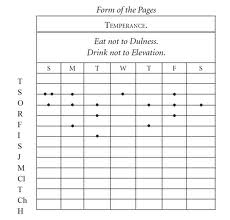
In his famed autobiography, Franklin recalls his attempt at achieving what he termed, “Moral Perfection.”  In order to reach this lofty goal, the young man created a list of thirteen virtues to cultivate:  Temperance, Silence, Order, Resolution, Frugality, Industry, Sincerity, Justice, Moderation, Cleanliness, Tranquility, Chastity, and Humility.  He then spent a week focusing on each virtue and recording his moral successes and failures with that virtue on a chart in a journal.  His plan was to perfect one virtue a week, which meant that after thirteen weeks, he would be…well…”morally perfect.”

Of course, Franklin freely admits that he was not perfect at the end of his project, although he does claim more success than I would have had, if my own track record is any indication.  And honestly, I tend to chuckle when I read of Franklin’s little experiment, and to think, “Yeah, right.”  Either he is being tongue-in-cheek in his autobiography, or he is deluding himself to think that this is a plan that would ever work.

The Bible portrays a different reality than is suggested by Franklin’s plan, and to be honest, the biblical reality is even more maddening to me.  In contrast to the “Protestant work ethic” so evident in Franklin’s little charts, the Bible tends to view us as ultimately passive recipients of transformation, which is effected by the Holy Spirit’s work within us.  Yes, both Jesus and Paul give much instruction regarding our actions in this life, but they also both acknowledge the futility of trying to achieve these things by ourselves.  Jesus says things like:

“I am the vine; you are the branches. If you remain in me and I in you, you will bear much fruit; apart from me you can do nothing” (John 15:5).

And Paul tells us to do such seemingly impossible things as “be transformed” and “be made new.”  Notice the passive tense there.  Clearly, Paul sees that another Force is at work to meet the standards that he sets in his letters.  That’s part of why I don’t see the Sermon on the Mount as a list of rules anymore.  While I view its fulfillment as the goal of my life, I have come to realize that only God’s Spirit, working within me, will ever meet that goal.

That’s why I honestly don’t take the “spot cleaning” approach to sin these days.  And I’m so over Ben Franklin’s charts and lists.  Maybe it sounds bad, but I really don’t have a mental list of “things I need to improve” that I keep with me at all times.  I’ve failed at that for too long, I guess.  I’ve given up.

Instead, I try to seek God with all my heart.  I figure that I’m nothing without Him, and so my only job is to make sure my wagon is firmly hitched to that Star.  Thus, when I get frustrated with myself and my daily failures, I don’t brainstorm ways to overcome them anymore.  Instead, I just say, “God, please help me!  I need your Spirit so much right now!  I’m screwing everything up!”  And then I just hope He comes through.

That passivity used to bother me.  I wanted to think of myself as a “self-made” person.  I have come to see, however, that that kind of thinking is delusional.  No one is self-made, and my own list of shortcomings is so long that I could never conquer it through willpower.  Instead, I have to surrender my efforts, my quest for moral perfection, to another Force entirely.  The funny thing is, I find that when I do turn my transformation over to God’s Spirit, I am much more effective in God’s Kingdom.  My acknowledgement of my dependence on Him makes me hunger and thirst for Him more, and I am finally able to see what David was talking about with that deer imagery.  Overall, it is a much more satisfying, peaceful existence.

At the very least, it sure beats that infuriating spot-cleaning!

On the spectrum from active to passive, how do you tend to see yourself in the process of attaining morality?

My Heart is Full and Satisfied

1.  We are having people over for dinner tomorrow.  It has been too long since we’ve had people over for dinner, and I’m really excited about it.  We are grilling out, and I’m making this apple dessert that I love.

2.  I had a list of people to talk to at church on Wednesday night.  I always had a “list of people to talk to” about various church projects while in South Carolina.  This was my first time to have that list in Tennessee.  For me, that means I’m starting to get plugged it, really plugged in to the church here.  It’s a good feeling.

3.  Also, I’m really excited about our church’s future.  There is just something in the air right now, and I can’t wait to see what happens.

4.  I only have a week of teaching left.  As much as I loved teaching, I cannot tell you how happy this makes me.

5.  I plan on spending my “teaching” time in May catching up on Project Life and working on some projects for church.  I can’t wait to get started on them.

6.  I feel incredible peace about homeschooling.  The more I think abot it, the more excited I get.

7.  My morning plans got canceled today, which allowed me to put a cleanin’ on the kitchen–and I mean, big time.  It was therapeutic.

8.  Then, Anna and I went to the zoo for a toddler class and a picnic lunch.  We had a blast, and she kept a smile on my face.

9.  The weather was beautiful today.  That has been a trend lately.  I am still not used to the beauty of Nashville in the spring.

10.  It was so beautiful that once we picked up Luke, we took him back to the zoo.  We went to see the new dinosaur exhibit, and the kids loved it.

11.  Then, we went to see the elephants, and they were eating hay and spraying themselves with water and dirt.  It was utterly fascinating.  I could have watched them all day.

12.  That night, when I asked Luke what his favorite part of the zoo was, he listed all the animals we saw instead of the Dinotrek, even though he insisted he loved the huge, robotic dinosaurs.  As he explained it, “It’s just that God made all those animals, and people made those dinosaurs.  I liked God’s stuff better.”

13.  I have an idea for my next “Citizenship 101” blog, and I”m excited to hash it out.

14.  We have been reading some really good library books recently, thanks to some online recommendations I’ve found.

15.  I thought of most of this list tonight while laying down with my adorable, four-year-old daughter, my arms wrapped around her and my face in her hair.  After a long while, I lifted my head up and gave her some kisses, which is the sign that I’m about to have to go.  SHe smiled and wrapped her two little arms tightly around my one, in order to get me to stay longer.  I obediently buried my face back in her air and stayed awhile longer.  I wish I could have stayed forever.

Kingdom Voices: Luke Timothy Johnson on the Sermon on the Mount

Last night was my first week “teaching” our women’s class at church.  We are currently inching our way through the Sermon on the Mount (coincidentally, we are doing the same thing in our Sunday morning class, which means this is my kind of church!).  Last night, we looked at the section on oaths.  It is kind of a strange section, so I came to class armed with Bonhoeffer and Willardwho both had some thought-provoking ideas about the passage.  I also looked up what Luke Timothy Johnson had to say about it in his book, The Writings of the New Testament.  While doing so, I found some cool thoughts on the “sermon” as a whole (he says that the term, “sermon,” is misleading).

Johnson views this collection of thoughts to be Jesus’ authoritative interpretation of the Torah.  He makes some really great points about the divine standard that is promoted in these chapters.  I encourage you to read these words and really ponder their depths:

The phrase ‘father in heaven’ runs throughout the sermon as the constant point of reference (5:16, 45, 48; 6: 1, 4, 6, 14-15, 18, 26, 32; 7:11, 21).  And if it is God’s effective rule that Jesus announces, then God is the only adequate measure of it:  ‘Be perfect as your Father in heaven is perfect’ (5:48).  The words of Jesus, therefore, do not present a program capable of human fulfillment, but a measure for all Christian existence.  A measure less ultimate than God would mean a kingdom less ultimate than God’s.  This is the essential framework for understanding the Messianic interpretation of Torah by Jesus” (201).

I love this idea of God’s holiness being the standard for the Sermon on the Mount.  Despite my best efforts, I tend to read the sermon as a list of rules, a “raising of the bar” on the Torah.  I read it and think, “Wow, that is a lot I have to do.  The Sermon on the Mount, however, is so much more profound than a list of rules.  It is a glimpse into what it means to be holy–what it means to be like God, quite frankly.  Johnson’s words here put me in awe of my calling as a member of God’s kingdom.

A few paragraphs later, he goes on to discuss Matthew 5:20, where Jesus says that “unless your righteousness surpasses that of the Pharisees and the teachers of the law, you will certainly not enter the kingdom of heaven.”  Regarding Jesus’ words here, Johnson asks:

But how do Jesus’ teachings exceed those of the Pharisees?  Certainly not in the multiplication of commands, for we are here presented with only a suggestive sample.  The exceeding is to be found in the radical nature of Jesus’ interpreation:  radical in the sense of getting to the root.  Jesus’ interpretations assert God himself as the only adequate and ultimate norm of the kingdom” (201).

That idea of the Sermon on the Mount simply being a “suggestive sample” is intriguing to me.  Even though I’ve always known that Jesus does not address the entirety of the Torah in this sermon, I have always tended to view it as a complete code of ethics.  I am intrigued by the idea that Jesus is just giving us a little sampling of how to interpret  what God really wants from us.  And again, I like how Johnson reasserts that God is “the only adequate and ultimate norm of the kingdom.”  I have grappled with the meaning of the Sermon on the Mount before, and Johnson’s interpretation helps confirm my suspicions that it is so much more than an updated version of “the rules.”

Finally, Johnson gives a helpful breakdown of the alterations Jesus makes to the traditional understanding of Torah:

How does the Messiah interpret Torah?  He radicalizes it in three ways.  In the case of murder and adultery (5:21-30), he demands an interior disposition corresponding to outer action.  For the prohibitions of swearing and divorce (5:31-37), he demands an absolute adherence rather than a mitigating casuistry (though cf. 19:9).  In matters of human relationships (5:38-47), he demands a response that goes beyond the letter of the commandment.  These antitheses serve to assert Jesus’ authority to interpret for the kingdom (201).

It might be my love for classification that makes me enjoy this last passage so much, but I appreciate how Johnson analyzes Jesus’ interaction with Torah here.  His analysis helped spur on my own thinking about the way that Jesus reinterprets the Law.

All in all, I really enjoyed these thoughts.  Part of why I’m putting them on the blog is that when I found them, they were highlighted and starred from when I read them years ago.  Needless to say, I had totally forgotten them.  I don’t want to let them get away again!

What do you think about Johnson’s analysis?  Do you have any “push back” to his thoughts?