Five-Minute Book Review: Everyday Justice

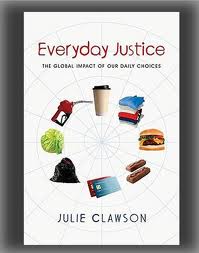
Book:  Everyday Justice

Author:  Julie Clawson

Date Published:  2009

What’s in it:  The book presents an informed, practical case for ethical consumerism.  After an introduction which encourages you not to panic and inspires you to take concrete action, Clawson organizes her book into seven chapters, each of which discusses an area of spending:  coffee, chocolate, cars, food, clothes, waste, and debt.  I’m going to be honest:  I mainly read the sections on coffee, chocolate, and clothes, because that’s where I am in my journey (and I’m just starting to think about clothes).

Why I recommend it:  If you are even marginally interested in ethical spending, this book provides a great, non-overwhelming introduction to the issues.  The book’s format lets you skip to whatever area interests you, and the chapters are fairly short (around 20 pages each).  In those pages, Clawson delivers lots of information through a casual, readable style.  I particularly love the depth at which she looks at Scripture.  My favorite part, however, is that each chapter ends with resources for further study.  It is through this book that I found the three others I am currently reading.

Any drawbacks?  This book functions well as an introduction to the issues, but I (and most certainly the author herself) would recommend further study.  After all, twenty pages per chapter is not much when you include, as Clawson does, personal stories, little anecdotes, global history, Scripture analysis, and action steps.  Still, this book is a great place to start informing yourself about slavery issues and ethical consumerism.

Favorite quotes:

“All too often I find that conversations that involve changing our lifestyles result in us feeling overwhelmed at the sheer immensity of the problem.  There is too much hurt out there, too much that needs to change, and too much to tackle all at once.  From just becoming aware of the needs in the world, to realizing that our lifestyle choices make a difference, to understanding how our faith informs how we approach justice issues, we can feel shaken to the core.

Encountering new ideas and allowing those ideas to change who we are is a huge step for most of us.  Too often we live compartmentalized lives that don’t allow for the different spheres of our existence to interact.  Church is separate from shopping.  Our morning latte doesn’t connect with our volunteer work…Our waste disposal habits are removed from our politics.  They each exist separately and apart in our hectic lives.

But encountering justice issues changes all that.  Our lives are no longer just a series of unrelated tasks and errands with the occasional leisure activity thrown in when there’s time.  Our lives are part of a bigger picture.  Our local, everyday choices reverberate around the world.  And at the center, pushing and informing all of those choices, is our faith.”  (From the “Warning” at the beginning of the book)

“I don’t doubt that nearly all of us morally oppose forcing children into slavery.  We may feel tricked into unknowingly participating in oppression just because we like to eat chocolate, but the problems continue because most people…are unaware that they exist at all.  We are, in a sense, victims of a system that causes us to be victimizers.  No parent would request the kidnapping, beating, and starving of other children so that they could serve chocolate cupcakes at their child’s birthday party, but nonetheless, this is essentially what happens.” (From p. 57)

I found my copy of this book at my local library.  It’s currently available at half.com for less than $5.  In fact, if you are interested in reading it, but can’t afford it, send me your address, and I will order one for you!

Kingdom Voices: Christopher Friedrich Blumhardt

My wonderful Advent devotional begins each year on November 24.  This is my third year reading through it, and it’s funny to see how the ideas from the devotions have seeped into my brain.  I guess that’s why these words from Blumhardt resonated with me so deeply this year.  Part of it is that I am neck deep in reading about the phenomenon of global slavery today.  Reading so much about the darkness of the world and desiring to do something to change it adds weight to the following words.  I highlighted my favorite parts:

“As long as God’s kingdom has to be fought for, it is more important to be dressed for work–ready for action--to make an effort to do something in keeping with God’s plan, often against the whole weight of the world.    A practical way exists, and we must be ready for this with our whole being.

‘But,’ someone may ask, ‘What sort of thing, exactly, are we to do?  What will truly serve God and his coming reign?‘  This is a serious question; no human being can answer it.  We have to learn to live in what is coming from God every day and to carry a light from this awareness into the darkness

Anyone whose attention is fixed on the coming reign of God and who wants to see a change brought about in God’s house will become more and more aware that there exists a universal wrongness that is pulled over us like a choking, suffocating blanket.He will know that the thing to do is to take hold of God’s hand so that there is some effect on this night, so that at least a few areas are made receptive to God’s truth and justice and are made ready to receive God himself.  But to do this work we have to have a light.  With this light we can then illuminate every corner where we have some work to do…

Let us keep staunch our eagerness to do whatever comes to us of the truth.  Then there will be knocks on our door, over and over, and God’s coming will not be hidden.  For devoted hearts the light will keep dawning from him who is merciful and compassionate.

The work for God goes on quite simply in this way; one does not always have to wait for something out of the ordinary.  The all-important thing is to keep your eyes on what comes from God and to make way for it to come into being here on the earth.  If you always try to be heavenly and spiritually minded, you won’t understand the everyday work God has for you to do.  But if you embrace what is to come from God, if you live for Christ’s coming in practical life, you will learn that divine things can be experienced here and now…”*

I don’t think I could read about the darkness in the world if I didn’t have hope in God.  Because of my faith in Him, I have hope that there is something for me to do on this earth, something that can bring light and make a difference to others.  And I know that to do that, I have to always look to Him and follow His guidance.  The problems are too big for me to solve, so clearly, solving them is not my job.  My job is to obey the nudges of the Holy Spirit and to spread love and light to the places the Spirit shows me.   I think I can manage that.

*quote taken from:

Blumhardt, Christopher Friedrich.  “Action in Waiting.”  Watch for the Light:  Readings for Advent and Christmas.  Farmington, PA:  Plough Publishing House, 2001.

Getting Educated

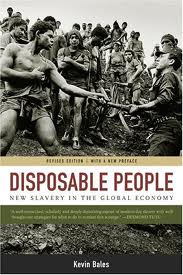
After a year of trying to take small steps to be a more ethical, Kingdom-minded consumer, I have that fire in my bones again, and I’m taking steps to further educate myself on a few issues.  Here are the books I’ve either checked out from the library or have ordered on half.com.

There is a 100% chance you will be hearing about these issues here in the future.

Consider yourself warned:).

Thankful

I don’t know what it is this year, but I am looking forward to Thanksgiving so much.  In anticipation, I checked out tons of books about Thanksgiving from the library, and the kids and I have spent the last couple of bedtimes reading all about this wonderful holiday.  I have also enjoyed seeing people list what they are thankful for on Facebook.  I have thought about doing that myself, but I quickly discovered that I am too verbose for Facebook’s status updates.  Also, I can’t narrow it down to one thing a day.  Seriously, I started thinking about all the things that I’ve been thankful for in November so far, and I came up with the following list.  All of these pictures and all of these thoughts occurred within the last three days:

1.  I am thankful for how well my children get along.  A few weeks ago, a friend asked me if my children are close.  Now, of course, they do squabble with each other, but the answer to her question is, yes, they are close.  Sometimes even weirdly so.

For example, here they are wearing matching outfits.  This was ALL their idea.  I tried to dissuade them from it, but they would not be moved.

And here they are sharing my jacket in Kroger, because, according to them, it was “FREEZING.”

2.  I’m thankful for wonderful parents, who always love, support, and encourage me:

It means so much to me when my mom tells me I’m a good mom.  I guess it’s because she is the best mom I know, and so her I value her opinion on the matter.

3.  I’m thankful for all the good movies that are out.  I love watching movies, and yet, so often, there are not any movies worth seeing.  Right now, my list of “must see’s” is quite long:  Argo, Lincoln, Skyfall, Flight, Wreck-it Ralph, The Hobbit.  WOW.  That has got to be a record!  I’m not sure when and if I will get to see them all, but I am thankful to have that fun to look forward to.

4.  And I’m thankful for a husband who, for some odd reason, seems absolutely smitten with me:

5.  I am giddily thankful for the fact that the NASHVILLE PUBLIC LIBRARY HAS A MOBILE APP!  And yes, that proclamation is worthy of all caps.  Seriously, for months–months, people!–I have been bemoaning the fact that our otherwise wonderful and exemplary library system has no mobile app.  As I look up books, put in requests, and renew books almost daily–if not multiple times a day–I have longed for a way to do these things easily on my phone.  I have searched the app store for such an app, just knowing that it had to exist.  Not finding it, I have complained to several of my friends about the library’s tragic oversight in this area.  But this morning, I made an amazing discovery, via the Nashville library website:  they do have an app.  In fact, they have probably had it for awhile, and I just didn’t notice.  And if possible, it is even more wonderful than my mental daydreams of it.  I kid you not, when I found out this wonderful information, I squealed, did a little happy dance, and ran and told Greg.  This is a game changer, guys.  Game. changer.

6.  I’m thankful for Nashville’s autumns.  After spending most my life in the deep(er) South, the phenomenon of leaves that change color and fall off the trees continues to blow my mind daily.

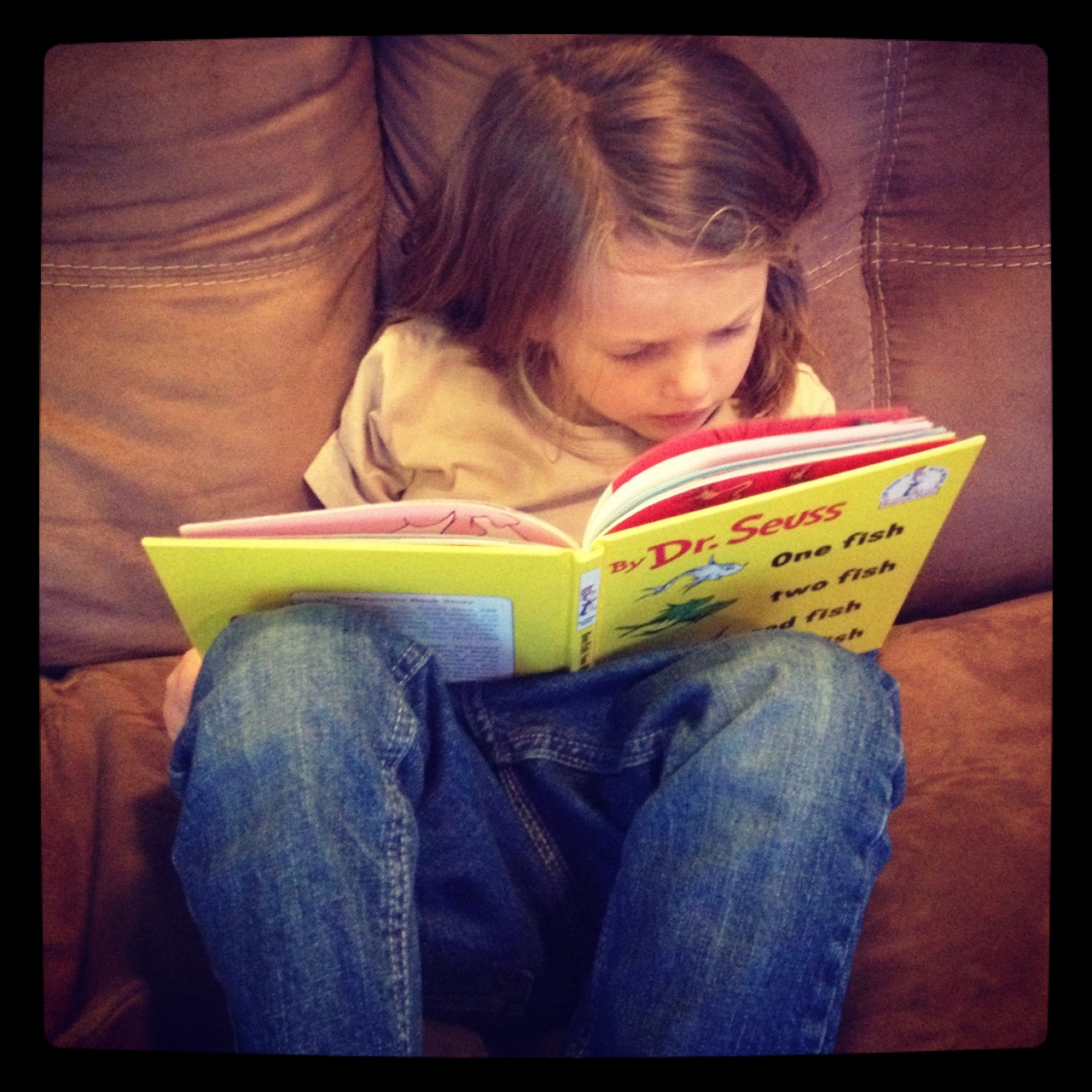
7.  I’m thankful I get to watch my children learn.

8.  I am thankful for our wood-burning fireplace in our kitchen.  And I am thankful for woods behind our house.  And I am thankful for a husband who cuts wood and starts a fire, without fail, at the request of any family member.

9.  Speaking of my husband, I am so thankful for what a wonderful man he is.  I was just thinking the other day of all the things he does around the house, big and little, and I came up with this list:  makes and tends fires in the fireplace and outside fire pit; fixes anything that is broken, and if he can’t, arranges for a professional to come; takes care of our budget and finances; does all outside yardwork; washes the cars; handles the thermostat (seriously, until I thought of this list and asked him, I did not know where the thermostat was); takes out the trash and brings it in (no small feat with our massive hill of a driveway); handles any and all computer malfunctions; figures out how any given item in our house works and then explains it to the rest of us (the latest example is our telescope); helps out with science experiments for homeschool (mine is more of a “humanities-leaning” mind); makes sure all the doors are locked at night; introduces me to new music, and keeps me updated on general current events (basically, I live happily under a rock, and Greg is my connection to the larger world); and I’m sure there’s more.

10.  I’m thankful that November 1 marked one amazing year in Nashville.

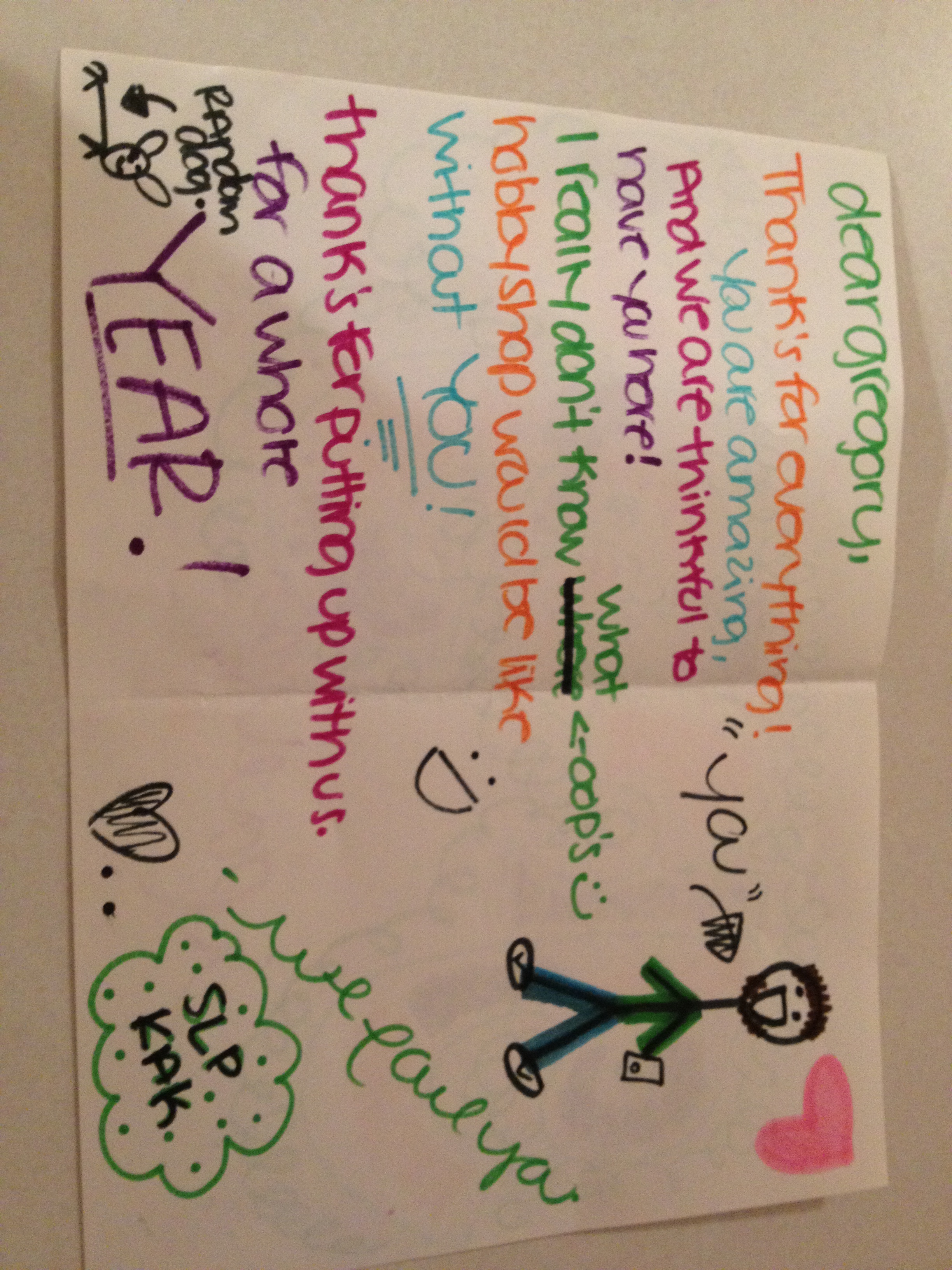
This little note was waiting in Greg’s car the other day.  It was from two of his teens.  He absolutely loves his job, and it makes me happy to see him so happy.  He gets to see his teens everyday at the after school program, and he tutors them daily, goes to their school and sports events, and takes them on all sorts of fun trips.  Several of them have referred to them a second (or a first) father to them, and it is clear that he plays that role in many of their lives.  My favorite comment came when he was taking two teens, a brother and a sister, home one night, they passed a Greek Orthodox church, and the sister inquired about the meaning of “Greek Orthodox.”  It was a simple question, but when Greg explained, the boy asked in outright amazement, “How do you know so much??  Wow…it should be illegal for one person to know that much stuff.”  I remember feeling the exact same way about my own dad, and I smile every time I think about that comment.

I also smile when he relates so-and-so’s progress on her 6, 7, and 8 times tables, knowing that Greg has promised her Tacquis if she memorizes all of them.  Or when he tells me about how he is mentoring an incarcerated young man as part of a local Christian program to rehabilitate prisoners.  I am so incredibly thankful that my husband is doing work that both fulfills him personally and helps to spread God’s kingdom.  I’m so thankful to be able to support that work as his wife.

11.  I’m thankful that we get an extra hour of sleep tonight!

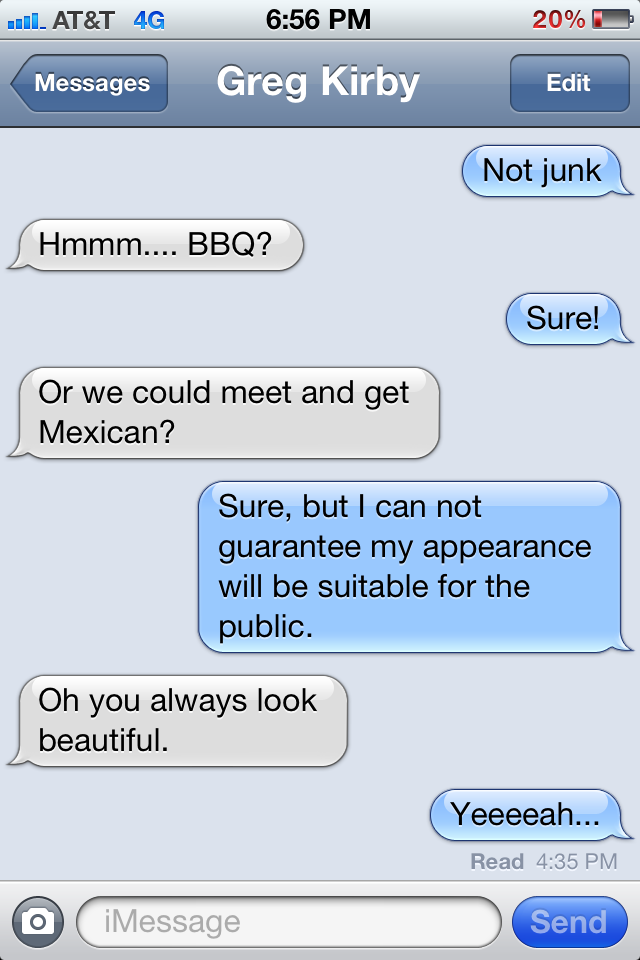
So do you see what I’m saying about the Facebook thing?

What are you thankful for?

My Peace with Pinterest

“Woman was not made for Pinterest, but Pinterest for woman.”–Kim Kirby

I tend to be protective of my mental health.  My protectiveness stems from the fact that I view the human mind as quite fragile, which means it should not be subjected to pointless stress and strain.

It is that conviction that kept me away from Pinterest until last month.

When I first heard about Pinterest, I didn’t really understand what it was all about, but I signed up anyway, vaguely thinking that it might be a good way to keep up with the blogs I like to read.  Which, of course, makes me the only person on the internet who responded to the idea of Pinterest with, “Hmmm…that sounds interesting.  I’d like to use it to organize my reading material.”

Clearly, I didn’t get it.  And just as clearly, I’m not a crafty person.  The idea of using Pinterest as a repository of creative ideas held no allure to me.

When I first started a Pinterest account, back in those early days, I immediately became 1) disillusioned with Pinterest’s usefulness as an online blog organizer, and 2) freaked out by the fact that several of my Facebook friends started following me on Pinterest.  Those stalkers!  At the time, I didn’t even know how they knew I was on Pinterest!  Paranoid, I promptly deleted my account.

By the time I actually understood what Pinterest was, I was even more disinterested in using it.  However, last month, my bff convinced me that as a homeschool mom, it was criminal–criminal!–to not be on Pinterest.  She convinced me that the site would be an invaluable resource to my children’s education.  And since I was already haunted by the prospect of my artsy daughter condemned to a life of educational drudgery at the hands of the most uncreative teacher ever, I capitulated and signed up.  Again.

And guess what?  My friend was right!  Pinterest has helped my family a lot!

But.

But I believe the reason that Pinterest has proven valuable in my life is because I cling to three simple mantras in my Pinterest use:

1.  Pinterest should not make me feel bad.

I know that sounds lame, but it is one of the main reasons I hesitated to sign up for Pinterest.  I really try not to judge myself too harshly or compare myself to others, but I worried–and not without reason–that the sight of all that wonderful creativity would just depress me.  Instead of inspiring me, it would just remind me of my own artistic failings.  And again, I know that sounds lame, but I have had to stop reading blogs before for similar reasons.  Here’s how it would go down: I would start reading a blog by a wonderful Christian mom who was always doing creative crafts with her ever-smiling children in her beautifully decorated house filled with only organic food.  And then instead of coming away inspired or even–I don’t know–happy for her, I would instead dwell on my own disheveled, chemical-filled, art-free home and feel like a massive failure.

Which is stupid.  Let’s just acknowledge that.  Other adjectives that come to mind are petty, insecure, jealous, selfish…I could go on, but I think you get the picture.  These feelings do not bring me closer to the Lord.

However, they are what they are, and when I get in those situations, I just have to mentally tell myself, “I am so happy for that blogger and hope that her life is every bit as wonderful as her blog makes it seem…but I just don’t need to read about it ever again.”  And then I move on with my life.

At this point, Pinterest has not made me feel bad, and I think a big reason is that I limit my exposure to it.  That brings me to mantra #2:

2.  Pinterest should not waste my time.

I have enough time-wasters in my life (I’m looking at you, Facebook), and heaven knows I do not need one more.  As a Christian, I am convicted by the fact that my life is a gift from God to be used to build up His kingdom.  Thus, anything that wastes my time wastes that gift.

Thankfully, Pinterest has not done that so far.  When I need an idea, I search for it.  When I don’t, I stay off Pinterest.  Seems simple enough.  I think it helps that I’m not naturally crafty and so am not tempted to look for ideas for their own sake.

3.  Pinterest should make my life easier.

This is a big one.  Sometimes, I see the lengths that people go to fulfill some Pinterest inspiration and I think, “That person’s life would have been so much easier if she had never seen that on Pinterest.”  I thank the Lord that I got married before Pinterest, because the pressure to create “Pinterest-perfect” weddings seems enormous these days.  Some people love all that stuff, and again, I’m happy for them (really!), but to me, all that wedding planning sounds like torture.  (Full disclosure:  I barely planned my own wedding, much to my mom’s delight.  She would call me periodically to tell me what kind of flowers she had picked for me or what photographer she got, and I tried politely to feign interest, all the while grateful that she was handling it and letting me finish my last semester at school.)

My point is that I think that Pinterest can make life more complicated, whereas my goal is to make it more simple.  Thus, I only pin things that are really, incredibly, extremely easy to make.  I know that I can’t handle much Pinteresty brilliance, and that my life is complicated enough without having to figure out what “modge-podge” is.  (Actually, I do have something pinned now that calls for modge-podge, and, though it seems very, very simple, it still makes me shudder just a little bit.)

But let me give you an example of how Pinterest made my life easier today.

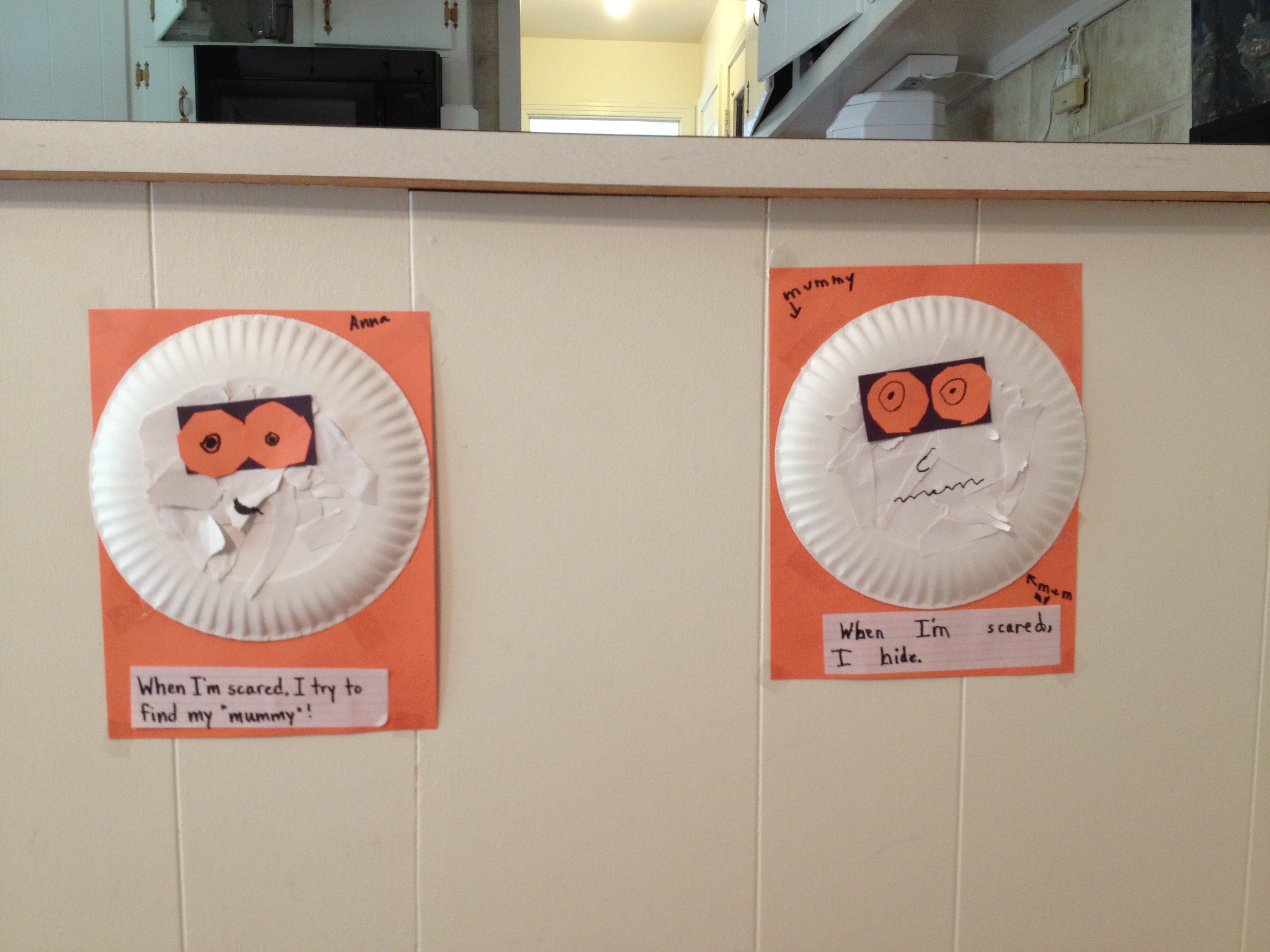
I had been feeling bad about my kids not doing any “fall” crafts, and so I found this super easy one on Pinterest.  It was inspired by a book about mummies that was available at my library, and the required materials were construction paper and paper plates.  We did it this morning, and the kids thought I was soooo crafty.  (It’s important to set a low bar.)

We finished up the morning with Language Arts and Math.  Math was a struggle, and afterwards, I desperately needed a sanity-saving break, so I kicked the kids outside to enjoy the beautiful fall day while I straightened the kitchen and caught up on one of my friend’s blogs.  Coincidentally, she talked about making homemade sidewalk paint from Pinterest, which I read at the same moment my son was leaning against the window mouthing to me that he was bored.  Sidewalk paint takes corn starch, water, and food coloring.

Done.

That bought me enough time to make lunch.

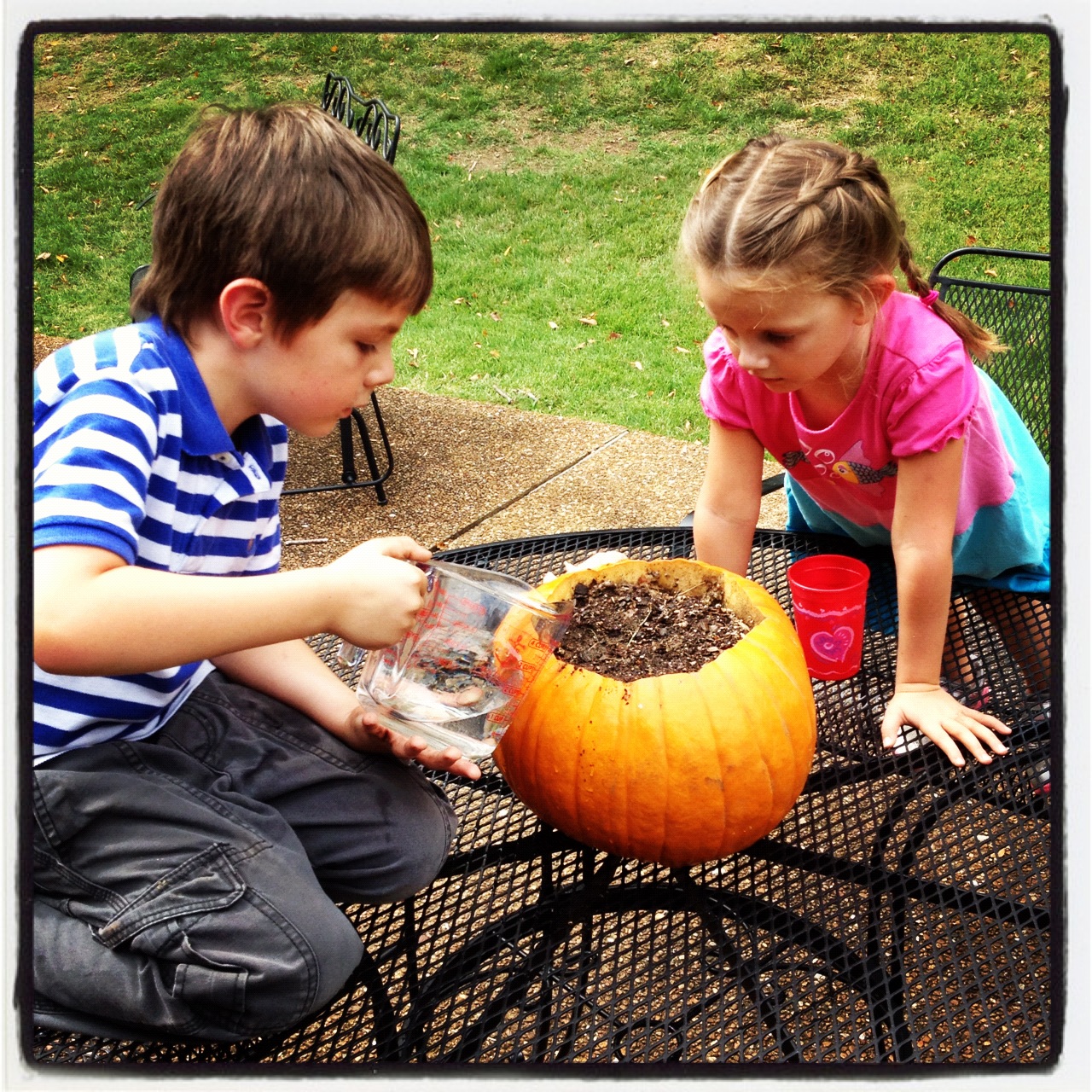
Then, after lunch, the kids asked if we could do yet another Pinterest-project that consisted of converting a pumpkin into a planter.  Here’s how you do it:

1.  Cut the top off a pumpkin.

2.  Walk inside and do whatever you want while your children spend twenty minutes filling it with dirt and watering it.

Here’s hoping those pumpkin seeds will grow.  And even if they don’t, these three incredibly simple projects made me feel like Mom of the Year and Martha Stewart all in one.  And combined, they took about fifteen minutes of my time.

That’s what I’m talking about when I say Pinterest should make your life easier.

And I hope that if Pinterest ever stops making my life easier, that I will (again) delete my account.  The way I figure it, life has too many natural struggles and stresses for a website to add to them.  For some crafty people, Pinterest might be unmitigated awesomeness.  For my non-crafty self, it is a little more of a challenge to make sure that it benefits the lives of my family and does not detract from them.

Do you use Pinterest?  Have you noticed any pitfalls?  Or do you just love it??

Defending God

Last week, I read the novel, Life of Pi, by Yann Martel.  If you have read it before, I’d love to hear your take on it.  For me (and I can’t believe I’m saying this), it was a little too postmodern.  What I got from the book was that one should choose to follow a religion, not because that religion is rooted in any objective truth, but because it is a “better story” than the brutal, senseless reality of life.

Cheery, huh?

However, despite that bleak, existential message, I did find some interesting ideas in the book, including this gem:

“There are always those who take it upon themselves to defend God, as if Ultimate Reality, as if the sustaining frame of existence, were something weak and helpless. These people walk by a widow deformed by leprosy begging for a few paise, walk by children dressed in rags living in the street, and they think, ‘Business as usual.’ But if they perceive a slight against God, it is a different story. Their faces go red, their chests heave mightily, they sputter angry words. The degree of their indignation is astonishing. Their resolve is frightening.

These people fail to realize that it is on the inside that God must be defended, not on the outside. They should direct their anger at themselves. For evil in the open is but evil from within that has been let out. The main battlefield for good is not the open ground of the public arena but the small clearing of each heart. Meanwhile, the lot of widows and homeless children is very hard, and it is to their defense, not God’s, that the self-righteous should rush.”

Preach on, Yann Martel.  I may not agree with you about the nature of objective truth, but I’m totally with you on this.

So…have you read Life of Pi?  What did you think about it?

Full.

That’s the best way I can describe my life of late:  full.

And by full, I don’t mean busy.  Not at all.  In fact, I wish I could properly convey how I despise the frantic pace, the unceasing rush, the gnawing stress of busyness.

That’s not what I mean by full.

Throughout the hot July, our lives were full of family and friends.  We spent the 4th with my parents, and life was full of delicious food and luxurious, heavenly time with “Gaga and Granddad” and with dear friends-who-might-as-well-be-family.  The next week, some of our cherished friends from South Carolina came and stayed all week, and life was full of long hours of “catch-up conversations,” daily adventures around Nashville, and the occasional “Mommy break,” which mainly consisted of eating and talking some more.  The very day they left, the kids and I went on our own road trip, and that next week, life was full of the joy of an old friend’s wedding and awe over the Smoky Mountains and the beautiful Virginia countryside.  It was also full of the excitement of arriving in our nation’s capital and seeing our cousins.  It was then crammed full of all sorts of amazing sights:  a giant, towering obelisk; magnificent, imposing memorials; and museums packed with the memorabilia of a mighty nation.  There was also a trip to Baltimore that was full of water and war ships, full of picnics and coffee breaks at Barnes and Noble.  There were nights that were full of young cousins giggling and playing.  The whole week was just…full.

Then, we came home, started homeschooling, and started the fall program at our church.  And life is now full in a different way.  In the last month of summer, it was full of joy.  Now, it is full of purpose.  It is full of the things-I-was-made-to-do.  

Here’s what I’ve realized about myself:  I can’t be truly happy unless I am doing the things-I-was-made-to-do.  I can’t really explain the difference between a thing-I-was-made-to-do, and a thing I just enjoy doing, except in terms of the difference in fulfillment.  When I am doing the things-I-was-made-to-do, it’s like I am complete.  Whole.  Perfectly satisfied.

Writing is a thing-I-was-made-to-do, which is why I started this blog.  I was made to think and to mull over ideas, and then to express my thoughts about them in writing.  I just was.  And it gives me a profound sense of meaning to do so…even on this tiny blog!

Isn’t that funny?  My contentment of soul does not require that I get paid for the things-I-was-made-to-do, or that they be “big.”  I just have to do them.  And I will be full.

But in this last month, the one after our wonderful travels, I have been caught up in other things-I-was-made-to-do.  See, I enjoy teaching college, I really do.  But I was made to teach my kids.  I’m not claiming that all parents are or that everyone should homeschool. I ‘m just saying that the profound sense of meaning and purpose–and yes, joy–that I get from teaching my own children shows me that I am doing exactly what I’m supposed to be doing.

Because of our homeschooling schedule, I have also had more time to volunteer at our church and its co-laboring after-school program.  These past few weeks, I have been up to my ears in curriculum:  our homeschooling curriculum, the church’s Sunday school and Wednesday night curriculum, and also educational materials for the after school tutoring program.  I have organized materials, taken classroom inventories, purchased tutoring manipulatives, met with teachers, toured other educational programs, and tried to teach first graders (my own, and the kids at the after school program) how to add and subtract fluently.

And every moment of it has filled my soul to the brim.  Like writing, these are the things I was made to do.

I am very full right now.

And so ridiculously happy.

And oddly, that’s why I haven’t really been writing in this little spot.  My heart and my mind are so full and satisfied with the current “work of my hands” that I don’t have that aching need to find meaning in the keys of the keyboard.  That need was so real last winter and spring, when our lives were transitioning, when I was still trying to find my place in my new world.

I do still want to write here, and I plan to continue.  I always want this space to be here because I have found that my need to write comes in seasons.  It ebbs away, only to spurt abruptly back to life a few months down the road.  It is also nice to have an organized repository for all my spiritual thoughts and theories…and to see how they evolve and shift!

So if you are still reading, I want you to know two things.  One, I love talking to you in the comments and bouncing our thoughts off each other.  Writing organizes my thoughts; discussing them with others refines and purifies them.  And two, I (clearly) can’t guarantee the regularity with which I will write.  In the past, I have felt the need to be a “regular poster.”  I have no idea why.  It’s not like I was trying to be some kind of big time blogger  (in fact, whenever I read the comments on bigger blogs, I inevitably end up cringing and thanking God that I don’t have to deal with so many hostile strangers!).  I guess part of me was so thankful for your feedback that I wanted to offer you my own consistency as a writer.  Forced consistency, however, just leads to dry, forced thoughts.  I now think it would be better simply to write when I have something to say.

So…that’s my “catch-up post.”  I can’t really imagine anyone still reading and checking in, but if you are, I hope that all is well with you, and that you are tasting some of this magnificent fullness in your own life.

Speaking of which,

What makes you full?  What are your things-that-you-were-made-to-do?

O Canada

Today, I’m happy to share another guest post by Tim Fall.  I always appreciate his willingness to share his thoughts!

_______________________________________________________________________________________________________

I have a romantic idealism about our neighbors to the north, but I really like Canada. It could be our family camping trips there when I was a kid – yeah I’ve been to Penticton, folks – the cool Maple Leaf flag, all those Dudley Do-Right cartoons I watched, or this guy’s impressive spoken-word performance at the Vancouver 2010 Olympic Winter Games opening ceremonies. Whatever it is, I’m hooked.

Originally I planned to use this great winter headwear as further proof that Canada is all kinds of awesome. (You know you want one). But here’s something even more impressive, although it’s the coach and not the hockey league authorities that deserve our admiration. A team of 18-20 year olds wanted to play in a hockey tournament but the timing was bad, coinciding with exams at school. So the players told the coach they couldn’t go unless the trip included study time. The coach agreed and notified the league that the players would miss the opening and closing ceremonies because they had to study. After the tournament finished, the league told the coach he made the wrong choice (all players had to be present at all functions according to the tournament manual) and banned him from coaching for a full year. Then it fined him $2000. He’s a volunteer coach. $2000 and a year in exile for making a choice that he informed them about ahead of time. Thanks for all your hard work, Coach; no we couldn’t have told you beforehand that the players weren’t allowed to skip the ceremonies.

From what little we can see of the coach in that article, I would bet he’d make the same choice if given the opportunity again. This is a coach who puts his players first, who answers to a higher sense of sportsmanship than that shown by the league.

This is a coach who reminds me of Peter and John.

In Acts 3 John and Peter performed a miracle, healing a man who had not walked in years. The amazed crowd asked how this happened and peter answered with a phenomenal sermon on the Good News of Jesus Christ. The authorities were not pleased.

The priests and the captain of the temple guard and the Sadducees came up to Peter and John while they were speaking to the people. They were greatly disturbed because the apostles were teaching the people, proclaiming in Jesus the resurrection of the dead. They seized Peter and John and, because it was evening, they put them in jail until the next day. (Acts 4:1-3.)

The next morning there was a trial of sorts, but it didn’t go as planned:

Then they called them in again and commanded them not to speak or teach at all in the name of Jesus. But Peter and John replied, “Which is right in God’s eyes: to listen to you, or to him? You be the judges! As for us, we cannot help speaking about what we have seen and heard.”

After further threats they let them go. They could not decide how to punish them, because all the people were praising God for what had happened. For the man who was miraculously healed was over forty years old. (Acts 4:18-22.)

Doing what’s right because it’s right. Not following orders, because those orders violate a higher principle. Taking your lumps for doing so (like going to jail), because you know you that ultimately you answer to God and not people. (Psalm 56:4; Joshua 22:22; Luke 16:15.)

Where have you seen this lately?

Would you do the same?

[Biography: Tim is a California native who changed his major three times, colleges four times, and took six years to get a Bachelor’s degree in a subject he’s never been called on to use professionally. Married for over 24 years with two kids (one in college and one just graduated, woo-hoo!) his family is constant evidence of God’s abundant blessings in his life. He and his wife live in Northern California. Tim guest posts on other peoples’ blogs, but is too lazy to get a blog of his own.]

“What is the point of all that Bible reading if you can’t even love your neighbor?”

In 2010, I set out on a quest to read the whole Bible in a year and to blog about my reading every day.  The first few weeks were more than a little daunting and overwhelming, and it was only by God’s grace that I pressed on past January.  As unsuited to the task as I felt,  however, and as overwhelmed as I often was by my own ignorance, there was also a part of me that–let’s be honest–was ever so proud of the fact that I was reading and blogging through the Bible.  My whole life, I have heard of the importance of daily Bible reading and disciplined time with God, and there was a definitely a part of me that was tickled pink at the fact that I was now averaging an hour a day at Bible reading and reflection.  This was the spiritual “big leagues,” in my mind.  This was monk stuff.  A bid for sainthood even!

I know that’s obnoxious.  I know it now, and I knew it then.  But you know how thoughts are.  They just come to you, and you’re like, “That’s so bad.”

but you still thought it.  And I found those little prideful reflections seeping in fairly regularly in my first few weeks of reading and blogging.
Source: charethcutestory on tumblr.com

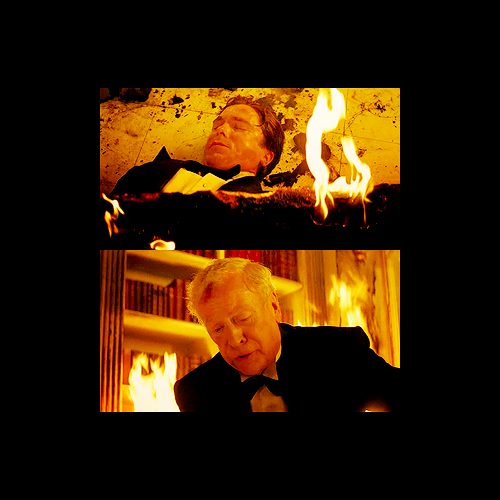
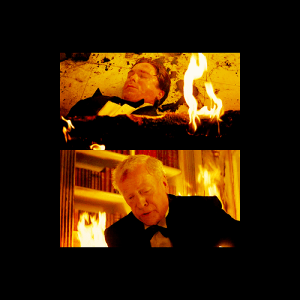
For all I know, I might have gone on like that, awash in my own sense of self-importance, were it not for another thought that came, unbidden, one chilly afternoon.  I had been having a normal day with the run-of-the-mill frustrations, and some situation was annoying me, gnawing at my mind.  I honestly cannot remember what it was, but I remember that I was unduly frustrated with some person–maybe even one of my children.  And I was having a hard time reacting in a Christ-like manner.  As I was stuck in this common, human moment, my brain asked me a question.  It echoed a scene from Batman Begins, in which Alfred  chastises/motivates  Bruce Wayne when he is in a tough spot.  Wayne manor is burning down around him, and the bad guy is getting away, on his way to do some dastardly deed.  In the meantime, Bruce Wayne is pinned helplessly beneath a beam from his crumbling manor, unable to get free.  Alfred comes running and tries to help, but he, too, is no match for the heavy wood.  Frustrated, he asks Wayne, “What is the point of all those push-ups if you can’t even lift a bloody log?”

Needless to say, that rebuke does the trick, and before long, Batman is in full pursuit of the villain.

It was that style of rebuke that forced its way into my mind that afternoon, and it cut me deeply:

“What is the point of all that Bible reading if you can’t even love your neighbor??

In a second, all my pride evaporated, and I was left in a puddle of humility and even self-loathing.  What was the point?  Who cares how many hours I spend reading and studying the Bible if I can’t even treat people right?  If the Bible is not changing me into a more loving person, then what purpose does it serve??  Why am I even doing this–it’s a complete waste of time, if my actions are any indication.

In his book, The Blue Parakeet, Scot McKnight addresses this issue of reading the Bible versus living the Bible.  He is very careful not to couch this discussion in terms of a list of rules, however.  Instead, he emphasizes that we read the Bible in order to have a relationship with the God of the Bible.  The Bible is not God, neither is it a list of rules.  Instead, it is God’s story to us, a story told in a myriad of ways over hundreds of years by many different authors.  This story cannot be tamed or systematized or completely “figured out.”

I feel the need to say all that because without that background, his emphasis on actions could be perhaps construed as legalistic.  Again, McKnight is not advocating a “rules” approach to Scripture.  Rather, he argues that the Bible should transform us, as the same Spirit that was at work in the Bible’s formation is at work in us as listeners.  Thus, reading the Bible should empower us to live out the story of God “in our days in our ways” (109).  Because of that emphasis on transformation instead of a systematized theology, McKnight questions the idea of proper theology apart from actions.  He illustrates his doubt with a story about a student, who comes to him with the following question:

“Why does my youth pastor ask me all the time if I still believe in the ‘inerrancy’ of the Bible?”  I was about to explain to him the history of the doctrine of Scripture and the battles Christians have waged over the Bible when he interrupted me with these words (and this is how he said it):  “You know, Scot?  I don’t give a d–n what my youth pastor’s view of the Bible is because he doesn’t give one frickin’ dime to the poor and he’s never met a homeless person in his life and he didn’t even know about Darfur when I mentioned it at Christmas” (94).

In McKnight’s story, the student goes on to aver that he, in contrast, tries to read the Bible and do what it says.  Then, the student asks another question:

“What good is ‘inerrancy’ if you don’t do what God says?”  Then he asked a question that shook me a bit:  “If I do what God says, doesn’t that show that my view of the Bible is the right one?”  (94-95).

As inelegantly as it is worded, the student’s frustration echoes a frustration that I have felt many times.  It is the same frustration, in fact, that I felt when I asked myself that question about reading the Bible.  There just seems to be something pointless in studying the Bible if you don’t act on it.

In the sermon on the mount, Jesus shares a similar sentiment:

“Therefore everyone who hears these words of mine and puts them into practice is like a wise man who built his house on the rock.  The rain came down, the streams rose, and the winds blew and beat against that house; yet it did not fall, because it had its foundation on the rock. But everyone who hears these words of mine and does not put them into practice is like a foolish man who built his house on sand. The rain came down, the streams rose, and the winds blew and beat against that house, and it fell with a great crash.”

Jesus’ little brother agrees with the importance of actions:

What good is it, my brothers, if a man claims to have faith but has no deeds? Can such faith save him?  Suppose a brother or sister is without clothes and daily food. If one of you says to him, “Go, I wish you well; keep warm and well fed,” but does nothing about his physical needs, what good is it? In the same way, faith by itself, if it is not accompanied by action, is dead.

But someone will say, “You have faith; I have deeds.”

Show me your faith without deeds, and I will show you my faith by what I do (James 2:14-17).

I believe that this “faith and deeds” dichotomy can also be applied to “Bible reading and deeds.”

As McKnight points out in his book, Paul makes the point explicitly in 2 Tim. 3:16-17:

 All Scripture is God-breathed and is useful for teaching, rebuking, correcting and training in righteousness, so that the man of God may be thoroughly equipped for every good work.

I’ve heard 2 Tim. 3:16 all my life, but it has not always been taught in conjunction with the verse immediately following.  McKnight argues that verse 17 is the main point.  The words, “so that,” signify that the point of Scripture is to equip you for good works.  Furthermore, he argues that these good works can only occur in the context of a relationship with God and can easily be summed up in the greatest commands:  Love God, and love others.

Now, the push back I would expect to receive from this position is that it downplays “proper theology.”  Is such theology not important?  I grapple with this question often.  How much does one need to understand of the Bible to follow it?  What views are indispensable?  And even more pointedly, does it matter if your view of substitutionary atonement is askew if you sincerely love God and love others?

I don’t know the answers really.  I do know that misinterpretations of Scriptures can really hurt people and drive them away from Christ.  At the same time, I have worshiped with people throughout my life that I believe are misinterpreting Scripture, and they believe that I am, and we will probably never come to an agreement…and yet, I love God and them, and they love God and me, so does it matter?

I’m inclined to answer no.  

Maybe that’s problematic.

I’m more confident in stating the reverse of that position.  Maybe proper theology does matter more than I think it does, but I can confidently say that one’s pristine theology doesn’t amount to a hill of beans if they aren’t living out God’s love in their lives.  I’m confident that love is the most important thing, and being filled with God’s love is more important than cognitively understanding the right things about Him.

Unfortunately for me, that means that there is no point in doing all this Bible reading if I can’t even love my neighbor.

_______________________________________________________________________________________________________

There are all sorts of ways to push back on this.  Feel free to try out some of those ways in the comments.

Also, the quotes from McKnight are taken from:

McKnight, Scot.  The Blue Parakeet.  Grand Rapids:  Zondervan, 2008.
Bad Shortcuts to Reading the Bible

Man, Scot McKnight really got me good.

I am still working my way through his book, The Blue Parakeet, and in chapter 3, he really lets me have it by demolishing my pet theories of studying the Bible. His book is about hermeneutics, which is really an unnecessarily ridiculous word that means the theory of interpretation. In this case, McKnight writes about how we interpret the Bible. He has his own ideas, of course, but before he gets to those, he spends some time discrediting some of our “shortcuts” to Bible reading. In chapter 3 of his book, he highlights five such shortcuts that he believes distorts the message of the Bible. The first shortcut is to read the Bible looking for “morsels of Law.” People who take this shortcut read the Bible as a rule book. The second shortcut is “morsels of blessings and promises.” People who read this way tend to turn the Bible into some kind of inspirational self-help book, a tome of positive thinking.

I really don’t see the Bible as either of those things, but that doesn’t mean I get off easily in this chapter. Whereas shortcuts 1 and 2 really don’t apply to me, shortcuts 3 and 4 hit home.

Shortcut 3 is called “Mirrors and Inkblots,” where the Bible becomes a type of Rorschach test that tells us about ourselves more than about God. McKnight definitely steps on my toes when he writes,

Some people read the Bible as if its passages were Rorschach inkblots. They see what is in their head. In more sophisticated language, the project onto the Bible what they want to see. If you show them enough passages and you get them to talk about the, you will hear what is important to them, whether it is in the Bible or not! They might see in the “Jesus inkblot” a Republican or a socialist, because they are Republicans or socialists. Or, they may see in the book of Revelation, a favorite of inkblot readers, a sketch of contemporary international strife. Or, they may have discovered in the inkblot called “Paul” a wonderful pattern for how to run a church, which just happens to be the pastor’s next big plan! You get the point–reading the Bible as an inkblot is projecting onto the Bible our ideas and our desires (48).

You’re killing me, McKnight! Honestly, I really do try not to project onto the Bible…but it just happens. For example, I really, really want Jesus to be a hippie who never says anything mean and always acts gently and lovingly…but he’s just not. And I really, really want God to be all peaceful and kind and for-heaven-sakes-stop-slaughtering-all-those-people-in-the-Old-Testament. Instead, in my Bible reading last week, God appointed Jehu king, and gave Mr. Seventy-Heads-in-a-Bucket the divine seal of approval! Argh. It truly does confound me sometimes that I can’t make the Bible my inkblot.

But that’s not even the worst of what McKnight points out. After all, I understand cognitively that the Bible is not an inkblot, as much as I apparently would love to remake God in my own image. When I got to the last shortcut, though, I was really thrown for a loop. I read it and honestly thought, “Wait…but isn’t that what hermeneutics is??” Here’s McKnight’s last bad shortcut: “Puzzling Together the Pieces to Map God’s Mind.” He says,

For some people the Bible is like a big puzzle. Once you’ve got the puzzle solved, you no longer have to work with the pieces. The shortcut is that once you’ve expended the energy to solve the puzzle, the job is done…These people know what the Bible says before they open it up because they’ve already puzzled it together (50).

And…this is me. I have referred to the Bible as a puzzle. I’ve referred to people as puzzles. In fact, I refer to most things as puzzles; I think in terms of puzzles. Puzzles are my favorite. I puzzle through everything, which means that I find various pieces of information spread out over the pages of the Bible, or the words and actions of my friends, or in a movie or a song or a genre, or in most anything that has information…and then I put them together to form some comprehensive line of thought. I’m a puzzler; it’s what I do. To drive the point home that this “shortcut” is aimed squarely at me, McKnight says, “Think about it this way: it is one thing to pull together the social thinking of Charles Dickens from his novels,” and then goes on to explain why that method is not applicable to Bible story (51). Friends, I kid you not, that was a paper I wrote in grad school: the social theory of Charles Dickens, based on his novels. It was one of my favorite papers, and I still think about it often whenever I contemplate social problems. The bottom line is, my puzzling is one of my favorite parts of my brain; I love its ability to take large, diverse chunks of information, distill them, and then systematize their underlying theories. This is exactly what I want to do with the Bible.

So far, I have been foiled. I have tried and tried to systematize the Bible into a comprehensive, coherent code of morality that takes into account every single book and story, but I just have not been able to yet. I was still holding out hope, when McKnight deflated the rest of that balloon. Here’s why he says the puzzle method doesn’t work.

1. It presumes to have “mapped the mind of God.” (Oh, the hubris!)

2. It “nearly always ignores the parts of the puzzle that don’t fit.” (You have to, or you’d go crazy. Trust me!)

3. It is impossible. (This is where he compares it to figuring out Dickens’ social theory and points out the diversity of viewpoints in the Bible.)

4. It “calls into question the Bible as we have it.”

That last reason is what really got me, and looking back, it is what inspired my post on cranky conservatism earlier this year. I had read this part of the book over Christmas break and then forgotten about it. Clearly though, the thoughts of the book were behind that post. What McKnight specifically says about reason number 4 is,

After all, had he wanted to, God could have revealed a systematic theology chapter by chapter. But God didn’t choose this way of revealing his truth. Maybe–this “maybe” is a little facetious–that way of telling the truth can’t tell it the way God wants his truth to told…

What is the problem here? In one word, mastery. Those who solve the puzzle think they’ve got the Bible mastered…God did not give the Bible so we could master him or it; God gave the Bible so we could live it, so we could be mastered by it” (52).

Sigh.

That man speaks the truth.

The last shortcut is called “Maestros,” and when we take this shortcut, we focus solely on our favorite voice, like Maestro Jesus or Maestro Paul, and ignore the others. That is tempting to me, as I love Maestro Jesus…but really, it’s the “puzzling” shortcut that got me.

Have you ever taken any of these shortcuts to the Bible? Which one(s) are your favorites?

_______________________________________________________________________________________________________

Quotes taken from:

McKnight, Scot. The Blue Parakeet. Grand Rapids, Zondervan, 2008.